
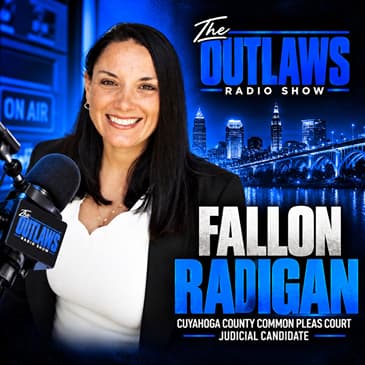

With years of experience as a prosecutor and as a criminal defense attorney, Radigan discusses how working on both sides of the courtroom has shaped her perspective on what it takes to be an effective judge.
We also discuss her work leading Ohio’s Internet Crimes Against Children Task Force, what motivates her to serve the community, and why she believes everyone who enters a courtroom deserves to be treated with dignity and respect, regardless of their circumstances.
This is the FCB Podcast Network. All right, we have a very special guest on the show today. She is running for judge, Cuyahoga County Common Pleas Court Judge, Fallon Radigan. Welcome. How you doing? I'm good. How are you? Thank you for having me here, Darvio. Good, good. And thank you for joining us. I really appreciate it. So, um. Before we kind of get into some of the nitty gritty, tell me a little bit about your history, where you're from, what brought you into the law profession, like all that good stuff. When did you know that you wanted to do this? Honestly, I was in second grade telling people I was going to be a prosecutor. I just wanted to be a prosecutor. I'm probably sure I didn't even know what being a prosecutor was. But I know that at one point I did, I dressed up for Halloween as a prosecutor. And I'm probably, I think I was in second grade when that happened. And I was telling people I had a little briefcase and I said I was going to be a prosecutor. And that's all I ever wanted to do. I just think that sometimes there's a calling for what you wanted to do. And I always wanted to be in a public servant role. And that's all I told everyone. I told everyone that would listen. I'm going to be a lawyer one day. I'm going to be a lawyer one day. I'm going to be a prosecutor. And that was my dream job. That was my dream forever. I grew up in North Ridgeville and, you know, we are a blue collared family and I was fortunate enough to go to Magnificat. And then when I went to West Virginia University. I actually was going to do pre-law political science and I changed a little bit. And I did a business major in case that I didn't go to law school. I had like a backup plan. And so I looked back and I said, you know what, let's try to get a business degree so I can do like marketing because I think that's what was good for me. And then I ended up going to law school. I took a year off and I went to the University of Dayton. And I wanted to do the two-year program because law school is three years. And I ended up doing three years because two years was kind of fast. And then. I wanted to go back to home. My mom got very sick when I was in law school. And actually, she was diagnosed with cancer my first summer. Of law school. And She was diagnosed with stage three, early four at the time. And they didn't know if she was going to make it. And I told her that, you know, I would come home and help her. And she said, over my dead body, are you coming home? You're going to continue to go to law school. And so I did. I would come home when I could, and I would sit with her doing her radiation and chemo treatments. And then I'd go back when I could, just back and forth. that really built like my drive to do this because law school isn't the easiest and um you know when you have someone that's suffering a little bit too you you're unable to do those things um that you want to do but you have to have a drive to finish them and she always told me she wanted a half pair by the time I graduated law school she did it but she had a great wig so um She, she, um, she lived for 10 plus years. She passed away in 2018, but that woman is probably the strongest person I know or knew. Um, and she helped me through it. And, you know, that's really just kind of who I am. Um, you know, I, I took the bar exam in the summer of 2009. Um, and a lot. Of people don't know this, but I have a learning disability. Um, And I can only memorize things through flashcards. And I remember I was struggling one day taking like study. And I'm like, mom, I'm never going to remember this stuff. There's just too much because, you know, you're studying for the bar exam. And I'm like, this is law school doesn't prepare you for the bar exam. And she did hundreds of flashcards for me. In a weekend. And the next Monday I had a stack of flashcards and she's like, here you go. What's the next subject that I need to do? So my mom helped me pass the bar exam. I'm making me all those flashcards. Um, and, and I passed it with flying colors, but we always joke that she, she felt like she took the bar exam because of all the flashcards we made for me. So, Yeah. So that's just a little bit about me. You know, I have an older brother and I'm married to a wonderful guy named Jim. And I have a beautiful son named Charlie that's going to be three in December. And, you know, I have a great family support and I have great friends as well. So that's just a little bit about me. Well, first of all, sorry for your loss. Thank you. Let's start there. Um, so as you, you passed the bar exam, what, what next, where, where did you go in your career? How did you get up to this point? So I, during law school, I volunteered at the, um, Lorain County prosecutor's office my first year that I was able to. So the summer of, I was going into my first year or second year of law school, I went I called Lorain County Prosecutor's Office and I was like, hey, is there anything that I can do? I'm a law student. I would love to be a prosecutor one day. And so they would let me volunteer during that time. And then my second summer, like going into my third year of law school, I did an externship with the Coyote County Prosecutor's Office because that's where I ultimately wanted to be. I always wanted to come home. And I wanted to work in Coyote County. So my dream was to do the most heinous crimes in the county. I thought that was what was driving me to be a prosecutor. I wanted to do the worst cases and I wanted to be the person that handled those type of cases. So I remember I interviewed with Bill Mason and I said, I want to do the murder cases and I want to do the rape cases. And Castro was happening during that time, I believe. It was one of the serial rape and murder cases. And he's like, well, this is a great place for you if this is what you want to do, but they're the hardest cases to deal with. And I said, well, that's what I'm here for. So when Bill Mason hired me, I started out in juvenile court and I worked my way up to general felony, which was doing all the, um, the trial work for like the low level. Felonies up to the, uh, high felonies. And then I would sit on second chairs with other, um, prosecutors that were in the major trial unit and the major trial unit handles the murders and the most heinous rape cases. Um, and I would jump on any case that would allow me to, um, and I didn't jump on the cases that just had the high media. I just jumped on any case that I can learn from. Because I always thought that knowledge is power. And if you want to be good at your job, you have to keep practicing and you have to be in those courtrooms when people are trying cases. And I wanted to be a trial attorney and that's what I am. And I jumped on every case that I could, which I think is the best way to learn something. And that's when you get your skills and you learn and listen and And, you know, sometimes I was just putting stickers on exhibits, but I was in rooms that I wouldn't necessarily. Have been in if I didn't volunteer to do those things. And then once I was promoted to the major trial unit, I was doing the sexual assault cases for child victims. So I did that for many years. And I also was able to supervise in juvenile court. doing the sex crime. So I was teaching young prosecutors how to try sexual assault cases. And in that role, I oversaw the safe harbor docket, which is a human trafficking docket. For juvenile court. So those are victims that are, are there defendants or delinquents that are victims of human trafficking, but have their own cases. So I learned a lot in that role as well. And then I finally became the director of the Internet Crimes Against Children Task Force. And in that role, I was able to not only try cases and prosecute individuals that harmed our kids. I got to go to the schools and teach kids how to stay safe online, which was the best part of my job. With that community outreach. And now I am currently a criminal defense attorney and a part-time magistrate in Rocky River Court. We're talking with Fallon Radigan, who's running for Coyote County Common Pleas Court Judge. And you touched on this a little bit, but you spent years working with victims and families who have experienced some of the most painful moments of their lives. How have those experiences changed the way you see people, especially those who feel like nobody's listening to them? You know, especially with child victim cases, you know, I've had young kids have to testify. Um, and adults have a hard time telling people what happened to them, especially with sexual assault cases. And people don't want to talk about, um, those type of things in public. And, um, I remember once I was in a trial and I asked someone, I picked on a juror and I said, juror number 10, I'm going to ask you when the last time you had a sexual experience and this individual's face dropped. And I asked that question because I had to have a young child testify. About someone assaulting them. And I I asked that question because I wanted someone to understand the fear that a kid has when they testify. Right. And so children and adults. Are fearful of testifying. So how do you make them feel comfortable on their worst moments? And I think that's when you talk to them as a person. You know, I never talked to a victim on the first time, especially in those sexual assault cases. and told them, please tell me everything that happened. You have to build a relationship with individuals. And a lot of times these kids, your prosecutor might be the only consistent person in their life at that moment because they have social workers and sometimes social workers change and caseworkers change and sometimes they're removed from their homes. And you have to be consistent with them and have them trust you. And the only way you can trust them is be a person to them. And they have to count on you and they have to have trust in you. And I think the only way you can trust someone is to be real with them and talk to them. And you feel the pain that they have. And if you're doing your job, you should feel the pain that these people are suffering because that makes you human. And I think having a human element to that really makes a difference when people trust you. People are human and. Just want to be heard and listen to and treat it with respect. And I think that just is building that relationship with someone. Real talk, real conversations. We got the heat. This is the outlaws radio show. We're talking with Fallon Radigan, who's running for a Cuyahoga County common police court judge. Um, can you remember a particular person or family you encountered while doing community outreach whose story stayed with you? What did that experience teach you about the people you serve? So I think a lot of the community outreach. So one thing is we get to go into the schools when I did that role and teach kids how to stay safe. But we also go into the communities. There's a, there's an ICAC van that like, goes to community events. And, you know, I remember we, we didn't just go to one community. It was all over Kyle County. We went to, um, streets, borough. Um, there was a young man that took his own life, um, for being extorted, um, for. Something that happened to him online. And I had the privilege of meeting his parents, um, at one of these community events. And they have a foundation now called Do It For James. And, you know, we. In the Internet Crimes Against Children Task Force, we get cyber tips. And his case did have a cyber tip, but unfortunately it was too late. However, this individual received 224 text messages, I believe, about telling him how his parents weren't going to love him and how he was going to be a sex offender because he took a picture of himself. And when I met his parents, I don't know if I could be as strong as his parents are to turn such a tragedy into something great that they're getting the message out about what happened to their son. And, you know, we were advocating for what you can do if something happens to your kid online and what kids should do if something happens to them. But they told their story and he was looking at colleges with his mom the day before he took his own life. And he was receiving all of these text messages standing next to his mom. And that really struck me as how can we do our kids better. And because this is a kid that was loved and he knew it and his parents loved him and they were with him all the time. And that's really someone like James should still be here with us. And sometimes we don't know what people are struggling through. And it goes back to, you know, we have our cell phones and sometimes we're not paying attention or, Our kids can. Hide it well. And their story really has affected me. And I try to remember their strength that they have for their son so that they can make our community better. Wow. Wow. Yeah. How did that how did that impact you like you? you've obviously had to deal with and been exposed to quite a few of these type of situations and type of cases. How do you, how do you process these things? How, you know, how do you deal with it? But, you know, I think, um, it, and I, I think you have to kind of take it in. Right. Um, the first time I heard their story and I've heard their story more than once, um, I was in tears and I, and, I think that's okay. You're allowed to have emotions for it, but we have to figure out as a community, how we're going to prevent this from happening and how we continue to educate people and how we remember James in a way that his parents do and how we teach people to do that, because he's not just the only person that this has gone, that people go through. And so for me, sometimes you have to process it and sometimes you do get emotional. Um, but I mean, sometimes. You do have to take a step back, especially in the type of cases that I've seen. Um, and you have to have an outlet. And I think that's, what's so important about having a strong family and a strong friend base. And, you know, I'm before I had my son, I was a big runner. I'm trying to get back into it, but, um, you know, working out always helped me. And, but I think you have to talk about these things. I think sometimes we have to have those uncomfortable conversations with people. So these tragedies stop happening. Yeah. We're talking with Fallon Radigan, who's running for Cuyahoga County common police court judge. And let's talk a little bit about that. So first two questions. First, what made you decide to run for judge? Let's start there. So I, I've always wanted to do it. Um, and I think it was always in the back of my mind that I wanted to do it once I, um, was at the prosecutor's office. Um, I, and my husband laughs at my first date. I told him I was going to be a judge one day. Um, I don't even remember telling him that, but he does. Um, but, um, public service was really, yeah, I disagree that I told him on our first. Date, but he, he swears by it. Um, but, Um, I always wanted to be public servant and I did it because I wanted to help people that couldn't help themselves. And I know I sound, that sounds kind of corny, but that's why I want, I did it. I, I am a strong person and I knew I could help people and this is the way I could help people. And sometimes when you're trying these cases and you're seeing sentencings and you're seeing the court system, you get frustrated sometimes. And I think that frustration is driving me to do this. Um, I've done now everything from the prosecution side that I could that would come. Before the court. And humbly now having this defense background, I've advocated for victims and I've advocated for defendants. And I think having both sides, having the victim advocate, advocating for a victim and advocating for the defendant, I think that's going to make me a better judge because I I thought I knew what being a. Defense attorney was like, but I had no idea. And I am very humble about that. I've told many of the defense attorneys that I look up to and say, I thought I knew what you guys went through. But you don't. And then you're sitting in a jail cell with individuals that are facing a lot of time and they have to make those decisions on their own with you as your attorney. And those decisions are hard. And once you lose a case and someone goes to prison for life, That affects you, but it makes you a better lawyer and it makes you a better advocate. And I see some of the sentencings that I've received on both sides as a prosecution and as a defense attorney. And I want to change it. And I want to change the system. I want to see people be treated with respect because sometimes people are not treated with respect in those courtrooms. And I want people to be seen and heard. And just because you commit a crime doesn't mean that you should be yelled at or not listened to. And I think that is what's driving me to do this. And I do see some systematic failures. And the only way you can change that is to be on the bench making those decisions. And with that, before you ever decided to run for judge, You were already, as we discussed, spending time in Cleveland neighborhoods and churches and community organizations. What brought you into those spaces and what kept bringing you back even when there was no election to win? Well, as a public servant, you want to be in the community. I truly believe that you can't just go into a community. You have to earn people's respect and see you and you want to see people that you are you're serving because as a Coyote County prosecutor, you serve the people of Coyote County and you owe it to them to talk to them about your cases or what's happening. And that I would go to the commander's meetings when I was in specifically, I was in the second district. That was my region. So I would go to the commander's meeting in the second district. I would go to Tremont West. Those are places that I would go and talk to the communities just to tell them about what's happening in our courtrooms. And I love doing that. I loved being able to tell individuals what's happening in their communities. If they had questions, they always called me. And I know council people were able to call us whenever they had questions. And I think that's important to see the people that are helping your community be better. And so I have done that since I started at the prosecutor's office. And then Um, obviously when I was in charge of the internet crimes against children task force, we did, we went into the communities, we did the T we went to the schools, we went to community events just to help people and give information about internet safety. And what they can do. And if they had questions, they would get to go see our van and they were able to talk to the investigators. And, and that was fun for me. That's a fun thing for us to do. And it gives you, um, it gives you a sense of, you know, you're happy to see people understand the work that you're doing. And, you know, as a prosecutor, it's a thankless job. And I think a lot of our public servants, it's a thankless job for things that you do, but you get to be a little human, um, little humanized, um, when you're at those events and people get to see you. And I think that's important. And, um, any place that we are invited to go, we went, and I think that's important. Um, And now as a criminal defense attorney, I have a different role, but I continue to. Do my outreach. I do the pro bono clinic with the court once a month with about 60 attorneys. And I help people with expungements. And I think that's important because just because you have a felony, if you qualify for an expungement, you should be able to get that off your record. But a lot of people can't afford it. And so. that's something that I'm able to do and help people. And I do that once a month. And I think that's important for people to give back to a community that you're serving. We're talking with Fallon Radigan, who's running for Cuyahoga County Common Police Court Judge. And on that note, there are obviously people who know you, you know, from the community meetings and and church presentations and neighborhood events, uh, rather than politics. What would you, what would you want people to understand about those relationships and why they mattered to you? Well, I think it matters because I feel that a judge works for our community. Right. And I think that when you are serving a community, you have to be seen. And I, it, you have to be in communities that might not trust what's happening in our justice system. And, you know, making decisions is one of the hardest parts of being a prosecutor as being a defense attorney, as being a judge, but you might have to make a hard decision, but you know what? I would be open to talking to people about my decisions. You know what I mean? Um, I want to be transparent and I will make decisions that might not satisfy everyone, but you have to make those hard decisions. And I had to make those as prosecutor. And you have to make those decisions when no one's watching, but you have to know that you have the integrity to do the right thing. And the right thing might not be popular. And I think if people know you and in any community, and they know that you're doing what you think is right, and they trust you, I think they'll understand you a little more and have a little faith in you. And I think that's really important. And I know you talked about. Both being a prosecutor and a defense attorney, and I'm kind of fascinated about that because you got to see both sides of the court. So. Particularly, obviously, in Cuyahoga County, when you walk into a community where people have historically felt overlooked or mistreated by the justice system, how do you earn their trust rather than simply ask for it? And also, how does that experience of seeing both sides of the courtroom, how does that help inform you when you are dealing with folks who might have been overlooked or mistreated by the justice system? You know, I. A couple of years ago, I. Met an individual and he asked me to come to one of his community events. And it was a forum for wrongful convictions. And I was still a prosecutor at the time. And I remember talking to individuals there and people asked what I did. And I said, I'm a prosecutor. And they were baffled by the fact that I was there. And I said, why are you so shocked by this? And they said, well, you're a prosecutor. You're part of the problem, right? And I laughed. I said, well, I'm not part of the problem. I'm trying to see what we're here for. And, you know, people that have been exonerated with wrongful convictions, I think that's important to learn from what happened to people, right? And I think people... don't trust prosecutors. And I think that's unfair. I think prosecutors sometimes get a bad rap. But when I was a prosecutor, there's a lot of power that you have. And I say that with regards to power in. The sense of you have to make sure everyone did everything right, that you have all of the evidence, that you're doing everything that you were supposed to do in trial. Did we present all the evidence? Did we have all the evidence? And there were a lot of sleepless nights that I had as a prosecutor because I owe that to the community. And I know that sounds stupid and silly, but that's how justice is supposed. To be done. You're supposed to be fair and you want to make sure that everything is on the table. And when I went to these wrongful convictions forums, I did it so I can learn from them. Because people need to know that. Especially if they were exonerated, that something happened to bring them here. And I didn't want to be part of the problem. I wanted to be part of the solution. And I think. That builds a lot of trust with people that I still talk to to this day because I went to those kind of forums and I went to bail reform forums and bail project forums because I. Wanted to learn. And I think you have to educate yourself so we can we can learn from our past and move forward. And so I've had a lot of clients of mine that say, well, you're you are a prosecutor. You're not going to help me. You're going to work with them. And I'm not going to I you know, I have relationships with prosecutors, but I'm still going to do my job. And I think that's that was the hardest thing for me to learn as a defense attorney is how I can I can prove to clients that, yeah, I was a prosecutor, but I'm going to be your attorney. And this is what we're going to do. Do. And this is how we're going to build that. And I still think it goes back to trusting people and understanding that prosecutors, me as a prosecutor, I didn't want everyone to go to prison. And I think that's a misconception. of people sometimes. And I think people respect when I'm just honest with them. Like, yes, I was a prosecutor, but I am a defense attorney now. And you have to, you have to meet people where they're at and you have to see people for who they are. And I think that was like the hardest adjustment for me. Being a defense attorney was that, that like little bit of knowledge. So with that, Talk a little bit about the fact that you have now seen it from both sides of the court. How do you think that is going to impact your approach as a judge? I think, you know, I've had two cases now that have really taken me back and have I've lost sleep over just based on their sentence. And one just happened and one happened a couple of months ago. And There was nothing I could do with regards to a case. There was no plea that was going to make this person whole, if that makes sense. And my client had some mental health issues. And we couldn't come to a good resolution without her coming out of it with a felony. If we went to trial, she would have had a felony. And it was very sad. It was a very sad case. Um, I had to talk to the judge because the plea, I, I couldn't have her plead to the plea, if that makes sense. Um, I just couldn't do it. And so I went to talk to the judge and we worked it out with the judge. And I say that because yes, she, she still came out with a felony and I felt horrible because she was a older woman with no felony record. Um, but the sentence was better when I talked to the judge. And I think that's, what's important, um, that having both sides of it, you have to be fair. And I think sometimes the prosecutors have a position and the defense attorney has a position, but that's why it's so important to have that open door policy with a judge to see what the judge can do with a case. And because a judge has such discretion, um, in certain circumstances, um, that sometimes that resolves cases in a better way than you resolving it with a prosecutor. And I think that's helpful. And I think that's the number one thing that I've learned throughout this is I'm never going to see eye to eye with a. Person not a hundred times out of a hundred times, right? But if you're able to talk to the judge and the person knows that you're approachable, I think that's important. And I think seeing. People that I have represented that do have mental health issues, that do have drug addictions, you see people more. And I think sometimes when you're in a courtroom, we forget that individuals have problems and they're problems that we might not know about unless you talk to them and see them. And when you can advocate that to a judge and they can make a decision, that will be helpful. I think that's the most important thing that I've learned throughout all of this. We have a few minutes left, but one thing I want to touch on is when someone stands before you on what may be the worst day of their life, what do you believe they deserve from the person sitting on the bench, regardless of their background or circumstances? I think what they deserve is for someone to listen to them. I think for me, especially being up there, um, advocating for someone on both sides, I think, you know, the judge has to listen to the victim, but they also have to listen to the defendant. And I think no crime is the same. All circumstances are different, but you really have to listen to what this person is saying to you. And I, I say this, um, When I first started out as a defense attorney, I did a probation violation hearing. And I remember I talked to the judge about it a lot. Actually, now I remember I was looking at the violation of he was on probation and this guy didn't do what he was supposed to do. And I was I was just like, OK, tell me all the good things that you're doing right now. Tell me really quickly, like, give me everything. And the guy told me all of these wonderful things that he was doing. And I went in there and I said, you know, a judge, he has a job. He, you know, he's raising us four kids. And, you know, I told him all of his background. And the judge looked at him and he said, how long have you been detoxing, sir? And he said, I'm struggling with the detox. I've been detoxing since I got in here. And I took a step back and I looked at the judge and he's like, you have great mitigation, but what, what can we do for him right now? And I remember looking back and it was one of my first probation violations, one of my first days as a defense attorney. And I look back at that day and I'm like, wow, I was so worried about getting all the good things about this individual. I, I didn't, I, I looked past that he was detoxing and I, And I look back at that and now I see it. I can see the people. That are going through these struggles when they're in the middle of a mental health crisis. And I say that because I was so worried about making sure that he had all this good mitigation that I missed that he was detoxing. And I'm never going to forget that day when I realized that. And sometimes when you. See these people that are in front of you, that's what you have to look for. They could have all of these good things going for them, but what's at the root of their problem? And the root of his problem was that he was in midst of a very hard drug addiction and we needed to get him help. And I go back to that day all the time. And that's, I want to learn from that. And I have, and I want to be that judge that sees those problems and identifies them. And I've been able to do that since that day. And I talk with that judge about it often. And and it was eye opening to me. And I think that that's going to that's what I want a judge to see. So switching gears just a little bit. So, yeah, if you win in November and you become a judge. Yeah. Obviously, that's an important role. What would you say to 10 year old you? who sees you on the bench in their robe and says, I want to be like her. What would you, what advice would you give to a young you? A young me? I would, I would tell you, you know, I think you'd have to say, give yourself some grace, um, because this road. Hasn't been easy. And, you know, I, um, I've had to fight for a lot of things to get here. And I say fight with like, you know, I went to school in Dayton. I had to come back home. I had to work my way up at the prosecutor's office. There were hard days. There were easy days. But you have to remember to give yourself some grace because not every day is going to be your best day. But as long as you put your best foot forward and keep going and believe in yourself. And believe that your integrity is everything. And you know what? I know that I believe in myself. And I think that's the best way to, I would describe it to my 10-year-old self. Say what you mean, do what you say, and be who you are. Years from now, when people who encountered you in the courtroom or in the community are talk about Fallon Radigan. What do you hope they remember about how you treated them? I just hope that they, they feel that I was, I treated them fairly. You know, I, I know that I was a tough prosecutor. I'm a tough defense attorney. Um, but I want people to say that I treated them fairly, um, and with kindness, because again, we're seeing people in the worst times and, um, I think people need to be heard and I want them to be treated fairly and with kindness. And that's what I really hope people would remember me for if they encountered me later in their life. I actually had someone literally this week, he pulled me out of the elevator. He pulled my arm and said, can I talk to you? I said, yes. And he's like, can I have your name? And I told him my name and he said, you prosecuted me in 2012. And it was an OBI case. And he said, I didn't know you were a defense attorney. Now I need you because you were such a great prosecutor. I know you're a great defense attorney. And I laughed. I actually called the defense attorney and he's like, Oh, failing. He, he thought you were tough, but I believe he wants you to represent him now. So, but you know what? He, he, he believed I treated him fairly. You know, I think that's important. Yeah, absolutely. So now, um, as we get ready to wrap things up, I'm going to ask you the most difficult question that I've asked you all, all episode. So I hope. You, I hope you're ready. All right. I'm ready. If someone wanted to know what is on Fallon Radigan's Spotify playlist, what's on the playlist? Oh, I have the most random type of music. I go from country to 90s rap to. R & B to. Oldies. I don't think my Spotify knows who's listening because I go from. Every type of random music that you will listen to. But I never loved country until I went to West Virginia University, go Mountaineers. And I used to listen to, you know, James Taylor with my mom. And, you know, right now, I think the last song that I played was Chris Young was the last country song that I listened to. Luke Brian or Luke Holmes is one of them. I have some Jason Mraz, you know, just a little bit of everything. All right. Give me give me your favorite 90s hip hop song. Oh, crisscross count is hip hop. Yeah, it does. They were rappers. They were rappers, yeah. Jump? So you going jump? I'm going jump. Okay. Okay. I see it. I see it. Fellow millennial. I get it. I get it. You know, I do look like some Dr. Dre, but I never know the song name. So I'm a big Dr. Dre fan, you know? All right. I got it all. I told you a little bit of everything. A little bit of everything. Okay, awesome. I'm looking forward to seeing your Spotify wrapped at the end of the year. I want to see what the songs are that are on your Spotify wrapped. All right. I can't forget Nelly either. I'm a big Nelly fan too. Okay. Can't forget Nelly. Yeah. You are warming my millennial heart right now. Oh, I'm glad you like it because some people don't. Absolutely. Let everybody know how to get in contact with you, how to follow you on social media, if they want to keep up with your campaign and all that good stuff. Yeah, great. So you can go to my Facebook page or Instagram. It is Radigan4Judge. It's very easy to find. Also, it's radiganforjudge.com. So those are the best ways to get a hold of me. And my email is radiganforjudge at gmail.com. So my email, though, is the four. So it's radigan for the number four and then judge at gmail.com. Thank you so much, my friend, for coming on the show. I really appreciate you. Thank you. I had so much fun. So thank you. I appreciate it. And I hopefully will be successful in November. This has been a presentation of the FCB Podcast Network, where real talk lives. Visit us online at fcbpodcast.com.