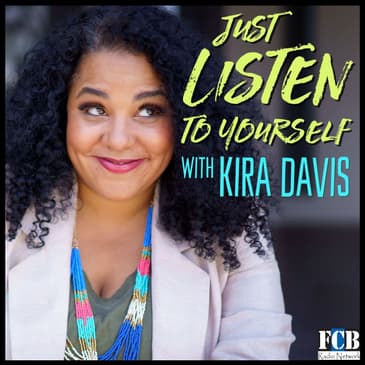
This is the FCB Podcast Network. A Braais Masoda day that we won't was Maathe, then we won't to say oh we got it does no one can dig that owen? This gonna be okay. A preas Masoda day that we won't with Bathe then we won't to say oh we got it does no one can dig that? Owen be okay. Hello, everybody, Welcome back to another episode of Just Listen to Yourself with Kia Davis. This is the podcast where we take hot topics, pot button ideas, and we discuss the talking points on those topics, and we draw those talking points all the way out to their logical conclusion. And today is a j lt Y plus and I have a very special guest with me, a personal friend of mine, mister Andrew Langer. He's a radio host. He is also the co host of Swamp Secrets and Andrew and Jerry Save the World. Are you still doing those podcasts? I know that gets asked. Yeah, whenever Jerry has the time to do it, we do them. So we just recorded one today literally right before we recorded this. Well, welcome to the show, Andrew Langer. Andrew so glad to have you on Just listen to yourself. This is your first time on the show, and we've been longtime friends. We met in the movement, and we've both been very active in the media space and recently had the opportunity to hang out again and discuss great topics like liberty and all of that stuff. Tell us a little bit about yourself, Andrew, what you do, where you live, what you know? Sure, And I wear two basic hats. I wear a media hat and I wear a public policy hat. And the media stuff that I do. I do three podcasts, which nobody should do three podcasts, but I do three. I do the Swamp Secrets podcast that's in the guise of the policy work that I do, exposing regulatory dark matter is the subtitle. Do my show with Jerry Rodgers, the editor of Real Clear Policy, called Andrew and Jerry Save the World. And again, we would like to do those more frequently, but sometimes, as mel Brooks would have said, affairs of State must get it in the way of affairs of state. And then I do a show for an outfit called the Federal News War called The One Chair, which is my deep dive interview show focused on public policy. This week, I just interviewed our friend Stacy Washington. Next week it's Zachary Marshall from Campus Reform talking about the unrest on campuses. And I do a ton of radio fill in work, and then on the policy side of it, which is the real great love. I taught for a couple of years on the regulatory process at a universe until COVID made that sho sideways. But I run the Center for Regulatory Freedom at the SEAPAC Foundation focused on the regulatory state, the cost of regulation, the use of regulation to enact all kinds of ideological goals. That seems to be a lot of the work that we're doing nowadays, what we call the whole of government approach, which is this idea that the progressive set an ideological goal of let's say, promoting transgenderism or DEI or whatever, and they use a bunch of different agencies to go and deal with it. So we file comments, we get grassroots folks involved, we get other organizations involved in commenting on things. The idea is to get us involved in analyzes of the widest variety of regulations. And that's a great passion of mine. It has been for many many years. I worked as a lobbyist for the National Federation of Independent Business. For a few years worked for a think tank. My very first job in DC, essentially was the reader and personal assistant to a blind constitutional and environmental regulatory attorney, which is part of how I came to the learning of this field, but it's or how I gained my passion in it. This intersection of regulatory policy and constitutional law. I was making for those listening, making an intersection motion with my hands. But that's sort of me in a nutshell. Live in Williamsburg, Virginia. I have been here for just under ten years. My wife and I both went to william and Mary so it's been fun to be back there. Got a couple of kids, one is about to graduate from college. Anyway, don't want to get ahead of myself. Well, no, that's very interesting. I was wondering, since you do a lot of work with policy, I do have a question for you. I have an icebreaker question, but this is on my mind. What policies are you looking at now that are really interesting to you, or that you're working on, what's weaving its way through either local or federal legislature, And it's interesting you, it's really it's really a much much more of a general question right now. You know, we're in the fourth year of Biden's either his only term or his first term. Either way, the Biden administration has really hit the gas pedal on the regulatory process. So real quick for your listeners and viewers to understand. Congress passes a law. Let's say it's the Clean Water Act and the Clean Water Acts as you can pollute a navigable water of the United States. They don't define what pollute and navigable and what of the United States means. They leave it up to the agencies to determine those things. And the agencies, the EPA have broad powers to deal with those things. And so that's the regulatory process. Whether it's you know, efficiency standards for home water heaters, or whether it is transgender policy under Title nine of the Civil Rights Act, or whether it is redefining the the auspices of the Pregnant Workers Fairness Act so that women who have abortions are now covered by that act. You know, things of drilling offshore, the EVY mandates. All of those things are now done through these agencies. And so it's very clear, it's astounding to be The American Action had a report out last week, you know, so the the the Obama administration effectively doubled the size of the regulatory state in the eight years that they were in office. Joe Biden has effectively done the same thing in three years. You know. He inherited a regulatory state that was about two and a quarter trillion dollars. Too, it hasn't doubled it, but he is on pace to do that. Certainly. The regulatory state has shot up by about one point three to one point four trillion dollars. And that's I don't want to get too far in the weeds here, but that's an astounding number because that gets into your everyday life real quick. One of the very first things I would do with dudes when I was teaching on the regulatory process is I would have them go to this really interesting website called regulations dot gov. It's where all of the new regulatory proposals are put up and people can file comments on them. And I would have my students pick one rule making that was that had just come open for comment in the previous week, and they would one rule making that was coming closed for comment in the coming week, and the idea was to get them to understand the vast breadth of administrative power, the wide variety of things the Federal Garment was involved in, to sort of let them, let them let that sink in, and that we've an executive branch of vast power and that power can be used in any one of a variety of ways. That's how we get to where we are. That's what I'm looking at. Well, I think there's a lot of people out there who would think, you know, policy is so dry, Like it's such a dry area to be involved in. What why policy? What makes you passionate about that? I mean like, if you ask me, I'm going to say, oh, it's the culture. It's you know, movies, film. We might ask another friend of ours and they'll say, well, I'm you know, and it's easy to look at me and say, oh, yeah, of course. Culture, that's fun stuff. Policy feels really dry. What is it that makes you so passionate about it? Because at the end of the day, it's where the rubber hits the road, and it's where the nebulous things that Congress does really impact the day to day lives of people. I'll give you a really good example I'm walking my dogs in it. And now we've been talking about there's there's a movement out to gas stoves, and that essentially means either you get rid of the market for gas stoves or you stop the infrastructure, right, you stop putting the infrastructure out to communities where there are gas lines going out there. Either way to choose the same thing. And walk my dogs near the house and I hear somebody's print home generator kick in. Now I don't have a generator at my house. Maybe I should, but and I'm never not really familiar with them. But I look over at the generator that's running and I don't know if it was a test or they lost power, what have you, But I see a gas line running into the generator and it hits me, oh my god, these people have you know that most of these and I'm going I look it up. Most generators, home generator, whole home generators are powered by natural gas, because that's infrastructure that if the power goes out, they it still gets services on depressure. And then I postulated, you know what happens if we start banning gas stoves and so you don't have the day to day infrastructure going under the need for infrastructure for day to day gas stoves in these communities. What happens to folks who want to engage in emergency preparedness, you know what happens to, you know, their ability to get a whole home generator that actually works in an emergency. The answer is there is nothing they can do right. You can guess you can fill a tank, but but you know, the way you're really secured it is by having access to some kind of a piping system, pipeline system, And that's what I mean by this. You know, it's the thing that pops in about you know, people being able to protect their homes in an emergency, or the idea of having an automotive policy that doesn't repare folks to either you know, be in a place like Alaska where they can't plug in cars, or be able to go four hundred miles on a single tank of gas without having to worry about you know what an hour to two hours to eight hours of recharge time for an electric vehicle. You know, all of those things are the day lives that we live in and telling those daily live stories is so important. You know, it came down to Kira, you know, I worked for you know, big law for a while. I'm not a lawyer, but I was working for this lawyer. But then when I worked for the National Federation of an Impended Business and talking about the impacts of regulation on these small businesses and what was happening when these businesses were being stymied, that brought it home for me. Right, some of this is about narrative, but the reality is that that these regulations are supposed to impact people. Otherwise, why bother putting them in Right, What's what's what's the purpose of this? You're trying to change something, change behavior, make people, make it more expensive for people to do the wrong thing in someone's mind then to do the right thing, and so understanding and then and then we get into the unintended consequences and comparing risk. And I know we're going to talk a little bit about what would do if I could wave my magic wand let me add a little other dimension here. Yeah, So my dad is an environmental scientist, my mom is an epidemiologist. My dad's always been a skeptic, and my dad was always talking to me about risk and assessing risk and public policies that are based on risk. And we don't really do that anymore, and if we do do it, we don't do it very well. And there are all of these kinds of unintended consequences that ensue. EPA, for instance, just decided to go ahead and ban a particular kind of asbestos, crisatile asbestos. And we all know, oh my god, asbestos. It's bad if you breathe it in. Yeah, if you breathe in asbestos, especially over a long period of time and you're a smoker, yeah, you're gonna probably get asbestosis or mesothelioma. But the reality is, for the bulk of us, this is not something that's important. Even if it's in our houses and we encapsulate it, it'll be fine. But asbestos, chrisatile asbestos has uses in things like the manufacturing of chlorine for water purification because chrysatile has some very interesting properties. And so if you are going to ban chrysotile and make it so that these folks can't the folks who make chlorine for water purification have to turn to a more expensive or a less reliable source. Well, what's the risk that's involved to people when chlorine gets more expensive or less available. One other really quick. Example, last summer, the EPA moved to effectively ban something called ethylene oxide, which is a gas. It can be a chriscinogen if you breathe it in the problem is that it's used in medical sterilization, where you can't use alcohol or heat to sterilize medical instruments. And the reality is that you cannot have a major surgical procedure in America without at least one piece of equipment or one item being sterilized by alene oxide. And yet the EPA had no answer for that when the industry turned around and said, hey, what are you doing here? We need this. And that's that's a lot of what why I get passionate about these things because so much of it is crisis driven. And I have an adage which is that policy made in a crisis is always bad policy, but the unintended consequences, the ancillary impacts can in many cases not all, but in many cases be far worse than the problems that they are trying to address. Yeah, I love the way you describe it. And as you're talking, I'm thinking, oh my gosh, this needs to be a high school class. One thing I have been touring the state talking to different Republican groups about is how do we win the future? And my angle is based on education. And I keep talking about, you know, the importance of Republicans, particularly using inner education as a centerpiece to win elections. Yes, it's an important issue, but also it's a winning issue because Democrats have been educating their voters for seventy plus years and we're seeing the results of all the voters they've educated. But the GOP doesn't have the same long term plan. And I think what you're saying is a great example, because the whole idea is that you can't you can't train people who are going to grow up and make good policy and make good government if they don't even know what good government is in the first place. They don't know what good policy is. And I have a sixteen year old and I'm thinking, Wow, how valuable would this I know she's never had this discussion in class, but how valuable would it be to churn out a generation or two of students who understand that connection between policy and your everyday life and the unintended consequences of that. We never talk about that, right, What happens when you engage in energy policy. And I'm going to be interviewing someone later today about this. What happens when you engage in energy policy that drives up the cost of energy, makes it's much much more expensive. What happens when you create an energy policy in which you give some government bureaucrat control over the thermostat in your house, right, and all of a sudden, you hit a ninety degree day in the Central Valley and you go in and you can't have air conditioning. And then you also particularize it, which is okay. Now, imagine your grandmother or your grandfather who are much much more heat sensitive than you are. Right for you, it can be a matter of comfort. You're talking to your average sixteen year old in merced or Modesto or wherever. But it's like you're but you know, all of a sudden, if your grandmother can't survive in that house because the heat is shooting up, you know it particularized? Is it for them? And you know it used to be it was funny they used to in the eighties talk about the the the the oldsters who would have to choose between or they have to eat dog food to sort of make make ends meet. Here now, it's you know, a choice between running your electry or more to the point, the idea of it's not even their choice, right, you can, you can understand it almost if it's some elderly person's choice to turn off their ac But if there's some bureaucrat who's making that decision to turn it off, that's that's a bad thing. I mean, you know, it's funny. You know, we could talk about car ability, but unfortunately in this day and age, I don't know about your kids. It took a while, certainly for my older my older child to want to get their license. My younger child was hot to try it about doing it, but it didn't quite hold that cachet. You know, we've got to talk about independence again and the issue of of making sure that these kids understand. You know that that if you're going to make you can make a gasoline more scarce, you know, in these electric anyway, there's a whole bunch of ways we can go about doing it. But this is what our friends are constituting America are doing in the Constitution. I've done a lot on that. It's funny. I was visiting my mom up in Canada last summer. My mom's a big hippie environmentalist and she lives in the only city on her rural island, Prince Edward Island. She lives in Charlotown and she walks everywhere, and she was complaining about the light the timing of the lights. The city or the province actually had just changed all of the traffic light timing, and so it was holding up traffic. The lights weren't timed evenly, and so traffic couldn't move at a smooth page. I see you nodding your head because you already know what this is about. So the traffic doesn't move freely, and that was creating a roadblock for my mom because she couldn't ever get the light to time properly to cross the street where she needed to, and it was taking a really long time, and so she was complaining, and I said, well, that's on purpose. This is the mental policy we do this in California. The idea is to make driving as uncomfortable as possible and so that you'll want to get out of your car and take public transportations. So the consequence of that is you, a senior citizen, having to wait four times as long to cross the street to get to your groceries because of that giving complaining bitterly about it. But when I told her it was, you know, connected to environmental policy, she was like, oh, I didn't know that. Well, oh I guess, I guess we just have to deal with it. Then. Now, to her credit, she was making the choice that she was going to deal with it, but she had not thought out as most environmentalists, she had got out the connection between what I believe to be right and how it is practically applied, and they are never ever the same thing right. And then you get into the issue in bigger cities with bigger elitist populations of the double standards that are our work right, because we know in the end that it's never right. If they succeed in banning gas stoves, it's not for the elites. Like the elites will always find a way to get their eight burner Viking stoves in their houses. They will always find a way to get their gasoline powered car if they want to have alan powered car, If they move everybody into mass transit, they'll find a way around this thing. It's interesting to bring up the making driving on conversation because I literally just had a conversation with a guy named Tim Jackson. He's written a book called Dude Wear Flying Car. And in our conversation about this, we literally talk about bike lanes and cities and the issue of making driving more comfort for people. It's listen, it's it's a it's a variation. There's the direct way to do it, right, which is the congestion taxing, something they're doing in New York. I have a really good friend who was carping about the fact that she spends an obscene amount an obscene amount kira on her car lease and garaging her car, and and then on top of it, is going to have to pay this this this tax, this congestion text, which is, well, why don't you just rent a car whenever you need a car because you don't drive your car that often. She wasn't willing to hear this, but that's the the overt is that way. But then following there was a guy named Cass Sunstein who is Obama's regulatories are. He wrote a book about using nudging to in one's policy, and that's what you're talking about here. It's this idea of nudging people to do your bidding by making it impossible to live their lives any other way, which I find galling policy here in California all of the time. It's just it's nudging. Sometimes we just get pushed right off the cliff. But I am really interested in the idea. And we've talked about this before, but the idea of policy, the progressive liberal, progressive approach to policy is that policy can shift human nature, that policy can control human nature, and personal belief that human nature is very strong and it's like a tree route it's going to find a way to perform no matter what. I don't think you can police it or change it through policy. But that seems to be the progressive view of what policy should be. What do you think policies should be? So I was reaching over. I always keep this book next to my desk where I do my work. It's The Triumph of Politics. It's a book by David Stockman, and I got this thirty years ago. It was after Stockman was long after David Style, who was Reagan's budget director, very much a small government kind of guy. And I read this passage that I've underlined here. Maybe you can't see it, Kira, and this blew my mind. When I read it. I'm going to read it now. By the way, folks, if you're listening, I have my reading glasses on. Stockman writes, the rights starts with history and society as they are, and places the burden of proof on those who would use the policy instruments of the state to bring about artificial change. The left starts with an abstraction, a vision of the good and just society, and places the burden of defense on those who would exist the state's attempts to impose it. The second is always the bloody process. Implicit in the conservation. In the conservatism of the right is a profound regard for the complexity and fragility of this economic order, and a consequent fear that policy interventions may do more harm and injustice than good. Anyway, he goes. He goes on from there. But that's exactly what you're talking about, is this idea of the bloody process of what the left wants. I swear to God, folks, we did not plan this. I literally I keep this. I keep this book by my by my my my studio desk, by my computer for that very reason, because invariably someone asks me about this issue and how I can I can go a little bit further into that philosophy, but that's I'll give you another example, and unfortunate, I'm not going to get out of my chair and go look. But back here on one of my bookshelves is uh, the the opposite, the opposite perspective on this. But unders with Stockman Wilson and you and I are roughly the same age. I may be a little bit older, but I don't know if you remember, but when we were in our twenties, the Sierra Club anointed its youngest president ever, a guy named Adam Werebach. And Adam Werebach wrote a book called Act Now, Apologize Later, and that title in and of itself underscores exactly what the left things. And certainly it's it's true today we're gonna we're gonna act. And it's a very maoist way of looking at things. By the way, this idea of we're going to act. There's a crisis going on, and we don't care who's grist for the mill, we don't care whose ox is gored. We are gonna con mixing metaphors here, but the bottom line is grind folks under the wheel of progress and progressivism and will apologize for it later on, right, But then there's nobody left to apologize too, so I guess. But yeah, I do think it's a fundamental it's a fundamental misunderstanding, whether that's purposeful or not, of human nature. And I think the best way to deal with human nature is to give it as much freedom as possible. Obviously you have some boundaries like harming people and just laws that keep your society orderly. But yep, to let me ask you this because I did a show on the social media ban in Florida, ask question should we ban social media? And I asked, from a policy standpoint, should states or municipalities or even the federal government Institute of Social Media ban particularly in this case for minors sixteen and under was Florida's law? And we went the nuances, we read the law, what it said. It's a difficult question to answer as a conservative who has very strong libertarian leanings. What's your take on it? I love to hear what you think. Well, I think you get the nail on the head, right, I mean, it's it's certainly we're talking about adults. The answer is a categorical now, and this is why I've sort of come down against the idea of a TikTok ban, even though you know you can ban it, certainly on federal phones and computers, with the ist nature of it in that kind of an environment, the question then becomes one of the issue of minors, and I don't like a ban's per se. I think it should be up to the parents to do it. The problem is that in America today, our parents have become such awful consumers that they don't quite understand right they to make the case to a parent, and you have to make it really simply, right, straightforward, which is this very simple idea that most folks. I mean, so much anxiety and envy has been produced via these social media platforms because people forget that this is the highlight reel of someone's life. Right now, there are folks who share everything for a lot of reasons, whether you know, because of narcissism, they want but you know, munch Johnson's by proxy or what have you. But for the most part, folks are showing the highlight reels of their life, right you know, the surprise divorce of a couple and you're like, oh, they look so happy together. Well, nobody can peer inside what's going on in people's lives. The problem is most folks don't recognize that. Most parents don't recognize that, and so they can't turn around and translate it to their kids in terms of this issue of you know, the the harmful effects of social media in terms of kids self esteem and their interactions with one another. You know, this is this is this is the issue, right. I mean, obviously, now I'm not a big fan of making folks go and do identifications for accessing adult entertainment sites. Not that I have any personal experience with that. You just let me say that job, but but you know, but the bottom line is I think you should have should have that choice. You know. On the other hand, if parents are not going to be discerning consumers and they're not going to take the lead on informing their kids as to what happens, and they're not going to recognize the problem and the problems that can ensue from it, well then maybe it's something to think about it. Maybe it's maybe listen, Maybe it comes into in the same way that you have to get a driver's license or a babysitting certification, maybe you have to turn around and demonstrate some kind of an understanding of the harmful nature of these things before you go down that road. There are any any one of a number of ways. I'm never a big fan of skinning, of a of banning things. Let me just say one other thing about law and policy. All just law is born out of the intersection of rights. Right. You know, we are born as a people, as persons with the full measure of our rights. You know, all that is not surrendered is retained. The Ninth Amendment, the mere enumeration and the constitution of certain rights is not meant meant to deny or disparage the existence of others. It's when we exercise those rights and that exercise comes into conflict that laws are created. I have the right to wave my hands around and a wild interpretive dance under my freedom of expression. But if the back of my hand crosses the bridge of your nose, then that's not allowed. Right. You can't go around a whirl around and strike somebody across the face and say it's freedom of expression because they have been harmed by this, and you know, and then the law is supposed to weigh down more on the side of the person who is more agree justly harmed that's why I have always approached not always. Sorry, let me be really clear about this. I became a pro life libertarian after starting to read about this and understanding it with the context of that intersection of rights. Right, the law weighs down more heavily. Another part of this, going back to the social media ban, laws are supposed to weigh down more heavily on those least able to advocate for themselves, especially children. So we have laws that go into greater detail or greater to rids. So who is the least able to articulate for themselves advocate for themselves. An unborn child inside a woman's womb, and so the law steps in to protect the life of that child. In the intersection right of the right of the mother to choose her you know, destination in her life, and the right of that fetus who can advocate for itself, the law comes into wagh heavily on the side of that fetus. That's again, with exceptions we can talk about that. But that's that's how I've always Once I became pro life, that's how I approached the life issue. That's sort of how I went down this road. I had a long conversation with a guy named Mary saberin about that, who literally wrote the book on pro life libertarianism. That's fascinating. Yeah, you're probably the first person I've ever heard say they came to their pro life views through policy. That's very eas political philosophy there. I mean, that's political philosophy. It's sort of an understanding of the way things work and sort of applying. I read David Bose's book Libertarianism a Primer when I was early twenties, and it spoke to me and I was like, oh my god, this is what I believe because the libertarians on my college campuses college campus were crazy and I just didn't I was like, okay, I'm staying away from them. Sort of now understanding and I have good friends in the in the big libertarian movement, understanding that there is a huge swath of folks in the libertarian movement who are certifiably insane, not that there aren't certifiably and saying people in both the Democrat Republican parties. Anyway, The point is I saw this pro life libertarianism, like boy, what is that? And then I read about him. I'm like, well, that that makes sense to me. There's a certain kind of geometric logic to it. Sorry, go ahead, I've been filibustering here. No, that's absolutely interesting. Well, I'm going to take this opportunity to shift the conversation just a bit as we wind down our time together, because you have mentioned a couple of books and one question I usually ask at the top of the show, but we started this really interesting conversation, so I saved it. But a Bible, notwithstanding what is what you would say has been hugely influential in your life. It doesn't have to be the most influential book, because I know that's a hard question to answer. But what's your book? No, no, no, I'm gonna I'm gonna hedge it. And I'm going to use two because they go hand in hand with one another. Was actually talking about them that day last night. The Mystery of Capital by Hernando De Soto and Property and Freedom by Richard Pipes. Richard Pipes it was one of the architects of President Reagan's Cold War strategy. Because I came into the movement as a property rights activist. I worked on property rights issues for a very long time, and Hernando De Soto and Richard Pipes both lay out in these books the important role that property rights play in creating politically stable and prosperous societies. And the reason why I came up last night is we were talking about Haiti and why Haiti seems to be mired in chaos and corruption. And as Desto points out in the Mystery of Capital, it takes a dozen years to buy a piece of property in Haiti and more than one hundred and fourteen different steps that are at work there, right, and so there is no real impetus to buy the property. There's no impetus to protect private property. And as a result, the private property does two things right in terms of a society. It allows people to invest in their own future. Right, you can borrow against your private property and invest in yourself. But if you don't know that that private property is going to be protected by the government, because right that's the role of government to protect individual rights, including property rights, you're not going to invest in that future, and you're not going to have any hope for that future. Why should I Why should I hope for my future if I can't invest in myself using that which I own for myself. And so Pipes in his book charts the boom and bus cycles of societies based upon how they protected private property. The mystery of capital goes into a host of instances, not just in Haiti, but elsewhere about why these things are together. So I those those hugely, hugely influential on me. Let me add one thing. It's not a book, but it's a Supreme Court case that literally change my life. I could say NAACP versus Alabama, and I urge folks to going to read that. But the one that I talk about is New York versus the United States, which was a nineteen ninety two federalism case opinion written by Justice Sandrade O'Connor. I can quote it. I will not do all of well, I'll do both of this together. The Constitution protects us from our own best intentions. It divides power among sovereigns and among branches of governor's lee, so that we might resist the temptation to concentrate power in one branch as the expedient solution to the crisis of the day. In other words, the Constitution is a deliberative document, and it works to make us think about things before react. As I said at the beginning, policy made in a crisis is always bad policy. We have to be a thoughtful people. And then she goes on to say that federalism is not an end to itself, you know, or you know, the division is not an end to itself. Federalism secures to individuals the liberties that derid the diffusion of sovereign power. Power is supposed to be diffused among the states and the branches of government to protect individual rights. And I was a geek enough during the late nineties care that I had nyvus on my as my license plate for a number of years, and then I moved out of Virginia temporarily. But yeah, so those two books and that Supreme Court case are really loadstones for me. They are hugely, hugely important. That's pretty amazing, great thorough answer, and now I want to go find that Sandra Day O'Connor opinion and read it night. I'll send you the link. Great, send me the link, all right. And my closing question something I'm really interested in knowing from people. Let's just have bothesize Andrew that for one day the republic falls and you are emperor of a mayor. Just for one day only, you can change any law, make anything illegal do anything you want. What is the first thing you're doing as emperor of America? And it's one of those things where if the if the republic has fallen, maybe this doesn't a lot of sense, but let's just assume for a moment that I become emperor for a day in an American government that is surviving. That's sort of how I viewed this. And there are two things that I would do President Biden. It's actually three President Biden. Last year, well, one of the very first things that President Biden did was he undid a Donald Trump era executive Order on Regulatory Transparency and Accountability. I would reinstate that last year they enacted a whole new policy about how to assess the cost of regulation, essentially getting rid of assessing regulatory costs in favor of just benefits. I would undo that. But in terms of doing something, I would go and implement a mandate that all agencies have to engage in comparative risk assessment for their new regulations, especially for major rules, to sort of take a long hard look at unintended consequences. I used to talk about a thing where I would I would also create a mandate where bureaucrats would have to go. They would be given Every industry has what's called a NAKES code, an Industrial Classic Classification Code, and I used to want to mandate that once a year every bureaucrat has to go and do training where they need to figure out every rule, every regulation that a regulated entity has to comply with. Right as part of that training to sort of walk a mile in those people's shoes. So anyway, I know, it's a whole suite of things. The most important thing, though, is the is the executive order ins parenting, accountability. We need to do, we need to be we let the federal executive has far too much power that it's the greatest threat to individual rights that we face as Americans. We have to reign in that power. Amen, that's actually a perfect place to leave it. I like your version of America. And if we ever fall for one day, I hope mister Andrew Langer gets to be the emperor for twenty twenty four hour cycle. And I hope while you're sitting on that throne, you'll also just very quickly eliminate the Department of Education, if you see fit. Oh, yes, of course, that's it's not the one thing, but certainly it's on Listen, there are a whole bunch of I used to I used to joke real quick, I used to joke that would I would, I would get rid of most of the cabinet agencies, and I would create a Department of the Interior, a Department of the exterior, and an Apartment of everything else, right, everything in between. Right, so it gets stuff that deals with domestic policy, stuff that deals with foreign policy, and stuff that's sort of quasi in between the two. I used to joke about that you can't distill them. But yeah, there is a bunch of stuff, you know, get make the apation no longer be a cabinet level agency. We should get rid of the Department of Energy, I mean the whole whole host of a whole host of agencies we can eliminate. Yeah, yet's go work for the Department of everything else. Okay, Well, Andrew, thank you so much for joining the show today. It's been a fascinating discussion. Every discussion with you is fascinating. Tell people more about where they can find you and your work online. Yeah, let's start with at Andrew underscore Langer on Twitter. I still call it Twitter I know Elon Musk is now rethinking whether or not he should have renamed it. X so at Andrew underscore Langer on Twitter is really where you can find out most of the stuff that I'm working on. I'm pretty good about posting there. Go ahead and take a look if you can at at Andrew and Jerry Save the World available wherever fine podcasts are found, also on YouTube. The same thing with the lunch how of Federal news wire Swamp Secrets is usually available via Twitter. I usually am pretty good at tweeting that out, but also on the seapack website. In fact, if you go to seapack dot org, take a look at the Center for Regulatory Freedom. That's the work that we're doing there. All right, Andrew, Well, thanks so much for stopping by and talking with us today, and everyone, don't forget to download this episode, rate and review it if you can. Follow me on Twitter at real Kia. David's book Blanglines why conservatives need to battle fiercely in the arena of ideas until we meet again. Everyone, Remember, excuse me, this is important. Let me clear my throat. Every once in a while, just stop and listen to yourself that we won't was made, and then we won't with may oh we gotta does no longer digte o and okay o, prayers on that we won't to say then we won't, to say, oh we gott it does no longer take that oway okay. This has been a presentation of the FCB podcast Network, where real talk livets visit us online at fcbpodcasts dot com.