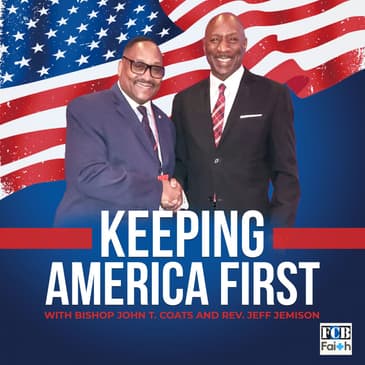
The following is a presentation of FCB Faith. This is Keeping America First with Bishop John T. Coates and Reverend Jeff Jemison on FCB Faith. Happy to be here on this great day in this great state and great country. Welcome to Keepin' America First, and today we have another dynamite guest. Very informative, very informative, very successful. He's just done a lot to help us, and we're going to let him just jump right into it. We have none other than Mr. Jesse Stiles, who is a candidate for the Ohio House District State Rep, Area District 57. So I'm going to let Jesse start. just tell us a little bit about himself, what he's doing. Jesse, welcome to our show. We're just going to jump right into it. What inspired you to run for this Ohio House of Rep? Yeah. Well, first of all, thank you very much for having me on. I appreciate this forum, Jeff. So for me, public policy has always been a passion of mine. Even in college, I was working in professional political staff work. I worked as an aide to Representative Callender for a brief period in 1999 when he was in the legislature the first time. I worked for. Commissioner Dale Fellows back when he was a county commissioner. So it's always been a passion of mine. And then I diverged for 25 years into the private sector and built up a couple of companies. And right now I own and operate North Star Towers that I founded. To develop and operate wireless infrastructure for cell phone companies. So Verizon, AT & T, T-Mobile, those are my customers. And I grew up from four sites in Ohio to 250 or so in 20 states and growing. So we're still very, very busy. But I built the company to the point that I have the opportunity to be able to give back. And I'd really like to do that. I've been very involved. In civic leadership within Lake County and Northeast Ohio. I'm on the board at Lake Erie College, Andrews Osborne, Fine Arts Association, and others, and have had those opportunities past and present to serve. And I think this is a logical next step to be able to bring a lot of my business and civic experience to Columbus and the legislature. So a lot of people are benefiting from your business and your cell towers, and they're not even- We are right now, right? Yes, right. They're not even aware of it. That's right. That's right. They're using your business. It's helping them with their daily- lives. What are two of the top issues that you hope to address in Columbus, and what specific actions would you take on those issues? Yeah, so I have spent, as I mentioned, 25 years working in the vertical infrastructure space, and it's a very complex space of developing critical infrastructure. With a lot of competing interests. Oftentimes, there's headwinds from different stakeholders, and there's tailwinds as well, You know, a lot of times you go to a zoning hearing and show up, there might be folks that are skeptical or curious about a project and they have two cell phones on their belt. So, you know, I've spent a lot of time bringing disparate parties together to discuss create something very positive. And I want to bring that experience and skill set to bear, particularly in the energy sector. That'll be my number one priority in Columbus. I believe that we're at a very significant moment of inflection and transformation with energy policy in Ohio and, and frankly, the entire country, um, whether it be through need for more baseload capacity, uh, generation within the state, or whether it be for, uh, uh, large energy consumers and the natural desire to keep rate payers held as neutral as possible, but still increase that capacity. So for me, increasing baseload capacity and energy efficiency in Ohio is something that I'd very much like to dive into. Another thing that's kind of a corollary to that is working on smart siting for data centers. Data centers have become very controversial. For me, I think we need to work on making sure that they're put in places that make sense and look at putting them in communities that welcome them, not trying to force the square peg into the round hole and put them in places where there may be resistance to them. For example, I don't support tax incentives for data centers. I think right now they're flush with capital. They need to have significant community benefit. And when we have surplus tax incentives for them, I think that erodes some of the community benefit. But on the other hand, I believe that we should not have moratoria in place. Data centers and AI computation and data storage to me is a national security issue. We cannot allow China to overtake the lead that we have in America. It's a rare opportunity for us to be ahead of China in something and I think we need to very much maintain that position. So those are two things I'd really like to dive into. Right. And I think that's so impactful just for the average person. Energy. We watch the news and there are blackouts taking place in different cities. And oftentimes, it seems like the power is just off too many times throughout the year and affecting too many people. So That is critical that we address energy and increase our capacity. So it'll be great to have you as an advocate in the House of Rep, in the Statehouse. Yes. Yeah, fighting for that interest and for that particular issue. That's one of the things. Yes. As you know, one of the two nuclear plants in the state of Ohio is in District 57, the Perry plant. And there's one reactor there. I wish there was the second one became operational. It never did. There's a long history behind that. But it is my hope that we not only maintain what we have there. But can expand upon it. I would be an advocate for even new plant creation. We've done everything we can to support, and we should have, carbon-based energy, whether it be natural gas, et cetera. I think renewables have a seat at the table where there's a private business case. I don't support public mandates on renewables, but if there's a private sector investment basis to do that, particularly solar, there are outstanding jobs, not just direct employment, with the nuclear plant, but also interact with vendors and companies that supply the plant. So I think we need to really look at these things as a net benefit in the community writ large. So that'll be great to have you as an advocate there, and we'll do whatever we can to support creating more capacity and controlling the rates. On the issue of data centers, so glad to hear you speak about that. There's a lot that needs to be done in that area, and to have you there hashing out those details that are going to benefit us would be just dynamite. How do you plan to stay connected with seniors and small businesses, community organizations, and just the everyday residents so that their concerns continue to be heard there in Columbus? That's a great question, Jeff. I think for me, voters willing, on November 3rd, I will be sworn in in January. But obviously, you know, I have to get through through Election Day first. But assuming I'm there in January, my my intent is throughout the course of the year to start doing open forums for residents and concerned citizens to be able to have a forum to come meet me, whether it's an open door at my my office in the district. I moved my corporate office from downtown Cleveland to Lake County. So I want to be accessible to folks as much as I possibly can be. But, you know, whether it's setting up, you know, one of my future colleagues does lattes with a legislator, whether it's a, you know, it's a coffee forum, lunch forum, whatever it might be. I'm not sure what shape and form it'll be. I intend to do that probably on a quarterly basis and have a very open door policy that folks can always contact me and be able to have a clear pathway to communicate with me. I was going to ask you, how would you work to bring state resources, economic development, jobs, and other opportunities back to the communities in your district? You kind of touched on that a little bit, but you want to talk a little bit more about that? So for me, bringing jobs to the district is obviously a priority for any leader in public service in any given geographic area. But for me, one of the key things that I want to really focus on is workforce development. and also how we are educating our youth to be the most productive workers at an earliest point in their professional career as possible. As I mentioned, I sit on a four-year college board. I love four-year college instruction. I graduated Cleveland State myself. I have a four-year degree. I think for a lot of folks, it's a great pathway, but You know, I came of age in the 1990s, I'm 47. And in that time period, it was, you had to be on college prep track to be considered succeeding. And I think a lot of parents advocated for that because even if they grew up in non-college track, they thought it was kind of, they proved to the world, hey, my kid went to college, I succeeded as a parent. And I think a lot of schools and educators, administrators also pushed that. And I think we need to destigmatize trade schools, blue collar work, skilled trades, And I have a strong alliance with a lot of labor unions and a lot of support from them. And I really, really want to advocate strongly for. What they do. And it also, I think that we need to make sure that working in a labor union or in the private sector in skilled trades is something that we are proud of. My daughter, stepdaughter, she went to cosmetology school right out of high school, and I'm very proud of that. Her mom and I and her father, the three of us, are very proud of the fact that she was able to become instantly employed. She goes to work every day. She works very hard. She has no student debt. The idea is. There's no college debt there. The expense of that school can be taken care of much more readily than a four-year degree where someone's living away. And I think that it is really, really important as a force multiplier in our culture to have young men and women coming out of high school instantly employed, more likely to start a family, more likely to own a home. And I think that that is extremely important. And we really need to make sure that that's something that we are prioritizing and de-stigmatizing any kind of negative thought around that. Amen to that. We want folks working and we want everyone to have successful lives and just participate in this great economy. We want to make this economy great, as great as it can be. And that does mean work towards full employment. I love that. Yeah. Also, I know we're running out of time here, but why must you be elected? Why should voters elect you? And how can they get involved with your campaign or reach you? Absolutely. So I think it's very important that I be elected because I bring a strong business experience. I bring a strong family experience as a father, as a husband in the community, as somebody who grew up in a. Very modest background. I'm a very unabashed capitalist. The American dream has been something that I've been able to fully embrace, and I'm very proud of that. And I'd like to be able to take the opportunity to give back, but also to impart a lot of what I've learned in that incredible journey along the way for the last 25 years. For my campaign, we have a Facebook, well, we have a website, stylesforohio.com. Again, that's stylesforohio.com. I have a Facebook page. You can find me there. I have a campaign manager that can be reached at sam, S-A-M, at stylesforohio.com. You can also email a general page info at stylesforohio.com. If anybody would like yard signs or to volunteer, we're going to be doing some significantly more door-to-door. And if anybody wants to. Just meet me and have coffee and get to know me or ask any policy questions, I'm certainly open to that. Thank you, Jesse Stiles. for this great interview and just keep doing what you're doing. And man, we're just hoping for your success and whatever we can do to help get this information out, we're gonna do. And again, thank you to our audience. Let's remember how important these issues are to us, workforce development, energy, and the other issues that he's shared with us today. So to our audience, again, thank you. Let's keep doing it. fighting the good fight, doing what we can to make this, our neighborhoods, our communities, our state, and our country a better place for us all. I look forward to talking to you next year from Columbus. That's right. We're looking forward to it. Thank you, Jeff. Thank you.