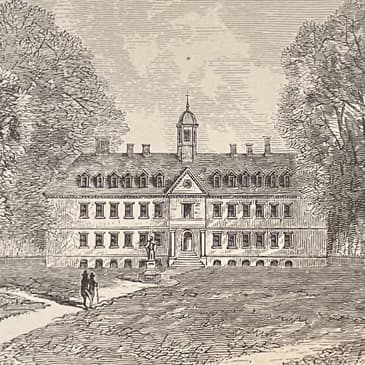
Welcome back to the Growing Patriot podcast American History for Kids. You might remember in the last episode we talked about Thomas Jefferson and all those siblings. How he went to college at William and Mary and he met a lawyer there in Williamsburg named George With. George With became a mentor to young Thomas, teaching him all about natural rights and things like that. You might want to go back and listen to our episode about John Locke if you need a refresher about all that philosophy. We left him as a young man of twenty four who was just becoming a lawyer, and that's where we pick up his story today. Thomas Jefferson was officially admitted into the General Court of Virginia in seventeen sixty seven, which meant he was officially lawyer. There are no records showing the exact date, but his earliest recorded case was on February twelfth, so sometime before then he joined the General Court. And that was really difficult to join. It was the tippy top of political, social, and legal authority in the colony, and the Colony of Virginia was a pretty important colony to begin with. Now, the Court didn't have professional judges. It had the Royal governor and a twelve member council. So maybe it helped that Thomas Jefferson had dined with the Lieutenant Governor as a student. And those twelve seats were held by the wealthiest planters in the colony, the most important people, and of course the members of those families tended to be close friends and even marry between each other, so it was almost like an aristocracy. You can remember that Thomas Jefferson was a member of the Randolph family, one of those important families. He was friends with the withs. Like I said, he had dined with the Lieutenant governor. All of that was important. And then in seventeen sixty one, just a few years before Thomas became a lawyer, a law was passed that said lawyers had to choose they could either practice in the county court or in that fancier general court, and he chose that special elite colonial bar Anyone who chose that route had to go to Williamsburg for an exam. He was lucky because he was there anyway, and those examiners were the colony's top legal minds, like Peyton Randolph, and if that name sounds familiar again, Remember that Thomas's mother was a Randolph Peyton, was his first cousin once removed, and his own mentor George. With having to choose between the two courts also meant that some people worked in those lower county courts for a while before trying for the general court, but not Thomas Jefferson. He skipped over they were those lower county courts and went right for the General Court, which meant that not only did he think he had the skill, he was pretty sure he had the high status to get through, and he did, but he only practiced law for about eight years. Even with that, we can see that legal training throughout his life because the way that he writes is laid out and explained like a lawyer would write it. As a lawyer, he worked mostly on things like land disputes and claims about property, but he also did high society wills and inheritance. Notably, he also took on cases for enslaved people for free at least seven different times, despite being a slaveholder himself, but he still represented enslaved people and indentured servants who were suing for their freedom. In one case he even went up against George with in seventeen seventy and argued, under the law of nature, all men are born free. He'll write something pretty similar a few years later in the Declaration of Independence, and then in seventeen seventy four he gave up the law entirely, giving all of his remaining cases to his close friend Edmund Randolph. Yes another Randolph, this one his second cousin. After all, by seventeen seventy four, Thomas had other things on his mind. To get to those other things on his mind, we'll go back a few years, because something was happening in his life while the law practice was growing. In seventeen sixty eight, just a year after becoming a lawyer, Thomas was elected to represent Albemarle County in the House of Burgesses, Virginia's colonial government. He officially started in May of seventeen sixty nine and was there alongside men like George Washington and Patrick Henry. He was immediately on their side, the anti British side. It probably won't surprise anyone to know that he wasn't much of a speaker in the House of Burgesses, but he was a major writer. He started out with a bang with bill he introduced saying that owners should be allowed to free their slaves without the permission of the government, but the Assembly rejected that idea. Not long after that things escalated in the House of Burgesses. They basically said no taxation without representation. In response, the governor, Lord Bodaitot dissolved the Assembly and said you're not allowed to meet anymore. But they weren't going to accept that. They just went a few steps down the street to the Raleigh Tavern and met there, establishing the Virginia Association, and that association decided to boycott British girl goods, which was very bold. In seventeen seventy four. He wrote a summar review of the rights of British America in seventeen seventy four, and that said that the King and Parliament had no real authority over the colonies. Of course, he would have even stronger things to say about that in seventeen seventy six, but that writing really put him into the spotlight. People started to recognize him as a guy who could explain very well why some Americans thought we needed independence. But also in seventeen seventy four, another royal governor, this one, Lord Dunmore dissolved the House again, this time for joining the protest against the Boston Port Act. So Jefferson, Patrick Henry and others went right back to that Raleigh tavern and called for the First Continental Congress. And that's where we're going to leave his political life right now. Now, I know it's a cliffhanger, but there's a lot more going on. As if Thomas Jefferson weren't busy enough. In seventeen sixty eight, he decided to start building a house. And if your family has ever built a house, or maybe you know some people who are builders or work on building houses, you know it's a huge job and we have power tools now they had to do it all by hand. Plus to get ready to build his new house, Thomas Jefferson had to flatten a mountaintop. While living at his home in Shadwell, where he was born, he started a huge project just a couple of miles away, creating a new home that he named Monticello, which means little mountain in Italian. When he was growing up in Shadwell, he would wander over to this neighboring peak and dream of builduilding a home there. Someday, so he did. He wanted to build something entirely of his own, and he had been studying new architectural styles that were very popular at the time, so he wanted his home to be like those in the Palladian style. But building a house on the top of a mountain in rural Virginia in the middle of the eighteenth century was not very practical. It was windy, the weather was moody, and it was really hard to get water and building materials up there. But Thomas Jefferson was really into what was called the Enlightenment. A lot of those big thinkers like luck who we talked about before, and that all went into that Palladian style. He wanted those big views of nature, the clean mountain air, and to be far away from the big city, and Monticello gave him that up in the Blue Ridge Mountains of Virginia. But by seventeen sixty eight, when Jefferson's started work on Monticello, there was another reason to build. Shadwell was a mature, flat lowland plantation. It was focused on cash crops, mostly tobacco, So Jefferson decided he would keep Shadwell and make it agricultural and industrial, but Monticello would be his home, his private space, a place to experiment on architecture, to build the house, but also his other intellectual interests, a place to build an ornamental garden. It was kind of like having a home and an office. So the plan was to live in Shadwell until Monticello was ready, but a fire took Shadwell in seventeen seventy, so we had to move into just a little piece of Monticello that was ready before the whole house was complete. Monticello still exists today and is a huge part of Thomas Jefferson's legacy and how we remember him. So it's a good thing he built that second home to be his special place. Do you think he was busy enough? Well, one more big thing happened in the middle of all of this. In seventeen seventy, through the social circles of Virginia High society, Thomas Jefferson met a young twenty three year old woman named Martha Wales Skelton. Her father, John Wales, was an English lawyer and the head of a wealthy, influential family in Virginia. They had a plantation called the Forest in Charles City, County near Williamsburg. He married a woman named Martha Epps. The Epps family was also prominent in Virginia. She had grown up at another big plantation called Bermuda hundred. They were married in seventeen forty six, and their daughter, also named Martha I know it gets confusing, was born in seventeen forty eight, and that is the Martha we're going to talk about. Little Martha was raised to appreciate the arts and be a proper society lady in Virginia. Of course, along with that went learning to run a plantation, speak French, and she was expected to make a good marriage, and she did that, but it wasn't to Thomas Jefferson. At eighteen years old, in seventeen sixty six, she married a man named Bathurst Skelton, who was twenty two. He had actually been a classmate of Thomas Jefferson's at William and Mary. They went on to live at his Elk Hill plantation and had a son, John in seventeen sixty seven. But just a little bit later, in September of seventeen sixty eight, Bathurst was in an accident in Virginia and very seriously injured. He quickly wrote out a will leaving everything to his wife, Martha, and later that very day, which left Martha an extremely wealthy young widow. Which sounds like another young Martha we know in Virginia, doesn't it, The Martha who would go on to marry George Washington. But back to this Martha. At just nineteen years old, she moved back to the forest, her dad's plantation, and in seventeen seventy that's where she met Thomas Jefferson. They connected over a love of music, and other suitors talked about coming to the house to see her, but then they would hear her playing the harpsichord or the clavichord and singing with Thomas Jefferson, and he would sometimes play the violin with her, so they would just give up and go home. But to get her affection, Thomas Jefferson ordered a handsome mahogany piano forte from England as a courtship gift, hoping that it would be what he said, worthy the acceptance of a lady for whom I intend it. But while the courtship was going well, not everything was perfect for Martha. In the summer of seventeen seventy one, her son, John got a sudden fever and died at only three years old. So by the time Thomas and Martha married on New Year's Day in seventeen seventy two, it was just the two of them, and the honeymoon wasn't perfect either. The wedding was held at Martha's family's plantation, the Forest, and Thomas Jefferson kept meticulous financial records, so we know that he paid the local clergyman, the Reverend William Lee, five pounds for performing the ceremony. He also gave little gifts of cash to the plantation's musicians and the enslaved household staff. And then it was time to start a new life together at Monticello. But first they had to get there, and traveling one hundred miles in the mountains in the winter in colonial times was not easy. They stayed at the forest until January eighteenth, but the weather was starting to get bad, so they really had to go, and as they got further into the mountains, they were hit with a blizzard, a record breaking blizzard that left them in three feet of snow. The carriage got stuck, so they had to ride their horses the rest of the way. Through the wind and the snow, those poor horses. They finally got to Monticello on January twenty seventh, but remember the house wasn't actually done. It was mostly just a little foundation with a few outbuildings. There was no actual house yet. The enslaved servants were asleep and none expecting them. There were no fires, no candlelits, nothing ready for them, so they just cozied up in a little one room outbuilding that is called the honeymoon cottage now, and there was no food, but they did find half a bottle of wine on a shelf behind some books and toasted to their new marriage with that. That's a pretty memorable way to start a new life. And on January twenty seventh, freezing in a little cottage with half a bottle of wine. And then on September twenty seventh, nine months later, their first baby was born, a little girl named Patsy. So Thomas Jefferson has a new wife, a new home, a new baby, a new career, and a country on the brink of revolution. And I don't think he can take anything else in one episode, so let's leave him here for now. Thanks for listening to this episode of The Growing Patriot podcast. Remember there are pictures, videos, links, and other resources for this episode and every episode at growingpatriots dot com. See you next time.