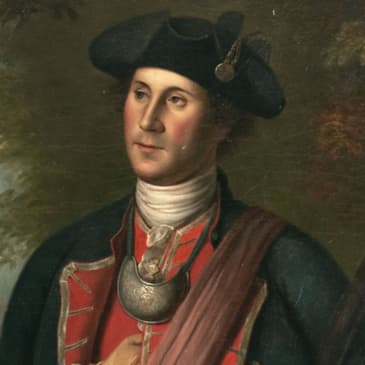
This is the FCB podcast network. They breed us solve the tarany staying and they bought so well working America and of. The Welcome back to the Growing Patriot podcast American History for Kids. Last week we left off in seventeen fifty two, when George Washington was a young man. He had been working most of his adult life as a surveyor. His brother Lawrence had passed away, and George Washington was renting the Mount Vernon Plantation, living life as a Virginia planter. This week we will find out what happens next when he starts his career in the military and politics. Here we go. We talked last time about how George Washington had distinguished himself with Colonel Fairfax. Remember he knew Colonel Fairfax because his daughter was married to George Washington's brother, Lawrence. I know it gets a little bit confusing, but they all knew each other. Lawrence also introduced him to other powerful, influential, important people in Virginia. So now when we catch up with George Washington as a twenty one year old in seventeen fifty three, just keep that in mind. He was beginning to lose interest in surveying and was more interested in pursuing a military career, following in his brother Lawrence's footsteps, and he knew just the man to talk to about this, Virginia's Lieutenant Governor Robert dan Whittie, who we think he met in seventeen fifty one on a visit to Williamsburg. And here is where the military career of George Washington begins. In October of seventeen fifty three, Dinwitty was planning to send an emissary, which is like an ambassador or someone to talk between groups, to the French in the Ohio Valley. George Washington volunteered to go and Dinwhitty accepted. The trip took months, and during that time Washington became certain that the French were planning a big attack on the British and he wanted to warn Dinwittie, but the whole group he was with couldn't leave. They had to stay and keep working with the French. So he left by himself with just one guide, and that was dangerous. It's safer to be in a big group. Also, he was walking, he didn't even have a horse. So on his way back to Williamsburg to warn din Wittie. He nearly drowned, froze, and starved, but he did get there on January sixteenth, seventeen fifty four. It's a good thing he had all that practice finding his way through terrain and sleeping rough when he was a surveyor. That bravery was rewarded and Washington was promoted to lieutenant colonel. The leaders in Williamsburg did listen to George Washington's warning, and they told him to gather men for a mission to get the French out of the Ohio Valley. And this was land that both the French and British wanted to control. The British wanted the French out. Something big happened on this mission. On his way, he came across French scouts and they had to be stopped before they could tell the rest of the French where he was. So he met with a local Native American chief and they went to the French camp. Washington intended to let the French surrender and be captured, but the Native American forces attacked the commander de juemont Ville and he was killed. After the attack, Washington built a small fort called Fort Necessity, so they would have a defensive structure. When the French retaliated on July third, seventeen fifty four, that happened. French forces attacked and Washington had to surrender. But here's where things get a little confusing. When he signed the terms of surrender, he admitted to the assassination of Jumonville. However, the terms were also written in French, which Washington couldn't read, so he was taking their word for what it says. He says that he did not assassinate that man, and that the reason that there was an attack is that the French were not scouts, they were spies. This attack was one spark of the French and Indian War, and many even see it as the beginning of a larger conflict between Britain and France that we now ca the Seven Years War. And if you've been listening to this podcast for a while, you know that that's a pretty big deal. So even though this didn't go very well, he did prove that he was courageous and decisive, and his military career only grew from there. He joined Brigadier General Edward Braddock as an aide de camp on his march west to capture the French Fort Duquaine in March of seventeen seventy five, and Fort Duquaine is now what we call Pittsburgh. This was his first time serving with a professional and experienced officer. On this campaign, they were attacked by French and Native American forces and suffered terribly. Even his commander, General Braddock, was killed in July. Colonel Thomas Dunbar, who had taken over, put them into winter quarters. In July, Dinwhitty asked the House of Burgesses for money to get the Virginia soldiers out of there again and put them under the command of George Washington. Washington agreed to take command, but only if he could have enough money to pay his expenses, the ability to choose his own officers and two aids de camp. Din Wittie said yes, and Washington headed to Winchester to set up his headquarters. But he had a hard time doing this job. A lot of men signed up and then simply deserted. They just left. And the laws were written so middle class and wealthy men didn't have to serve in the military, only poor people. Plus people in the countryside didn't even really support the war. There was a growing difference between regular, everyday people living in America and the people in Britain had different goals and didn't really care about a war between Britain and France, which is really what this came down to, But they did care about Virginia and Virginia's frontiers, which Washington was trying to maintain. The colonial government's plan just didn't work though, until a turning point in seventeen fifty eight. On November twenty fourth, seventeen fifty eight, British forces finally took Fort de Quine without even firing a shot, and the French were now losing the war. That was Washington's goal when he joined the military, to win the land for Britain over the French, and now he'd done it, so he was ready to resign his military commission at the end of the year. His personal life had also changed. Martha Dandridge Custis, a wealthy widow, had accepted his proposal and they were to be married the following January in seventeen fifty nine, and there was a big career change on the horizon too. George Washington had run for election to be a member of the Virginia House of Burgesses and he won, so his term would start in February. He would finish up with the military in December, marry Martha in January, and start his life as a politician in February. The timing was perfect, so at the end of seventeen fifty eight, Washington resigned his commission in the military. It was time for the next chapter of his life. He would be a legislator, planter, and husband. He thought his days in the military were over. Of course, we know that wasn't the case. I'm going to spend the whole next episode on Martha Washington and how she impacted George's life, so I won't really talk about their marriage here. We're going to skip right to his political career. As I said, George Washington ran for a seat in the House of Burgesses in seventeen fifty eight. That's kind of like the House of Representatives in Congress today. This was actually the second time he ran. He ran in seventeen fifty five, but didn't get elected, if you can believe that. So if you're ever feeling down about not achieving something, just think about that. Even George Washington didn't get elected on his first try, but he did get elected in seventeen fifty eight to represent Frederick County. For the first couple of years, Washington wasn't very active in politics. He didn't travel to Williamsburg for very many legislative sessions, and when he did, he didn't speak much. But he got more active in the seventeen sixties. You probably won't be surprised that he spoke out against Britain taxi the American colonies. You've probably heard the phrase no taxation without representation before, and George Washington certainly believed that. He was against the Stamp Act and celebrated when it was repealed, And in seventeen sixty nine he even introduced a proposal suggesting that Virginians stop buying British goods completely in response to the Townshend Act, which ended up being repealed too in seventeen seventy. You can tell from the year and from everything that we're talking about that things were really heating up between Britain and America in the early years of the seventeen seventies, and after the Boston Tea Party at the end of seventeen seventy three, Britain passed the Coerce of Acts. In early seventeen seventy four, which Americans also called the Intolerable Acts. We have a whole episode about that. Earlier in this show. Washington said that they were quote an invasion of our rights and privileges. In July seventeen seventy four, he and George Mason wrote up a list of resolutions for Fairfax County, including saying that slavery had to end, and it was all agreed upon and then something big happened in seventeen seventy four. In seventeen seventy four, George Washington attended the First Virginia Convention. This meeting began on the morning of August first and lasted for about a week, where dozens of Virginia's leading gentlemen met in Williamsburg to talk about the politics of the colony. And the group didn't answer to anyone, not even the governor or the king. The First Continental Congress was scheduled to meet the next month, so this group decided who would represent Virginia. Of course, George Washington was chosen, and that is where things go to a whole nother level for mister Washington, and we will talk about that in another episode. Thanks for listening. You can find pictures, links, and other resources for this episode at Growingpatriots dot com. We hope you're enjoying learning all about George Washington and I'll see you next time. They freed us off with Jeremy staying, and they thought so well working America and