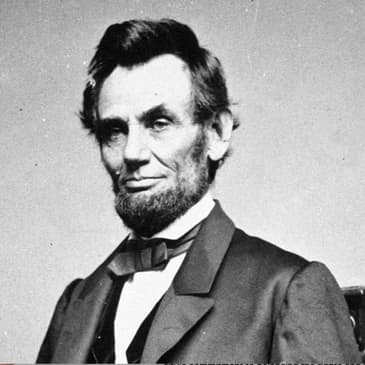
This is the FCB podcast Network. They're bringing us at the Jeremy the Story of the Thing, and they thought so when we were in America and of the Welcome back to the Growing Patriot podcast American History for Kids. I'm your host, Amelia Hamilton. In this episode, we're taking a little bit of a side journey outside of the colonial period. In the last episode, we talked about some of those themes that hold the colonial era together. And another president came along about seventy five years later who embodied a lot of those same things, and today we're going to talk about him. Can you guess who it might be? I'm Jonathan White. I'm a professor of American studies at Christopher Newport University in Newport News, Virginia, and I've been writing books about Abraham Lincoln and the Civil War for about fifteen years now. Gosh, and you are so you're a college professor, but you've also been trying to teach little ones about Abraham Lincoln recently. That's right. I have two daughters. They are ten and almost eight, and we've been taking them to historic sites for a long time. I've been reading history books to them for a long time and I recently decided that I would write a children's book of my own, and it's something that comes out of the fun I've had with them in terms of looking at history together. So when I was looking at your book, I realized that it went kind of perfectly with an episode we just did, which is Abraham Lincoln. Well, he has a lot in common, I think with a lot of our founders because we mostly focus on the founding period here, But Abraham Lincoln, I think that his heart was kind of a heart of a founding father in a lot of ways. So, first, would you agree with that? I absolutely think so. He Lincoln looked at the Declaration of Independence as the touchstone of his thinking. He believed that the principles of the Declaration of Independence were real and that they applied, as he said, to all people of all colors everywhere. And so what Lincoln wanted to accomplish as a politician and then as president was to get America to live up to the ideals of the American Founding. He did not want to reject the principles of the American Revolution. He thought the American Revolution was good and that the principles that put forward were good. He just looked debt the country and his generation and thought, we're not living up to it. And so throughout the eighteen fifties he gave speeches pointing Americans to the Declaration of Independence, and then as president he's able to actually then help create policies that put those principles into action. In one of those famous speeches, he says a phrase that I think a lot of people think actually comes from one of the one of the founding documents, and that is of the people, by the people, for the people. You know, that is from his I think probably his most famous speech, the Gettysburg Address, And it seems to me, I think when people reference that, I hear a lot of people think that comes from our founders. Have you found that I have, And I think a lot of people don't know where it comes from. I think some people have even thought it comes out of the Constitution. It's a phrase that Lincoln used at Gettysburg, and he had used variances of it before, but I think that's the most famous version of it. It's an idea that is rooted in the Founding because again, the Declaration of Independence is all about government by consent, and so Lincoln is taking that idea and giving it a new phrase to capture what they were getting at. Yeah, that idea definitely comes from our founding, but he wrapped it up so nicely in that phrase. Yeah. But what I was kind of getting at before is that we just recently did an episode about some themes from our founding, and I think that Abraham Lincoln really embodies these two. So I wanted to kind of take this episode and go through it a little bit from the frame of Lincoln. So Lincoln, with his focus on the individual, how did he embody that? Lincoln really believed in the idea of what he called the right to rise, that anyone from any background could work hard and make a better life for themselves. That is Lincoln's story. Lincoln grew up in a very poor household. His father was a farmer, his father a farmer and carpenter. His father was not educated, but Lincoln realized that through hard work and through education, he could make a better life for himself. And so even though his dad didn't value education, Lincoln did everything he could to teach himself to learn and to develop his skills at reading and writing. He would write poetry that was you know, kind of not sloppy, but you know, not great poetry. But it was a way for him to learn how to play with words and hear how they sounded and fit together. And I think those kind of skills helped him develop as a writer and a public speaker as he got older. He also got other jobs. You know, he was a land surveyor, and there's kind of an interesting connection between him and George Washington because George Washington had been a land surveyor as a young man, and so Lincoln was developing skills that would help him meet people and get well known in his community that he then used to turn into a career in politics. So from a very young age through his youth and adulthood, he's always trying to figure out, how can I work hard? How can I better myself? How can I make my life better? And then he took those principles as president and as a politician, and he would give speeches about how these apply to everybody, regardless of your skin color. He wanted people to be able to rise and live a better life. Absolutely. And the second one, I think is one that is pretty synonymous with Abraham Lincoln, and that is the idea of liberty. Yeah, Lincoln really believed in the principles again of the Declaration of Independence, that all men are created equal, that they're endowed by their creator with certain andalienable rights, among which are life, liberty, and the pursuit of happiness. And for Lincoln, he believed that slavery was incompatible with that. He believed that slavery was a moral wrong that needed to be dealt with. And at the same time, Lincoln believed that the Constitution does not allow our politicians to do anything they want to, and a lot of our politicians today don't realize that. But Lincoln believed that just because slavery was wrong, it didn't mean that as president he could do anything he wanted to get rid of it. And so as president, he took steps to strike at slavery, to try to minimize it or get rid of it in different ways that he believed the Constitution allowed for. And in doing that, he was trying to spread liberty and make it something that would be available eventually to all Americans. And that leads perfectly into the third one, which is the idea of fairness and justice. Yes, Lincoln, everything I think Lincoln did, he did out of a sense of justice. He had a very keen sense of what was right and wrong. And I've written a lot about Lincoln and the pardon power, and for young listeners, that's something that happens when someone commits a crime and they get convicted in court, they can petition their governor or the president for a pardon, meaning that they might get let out of jail, or if they have a fine or another punishment, they get out of having to serve that punishment. And as President, Lincoln dealt with hundreds and hundreds and hundreds of pardon requests, and every time he would look at them, you get the sense that he would try to think about what is the just outcome, what is the right decision here? And if someone committed a very bad crime, he would allow them to endure their punishment. But if he looked at it and he thought there are circumstances here that make me think this person shouldn't have to go through their full punishment, he would then he would often pardon them or do what was called commuting their sentence. Yeah, so I think one of one of the major things that Lincoln would have understood, and that our founders absolutely also understood is the idea of compromise when you are the president, or when you are in any position of power. When you're in charge, you're not going to absolutely get what you want. You're going to have to come up with something you can live with that will work for everyone. Yes, Lincoln. It's interesting. Lincoln once talked before the Civil War about working with people who had different political views than him, and someone criticized him for this, and Lincoln responded with a letter, and I'm paraphrasing it here, but he said something along the lines of work with people when they are doing right, and part with them when they're not. And so there was something about him that enabled him to work with people he disagreed with if they shared a common goal. And one of the things we often forget about Lincoln is that he was actually hated during his lifetime. If you look at political cartoons from the eighteen sixties, you can see how much people despised him and how critical of him they were, and that included members of his own political party. There were people in his own political party, the Republican Party, who thought he's not doing enough, we're not satisfied with him, we want to get rid of him. And then there were Democrats who hated Lincoln because they were in the other political party and they didn't like what he was doing. So from all sides, Lincoln was roundly criticized, and yet he did what he could to work with people who opposed him in order to try to accomplish a common goal. So Democrats of his era were perfectly fine with slavery, and they did not want to abolish slavery, but they believed in saving the Union, and so Lincoln would go to them and say, if you believe in saving the Union, so do I. How can we work together to accomplish that? And radicals thought he wasn't doing enough, but he would find common ground with them and be able to try to fight to save the Union and end slavery and bring about liberty and political rights for former slaves. And so he was struggling to find compromise and common ground with a lot of different people, but somehow he was able to do it in a really remarkable way. Yeah, and that brings us perfectly to point the last one point number five, which is, you know our founders in Abraham Lincoln, you know, they always had their eye on that idea of a more perfect union. Not a perfect union, but you just need to make things better. And one of those things that the Founders even fought about was slavery, and you know, they were not able to abolish it in their time. They were just trying to make things better. You know, they were able to get freedom from Britain, and it was it was in Lincoln's time that slavery was abolished. So you know, talk to me a little bit about that, that idea of improvement but not perfection. Yeah, And for the Founders, they they had a general sense, I think many of not most of them, that slavery was a moral evil, but they didn't know how to get rid of it. And so Thomas Jefferson very famously said that slavery was like holding a wolf by the ears. And you can kind of imagine what that would be like. If you've got this vicious wolf in front of you, you're holding it by the ears. You so badly want to get you want to let go and get away from it, but you know if you let go, it's going to attack you. And that was how Jefferson in the early eighteen hundreds thought about slavery. It's like holding a wolf by the ears in as the United States kind of moved forward, or I should go back for a second. And so the Founders, Lincoln believed, set slavery on what he called a course of ultimate extinction. And if you look at the Constitution, you'll see that it's a series of compromises, and some of them had pro slavery effects, but some of them had anti slavery effects. And Lincoln believed that the Founders wanted to get rid of slavery, they couldn't quite accomplish it in seventeen eighty seven when they wrote the Constitution, and so they put provisions into the Constitution that would ultimately lead to the death of slavery. And at the same time, they never used the words slave or slavery because James Madison said that they didn't want the Constitution to embody words that showed the idea of property in man, meaning the idea that one person could own another. And so Lincoln said that the Founders hid slavery away in the Constitution. He said, like if you had a really bad disease, He said, if you had a win or a cancer, if you had a big tumor, you wouldn't walk around showing it to people, you would hide it away, And Lincoln said that that's what the founders did with slavery. They hid it in the Constitution, hoping that it would eventually disappear. Well, things changed, and as many of your listeners may know, in the seventeen nineties, Eli Whitney invented the cotton gin and that made growing cotton very, very profitable. You could make a lot of money if you owned a big plantation. And the United States also started to spread westward through the Louisiana Purchase, and they began to acquire all this land that then was opened up to cotton. And so by the time you get to the Civil War, things have changed a lot. Slavery was no longer on the path of going away. It was actually on a path of getting stronger and stronger and spreading to more and more land. And so Lincoln's goal as president, as a politician, and as president is to try to stop slavery from spreading. And he believes if he can do that, eventually he'll be able to live up to the founder's ideals of destroying slavery. But it'll take a long time, he thinks, and it'll be slow and hard but that's how he ultimately approaches the issue. Yep, It's all about you know, like like our founders said, a more perfect union, and like Lincoln knew, just improving, just getting making things better over time. That's right. And the more perfect union for Lincoln would be living up to those original ideals of stopping slavery and eventually getting rid of it. Yeah. So who are some of Lincoln's you know, founding heroes? Did he look back to the Founders? I think Lincoln's biggest hero from the Founding generation would be George Washington. So I've written this children's book about Lincoln called My Day with Abe Lincoln. And one of the things, one of the stories, or one of the through lines in it, is that Lincoln loved to read, and he really took that up as a kid and then read throughout his whole life. And as a child he read some very famous books about George Wahts Washington, and he grew to love those stories of Washington crossing the Delaware and attacking the Hessians, you know, right after Christmas in seventeen seventy six, and those stories stuck with him from his childhood all the way to his adulthood. So a very famous story from his childhood is that he borrowed a book about George Washington and it was in the Lincoln cabin and it rained, and then the rain somehow leaked into the cabin and ruined this book that he had borrowed, and he borrowed it from a neighbor who then made him pickcorn for I think a whole day to kind of pay off for this book that he had destroyed. But the stories he read borrowing that book that was by a guy named David Ramsey, or reading Parson Weems's very famous biography of Lincoln, those stories stuck with him. And when Lincoln was elected president and started his journey to Washington, d c. When he left Springfield, Illinois, he gave a little heartfelt extemporaneous speech, meaning it wasn't written out, It was just him kind of talking off the top of his head, and he referred to George Washington and he said he now had a task before him that was greater than that that George Washington faced. And he eventually made it to Trenton, New Jersey, where he talked to the leaders of New Jersey in the state House, and he referred back to the books he had read as a child, and talked about how he remembered, you know, with great thrills, reading about George Washington and the Continental Soldiers. And then he crossed the Delaware River, going the opposite way that George Washington did, and he went to Philadelphia and Independence Hall, and on George Washington's birthday, he delivered a speech at Independence Hall. Again, talking off the top of his head, he said, I only came here thinking I would raise a flag. I didn't expect to give a speech. But in the speech, he then reflected on the principles He said that motivated the Continental Army to fight, and he said there had to be something in those principles greater than just independence from Great Britain. It was about giving liberty to all people. And what's remarkable about that speech is he was standing in the place where George Washington had presided over the Constitutional Convention. He was standing in the place where the Continental Congress had debated and revised the Declaration of Independence, and standing there, Lincoln said that if America lost those principles of liberty and equality, he said, it would be truly awful. And then again talking just off the cuff, he said, and I was about to say I would be I would rather be assassinated on this spot than to sacrifice those principles. And of course, four years later Lincoln would be assassinated for fighting to uphold those principles. So George Washington, I think, really motivated Lincoln in his thinking. The Declaration and the army of the Patriots really motivated him. And in fact, even in eighteen sixty two, when Lincoln was president, he was really frustrated with his commanding general, a guy named George McClellan. And it's February of eighteen sixty two and Lincoln says to McClellan, I want you to move by George Washington's birthday. So even thinking about Washington as a motivating factor in that way is a real big thing in Lincoln's thinking as president. Wow, what are some ways that Lincoln was different than our founders? Were there times where he made decisions that seemed different? Yeah? I think Lincoln was different in a lot of ways, and he was a man of a different time. I think Lincoln is a lot more approachable than our founding fathers in a very real way. We often think about George Washington as being quiet and aloof James Madison, Jefferson, They're hard for us to connect with in some ways, whereas Lincoln, I think is different. And Lincoln was very approachable in his day. So in my children's book, one of the themes that comes out is the idea of handshaking. And as a boy, Lincoln learned the importance of handshaking from his teacher in Indiana. His teacher would have students go around and shake each other's hands and practice their manners, which I think is something that children should still do today, learn how to shake hands and greet someone and make eye contact. And Lincoln took those lessons with him all the way to his presidency. I wrote a book a couple of years ago called A House Built by Slaves, and it's about black men and women who went to the White House. And in every moment where Lincoln met people at the White House, he shook their hands, and he talked to them, and he listened to them. And anyone who wanted to in Lincoln's time could actually go and meet with the President and talk about anything they wanted to. And Lincoln almost always greeted his visitors with a listening ear and a welcoming handshake, and a sense of kindness what we today would call authenticity, that he was real with them. And that's something that I don't know that people of the founding generation would have experienced in quite the same way in meeting with their president. It was a it was a different time, and I think a lot of the early early leaders were probably a little a little bit more removed from the ordinary people in a way that Lincoln. He just mixed and mingled. He had a great sense of humor. He would tell jokes, he would he would say things that were a little inappropriate at times, but that was his way of connecting with ordinary Americans. And and that was the thing. Lincoln was an ordinary person who rose to greatness, the first president kind of born on the frontier, who was living west of the Mississippi River to then be elected president. And because he was a common person and lacked education. There's another big difference. I mean, George Washington's education was lacking in some ways. But then the other great presidents, you know, Jefferson and Madison and Adams they had all they had very very good educations. Lincoln did not. Yeah, that's great, So what are some of the key things that you would like kids to remember when they think about Lincoln. So in the kids book I've written, there's a really big theme, which is the importance of reading, and reading is just so important for kids today. And I'll even say this reading in a book or a magazine, not just reading on a screen. Our eyes function differently when we read on a screen than when we read on paper, and we remember things better when we read on paper. And so I hope that kids who read my kid's book will see how important reading was to Lincoln, how it made his life better, and that it'll help ignite a love of reading and kids. I also hope that kids will learn that Lincoln overcame some really, really hard struggles. I think a lot of times kids today they struggle with things, whether it's anxiety or peer pressure or kids teasing them at school, and we often forget that Lincoln was a real person and he actually struggled with the same kind of things. So Lincoln's first day of school when he was a little boy, his mom sent him into school wearing a sunbonnet and teased him for that because he looks silly. And you know, kids who get teased for their outfits today can realize that Lincoln struggled with something like that. Lincoln lost his mother when he was nine years old, and children who go and he then ended up being raised in a blended family, and children who who have lost a parent or a loved one can see that Lincoln experienced something like that. Lincoln struggled with spelling. My kids have spelling tests every Friday, and sometimes they go well and sometimes they don't. Yeah, and I'm sure that all the listeners to the podcast to have to work on spelling. And as a child, Lincoln struggled with spelling, and in my Kid's book, I tell some really fun stories about that. But even as an adult, Lincoln struggled with spelling. I did a kid's event in Pennsylvania recently and another one in DC recently, and I've started doing all my kids events with a little spelling beat, and I'll ask the kids in the audience to spell certain words, and they're all words that I knew. Lincoln struggled with spelling. So in one of the events, I said, can anyone here spell the word very? And a second grader raised his hand and he spelled it ve e r E y. I said, nope, not quite, and an older boy, a fifth or sixth grader, spelled it correctly. And then I told the group, you know, Abraham Lincoln as an adult, spelled the word very v r r y at almost forty times and so and there were a lot of words that Lincoln struggled with spelling, and so I I hope that young people can can see that some of the things they struggle with, whether it's at school or at home, that Lincoln actually struggled with some of the same kind of things. And yet Lincoln was able to work hard and learn and overcome his struggles and become I think, our greatest president. You might you know, someone who does the founding might say George Washington. I'll put Washington way up high to but that Lincoln is a model for young people, and I hope that people can be inspired by his story. Absolutely, And where can we find your book and find out more about it? Yeah. So the book is called My Day with Abe Lincoln, and it's a chapter book with a lot of illustrations, and it's geared towards young readers, probably about six to nine, although parents can read it to younger kids. And I think older kids can still find a lot of fun in it. And it's available on Amazon and Barnes Andnoble dot com or BN dot com and all the different kind of places online, and it's carried out a lot of museums and gift shops around the country. It just came out in February, and it was illustrated actually by an art student from Christopher Newport University where I teach, and so it was a lot of fun to get to work with her. And my children make some appearances in the books in the book, and they were very helpful in writing it as well. So it's a really fun adventure story, and I guess I should tell people a little bit about it. It's about a third grade girl who doesn't want to go to school on Monday morning. And I won't spoil it, but she does something that causes her to travel back in time, and she goes back in time to Indiana in the eighteen twenties, where she meets a young Abe Lincoln and his sister Sarah, and she goes to school with them, and then she goes home with them after school, and all throughout the day she learns just incredible stories about Abraham Lincoln stories that are true about how he almost died a couple of times when he was a little boy, and his struggles was spelling and all the things he did to learn how to read. And she comes back to the present just a new person, kind of inspired by Abraham Lincoln. And my hope is again that the book will help inspire young people to learn about Lincoln and to be inspired by his story. That sounds like fun. It was a lot of fun to write. I spent a couple of years working on it, and it's a very fun creative thing to get to write a story like that. It's different from a normal history book. It still gives people the history, but it does it in a different way. Yeah, it's always fun to explore with our imaginations too. Yeah, thank you so much for joining us today. This was a fun leap forward in our historical timeline. But still Lincoln has always been one of my favorites as well. My focus has always been kind of in the founding period, but he exemplifies that spirit so well, and I don't know, he's always been one of my absolute favors too, So I'm so glad you were able to spend this time with us today. Share your book. Absolutely, I encourage everyone to have a look, go buy it, and yeah, share what you think. We will tweet links and share links on all of our social media so you will be able to find it there and tell us what you think. Thanks for joining me today as we took this trip outside of the colonial period, but with the president who still had that colonial spirit. Be sure to check out Growingpatriots dot com for resources that go with this episode and every episode, and find us on Twitter, Facebook, and Instagram at Growing Patriots. Can't wait to see you next time. Agree to solve with Jeranny, share the thing and then thought so would be Americaander. This has been a presentation of the FCB podcast Network, where real talk lives. Visit us online at Fcbpodcasts dot com.