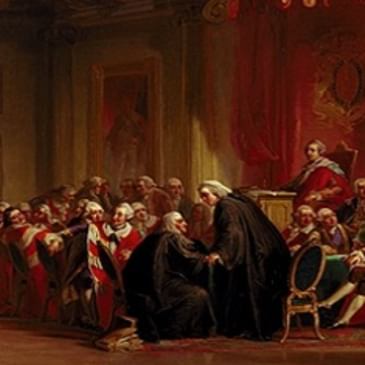
This is the FCB podcast network. They breed us at the Charny start of the thing and they bought so when we were America And. Welcome back to the Growing Patriot podcast American History for Kids. I'm your host, Amelia Hamilton. When we left off in the last episode, Benjamin Franklin was about to make his way to London. In this episode, we will find out all about his life and work there. First, some questions from Barrett. Hi, my name is Barrett. I'm eight years on Irven, Texas. My questions are why did Menumin Franklin move to London? What did he do for work while you lived there? Here were some of the people he met in London? How did he feel about the growing on West Back and Colony? Why did Benjamin Franklin return home to America for the. So my name is Henry. I'm the education manager at Benjamin Franklin House, which is the world's only remaining Franklin residence and it's located in London, England. That's so interesting to me that you can't go to Philadelphia or anywhere else in the world and find somewhere that Benjamin Franklin lived. Yeah, well, he was born in Boston on Milk Street, and I believe that the location of his house there is now a Greek restaurant. There is a little plaque above it saying that Franklin was born there, but obviously has changed over time. And then his house in Philadelphia is now part of the park Franklin Park, I think it's called, and you can actually see the outline of where the house stood. It's no longer there. So his house in London, luckily is still standing and you can come in and see what's left of it, and it is the only place that you can do that. So a very special piece of American history off or abroad. Does it have one of the special blue plaques that you see around. London, Well, it has one of the original designs of the blue plaque, So they weren't actually blue to begin with. They were made of metal and they were in the shape of a scroll. And the early ones. All they say on them is Benjamin Franklin, when he was born and when he was died, and that he lived at the property. Doesn't say anything about who he was or when he actually lived there. So a lot of people walk past the house and think that he actually spent his entire life here because it just gives his birth and death date. Unfortunately, but we do have claim as well to being one of the original blue plaques in London. Oh wow, So a couple pieces of history at the same site. Oh, lots and lots and lots of famous people who lived on the street as well. So Herman Melville, the writer, the author of Moby Dick lived down the road, and there was also a very famous German poet as well, called Heinrich Heine, who lived a few doors down. Must be something on that street that brings out the greatness and people. Yeah, well, it's very central. John Quincy Adams also had an office on the street, pretty much directly opposite Franklin's house. It's a ten minute walk to the Houses of Parliament. So the River Thames flows through London, and on the north side of the river you've got the Palace of Westminster where the British government work. You have Trafalgar Square just up the road, and Benjamin Franklin's house is just a short stones thrown away from Trafalgar Square. So pretty much whenever you type in the distance to London, it tells you the distance to Charing Cross, which is the roundabout next to Trafalgar Square. Benjamin Franklin lives pretty much. There, okay, so right in the middle of things very much. So yeah, all right, So what years was Benjamin Franklin there in London. Franklin lived in London actually twice in his life, very early on, when he was a teenager. He moved in seventeen twenty four to apprentice and learn the way of being a printer. London was a big metropolitan city and it was one of the centers of the print business. So he came here first to learn his trade. Then he moved back to Boston and soon after Philadelphia. But his main stay here was a bit later on in life, from seventeen fifty seven all the way up to seventeen seventy five. The evil of the American Revolution, as we like to say. Yeah, so we're talking about that earlier apprenticeship just briefly. So that would have been a pretty major opportunity though for a young man, wouldn't it. I mean, that would have made him I don't know, that would have been and I think an opportunity almost you know, for a tradesman, that would have been fairly elite. For a tradesman, I would think to be able to go study abroad in a. Way absolutely, And just then at the time when he was living there was a much smaller place than it is now. There wasn't as much opportunity for him to break away and make a name for himself, and London was very much the center of where news things were happening, and all of the best businesses or the biggest businesses were operating, and so he was able to take a packet from New York to London, stayed here for about eighteen months and was working with the leading figures in the industry and able to make quite a name for himself and gain the skills that he would then take back and eventually become a successful newspaper owner himself, having learned all of these skills whilst he was here in London. And it's actually where he gained one of his first nicknames. He was often called the water American because everyone in London, because the water was so difficult to clean and it wasn't very drinkable, people tended to have beer all about six to seven times a day, and Franklin, being the American, he stuck to water, and so he was probably the only sober person in the office whilst working on his apprenticeship. There interesting without a bit around the time that his his brother owned a newspaper. Would that be why he came and did an apprenticeship. I think his brother had a newspaper back back in the colonies. Franklin, he only went to school for two years, left school at the age of ten, had to become an apprentice under his father, who was a soap maker. He Benjamin Franklin, did not enjoy that. He wanted to be a printer. His older brother, one of his older brothers, was running a successful print company, so he actually apprenticed under him, but very quickly realized that he was perhaps better off working for himself and that he would be more successful if he had control of his own newspaper, and so he essentially ran away became a fugitive. At the time, when you were apprenticing for somebody, you couldn't just quit and walk away from it. You had to be let go by your employer. So he ran came to London, learned some skills when back to Philadelphia because obviously at the time he was still a fugitive, technically couldn't go back to Boston and Philadelphia is where he was able to make a name for himself. And it's one of the reasons why the city of Philadelphia have such a claim to Franklin, because that's where he began his career and then contributed a lot to the people of the city as well. Okay, now you mentioned the name the water American. I know that when Benjamin Franklin was working with his brother, he tried being a writer, and his brother didn't necessarily want to print everything that Benjamin Franklin said, so he became known under a different pen name. I don't know if you know what I'm getting at. Yeah, So Franklin, as I said, he only went to school for two years, and everything that he knew was self taught, and that's through reading, and he read a lot of books. And actually he would eventually become responsible for opening one of the first life libraries in America, one of the first subscription libraries. Because he was self taught, he was very independent, and he was very well skilled at writing, and he felt that he was a better writer than his brother, for his brother being quite jealous that his younger sibling was turning out to be more gifted at his career than he was, didn't allow him to publish anything under his own name, and so Franklin to get around that, started submitting these this old woman, this character that he created called Silence Do Good, which became very very popular and helped to propel the paper into a wider readership. But it was actually a young teenage Franklin putting on this character to try and get some work published in the press, and the success of that, I think would have only acted to bolster his own confidence in his ability and eventually lead him to take on his own company. Gosh and his brother never never noticed that this widow just happened to have all the same opinions as his little brother. Now, well, Franklin, he was a very gifted writer, and he was able to write in lots of different styles and forms, and it served him well during his lifetime. So let's turn to that second second time he lived in London. What were those years again. Seventeen fifty seven until seventeen seventy five, almost continuously. He did come back to Philadelphia for sixteen to eighteen months in seventeen sixty four, but other than that it was pretty much a sixteen year period living in London, so quite a significant amount of his life was spent living in London. Yeah, so what was he what was he doing there that time? Wow, seventeen fifty seven, Franklin had become the Postmaster General of America. He was very highly regarded as a scientist. He'd done his key and kite experiment, so in Europe he was very well known for his contributions to science. And he was essentially chosen by the people of Pennsylvania to go to London and discuss some issues with the people who were the proprietors of Pennsylvania at the time, the Penn Family, that's where the word Pennsylvania comes from. The Penn family were a British family living in London. They actually lived on the other side of Trafalgar Square, which is one of the reasons why Franklin chose the house that I'm now talking to you in. And his mission was to essentially convince them to start paying more money so that Pennsylvania could operate by its self, become a more successful Struggling to think of the right terminology, but he essentially tried to convince them to pay more money for the people of Pennsylvania whilst living abroad essentially. Okay, so it was maybe something of an ambassador role. Well, it's more of a to negotiate something. His ambassador role came a bit afterwards. So Franklin he was sent over to try and get the penn family to start paying more taxes. That didn't go so well. But being in London, Franklin very quickly realized that the British government were making a lot of decisions on behalf of the American people without having anybody there to sort of speak on their behalf. So Franklin essentially extended his what was supposed to be a six six month stay, he extended that to sixteen years and took on the role of ambassador. So we often call ourselves the first de facto ambassador, the first de facto embassy of the United States anywhere in the world. And that's because Franklin. One of the things he was doing was essentially advising the government on how to work with the American people to maintain the union between the British and American people. Yeah, and I think that leads nicely into Barrett's next question, which was who did he meet while he was there? Was he able to meet with King George or other you know historical well now historical figures that we might have heard of. Absolutely so, King George the Third was crowned in seventeen sixty and Benjamin Franklin actually had a front road ticket to the coronation. Franklin and his son William, who also came to London with his father, were able to watch the coronation of King George, so on at least one occasion they were in the same room with each other. We don't know if they would have ever sat down and discussed America together, but Franklin was there essentially from the very beginning of King George's reign. He would have also brushed shoulders with pretty much all of the leading political figures in London at the time. He corresponded with the British Prime ministers, especially during the build up to the American Revolution, and he also met lots of very very influential figures from the eighteenth century as well a lot of industrialists scientists. He was in a club called the Lunar Society, as a group of very influential thinkers who assembled in the city of Birmingham every full moon to discuss politics and science, theology and things like that, and some of their membership included Erasmus Darwin, Charles Darwin's grandfather, Joseph Priestley, the man who is accredited with discovering or naming her coming up with or identifying oxygen. And he also had lots of very influential friends, one of them being a lady called Patients right who opened a waxworks in London. She was American, but also like Franklin, moved to London and before Madam two Sword, if you've had heard of Madam Tusword's waxworks, there was the pau Mau Waxworks, which is a museum of wax figures, all of them modeled by a woman called Patients who became a very close friend of Franklin's and of her only two surviving models, one of them is a waxwork of j. Franklin. Wow, So you. Said his son was with him in Britain? Was any did he see the rest of his family in sixteen years? Well, so his son William accompanied him to London. They obviously saw a lot of each other. Back home in Philadelphia, Franklin had a wife called Deborah and a daughter called Sally, and unfortunately his wife and his daughter were never able to make the long journey across the Atlantic. Obviously, at this time the only way to get from America to Great Britain would be via a boat ship. That journey could take up to a month, if not more, and if you get seasick, it's a long journey to sort of put up with that. And unfortunately his wife Deborah was never able to visit in London. Franklin was able to go back to philadel once in that sixteen year period. He returned home in eighteen sixty four or eighteen sixty two until eighteen sixty four, but aside from that, he didn't see his daughter or his wife. And unfortunately, before he returned to America, his wife Deborah died, and so he wasn't even able to see her before her last moments. You didn't attend her funeral, He wasn't able to say goodbye face to face. It's quite sad, actually. It is. It is. And with the length of travel, you bring up another good point, which is the speed of communication. You know, you and I are on a zoom call and we are an ocean apart, but able just to have a conversation. But in the eighteenth century, you know, you would have to write a letter and wait a month for a ship to bring it to the other person. Then they would have to write a response month to get it back. So diplomacy would take a long time. So trying to you know, work on big political political issues. You know, in two months, something very major could have happened to, you know, change what you were even writing the letter about. So how, you know, how would all of this work? Very difficult to make it work smoothly, especially if your letter doesn't arrive a lot of the time. Let us get lost and people don't hear back from whoever they're writing to, or the letter ends up arriving months and months after you've sent it. So things were perhaps a lot slower than we're used to, even if you're living in a different state or colony. Rather before Franklin was Postmaster General, if you wrote a letter that crossed the border between one colony and another, it would first have to go to London to be stamped, and then go back to the intended destination. So at one point in time, if you were writing a happy birthday letter to your aunt who lived in New York and you lived in Massachusetts, could take around two months for that letter to arrive, So you'd have to be very good with your timing to try and get that on the day, if not around the time that you want that person to receive your letter. And in terms of political correspondence, it meant that things get lost, things get modeled, things don't turn up on time, and so we see a lot of actions take place without the ness the proper information. Good nice. So do we have do you have any documentation or any anything, journals, anything to indicate how Benjamin Franklin felt about what was happening back in the colonies at the time. Well, one of the reasons frank In is so widely studied and we know so much about Franklin is because he kept a lot of his letters and correspondences. The Franklin Papers are basically a collection of every letter, journal, entry piece that Franklin wrote, anything that he had written during his lifetime that has been preserved and digitized as well. So today we can actually google letters that Franklin wrote, or very quickly find entries that Franklin put into a journal, per se and find out what he felt about various different issues, and surprisingly, although we know Franklin today is being obviously one of the leading founding fathers, and some would argue one of the exemplary American patriots. Right up until pretty much Lexington and Concord, the first shots of the American Revolution, Franklin was fighting to keep Britain and America together. Franklin spent a lot of effort, a lot of his time in London trying to find ways to convince the British government to maintain that union and to respond to American issues with a two sided approach. Very much, a lot of the way that the British government worked was in their own interests without considering the response it might generate. In places like Massachusetts, especially after the Boston Tea Party, for example, Franklin fought quite hard to squash any sense that there was going to be a big conflict. He offered to pay the damages caused by the Boston Tea Party, and I think that shows you just how much or how far he was willing to go to maintain the peace between Britain and America. And essentially, right up until his final moments in the city, he was trying to find ways around a conflict taking place. He came up with all kinds of solutions for a way that Britain could keep ahold of the American colonies under its growing empire. Unfortunately, or in some opinions, fortunately, the British government didn't listen to him. Yeah, I think that was I think that's how most you know, colonists, most founders felt until it just wasn't going to work, you know. I think I think most people wanted to stay united until there was just no way around it. Yeah. Absolutely, And things sort of escalated and snowballed into what would become the American Revolution and the American Revolutionary War. So as we get closer to that end date when Benjamin Franklin came home, we get to Barrett's last question, which was why did he come back to America for good? Well, Franklin, in a dream scenario, would have stayed in London indefinitely. He didn't want to leave. He had a very comfortable life. He had lots of friends, lots of you know, surrogate family almost that he was living with. He had to leave London because in his final moments there was a warrant out for his arrest Franklin had leaked some papers, some letters that were written to the Governor of Massachusetts or by the Governor of Massachusetts asking for the British government to clamp down on rebellious individuals or groups that were forming in Boston, and Franklin had released these papers was to try and show the people of Boston that it wasn't the British government leading the charge. It was actually some closer to home threats that were causing these conflicts to escalate. Franklin was blamed and he was charged with essentially being a spy. At this point in time, a lot of people in America felt that Franklin was a spy for the British, and a lot of people in Britain felt that Franklin was a spy for the Americans. So there was a lot of distrust about where Franklin's allegiance actually lay. And unfortunately, he was essentially chased out of London by an angry mob almost and he was forced to go back to Philadelphia, where he would obviously become involved with the signing and the drafting as well of the Declaration of Independence and the things that were happening in seventeen seventy six, But it was wasn't the last time that Franklin would be on this side of the Atlantic. Because the Declaration of Independence, Franklin made the first ambassador to France, and so he's sent back to Europe, this time to Paris, where he would spend eight years working with the French government. We know that he met some very important people in the court of France, Marie Antoinette being one of them, who he actually gave music lessons too. He was able to work with her and teach her to play one of the instruments that he had invented whilst living in London. So it wasn't the last time that Franklin would leave America. Yeah, he certainly led one of the most interesting lives of the eighteenth century. Yeah. I mean, if he can objectively or subjectively make a list of the most important or the most significant people from that century, Franklin would be up there in the top ten, no doubt. He's a very interesting person with interests in all subjects. I don't think you can find a subject at school that you can't link Franklin to because he did so much and so many things in his lifetime that he's very easy to find a link with. Yeah, so what is sort of the top thing that you want kids to remember about Benjamin Franklin's time in London. Franklin's time in London is very much a period where he's made a name for himself. He's a famous scientist, he's well educated, he's got a successful newspaper business. He's opened hospitals and colleges, libraries, fire departments, all kinds of institutions for the benefit of people in Philadelphia. And during this period he's essentially representing America in Great Britain, and he is one of, if not the most famous Americans in the whole known world at the time, and he is essentially the template for what would become someone might say the American dream. He had come from very little two years of being at school, and here he was in London, representing the entire Americas or American North America. And it's very much a period of transition from being a loyal British subject to becoming an American patriot. And even though he was perhaps a loyal British subject right up until the final moments, it was those final moments that essentially pushed him over the edge into becoming one of the founding fathers and responsible as well, largely responsible for America becoming formally independent. He's the only founding father to sign the four documents that actually made America its own independent nation. So Franklin's very much at the forefront of American independence, but not necessarily taking the limelight. There are obviously other figures as well that we celebrate that Franklin definitely had a leading hand in the way that things turned out. Excellent. Yeah, it kind of sounds like that that period where he sort of turned into the Benjamin Franklin that we all know and love. Yeah, it's very much where he becomes an international celebrity essentially, and I think it's where he's able to cement himself in the history books as being this great man of many words, a great diplomat, scientist, innovator, and possibly some could say one of the first influencers as well. He very much influenced the governments of Great Britain, America, France. People listened to him. He had a huge following. I mean, if he was around today, he'd probably be very popular on Instagram. Maybe not so much TikTok, but he was very, very influential person. Now you have me wondering what the Benjamin Franklin you two would have been. I think he'd be up there with mis debeasts. He very rarely put put a foot wrong. He was an exemplary person. He he did have certain aspects of his life that we perhaps frown upon today. For one instance, he sort of abandoned his family in America, call part of his family, to go on and continue his career. But he did contribute a lot to the society that we still live in today. Yeah. Absolutely, Well, Henry, thank you so much for joining me this morning and telling us all about Benjamin Franklin's time in London. Well, thank you for having me. It's been a pleasure. Thank you so much for joining us today and finding out more about Benjamin Franklin's time in London. Can't wait to meet you again next time to find out what happens next in the life of Benjamin Franklin. And in the meantime, you can find us at Growing Patriots on Facebook, Twitter, and Instagram or growingpatriots dot com Until next time. Agreed us all with your any and they bought so we would be America. Nanda M. Hm