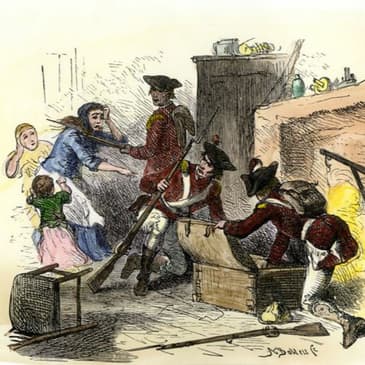
Now this is the FCB podcast Network. The greed us solved the army and they thought so well, Working America. Welcome back to the growing patriot podcast, American History for Kids. I'm your host Amelia Hamilton. This week, we are continuing our journey through the Bill of Rights by digging into the Third and Fourth Amendments, which are all about being safe in your house. The Third Amendment says no soldier shall, in time of peace be quartered in any house without the consent of the owner, nor in time of war, but in a manner to be prescribed by law. So that means that the government can't force you to let soldiers stay in your house. The Fourth Amendment is a little bit longer. It says, the right of the people to be secure in their persons, houses, papers, and effects against unreasonable searches and seizures shall not be violated, and no warrants shall issue but upon probable cause, supported by oath or affirmation, and particularly describing the place to be searched and the persons or things to be seized. We will talk about what all of that means, but first let's get some questions from Clara. I'm Clara, and I'm eight years old. I'm almost turning. I live in Milwaukee, stock My favorite animals are a panda's huskies instincts. I have some questions for you. Why were the founders worried about people coming into our homes? What did probably will cause me? Why were they worried about the government searching their staff? If people don't have anything to hide, why should they worry about being searched. This is a force a Fourth Amendment so important. Now, now we're going to hear from the man with the answers to those questions. Rob Johnson from the Institute for Justice. Name is Rob Johnson. I'm an attorney at the Institute for Justice. The Institute for Justice is a law firm. It's a nonprofit law firm, meaning that we're a law firm that exists to help people, not just to make money. And we do cases against the government. So you know, when people are having problems with the police or with other parts of the government, they come to us and we help them. Yeah, and I know we thought of you for a guest today because you have a whole section of the law firm devoted to the Fourth Amendment. Right, that is that is exactly right? Yes, so we do a few things, but a lot of what we do is you know, what we call property rights, so protecting people's right to be secure in their in their property like their homes or their other possessions, all their different things. And part of that is the Fourth Amendment. So we have a project on the Fourth Amendment where we help to uphold people's Fourth Amendment rights. It great and so as we were looking into this episode, you have a certain Fourth Amendment really go together in a lot of ways because it's all about being safe in your home. And so I just quickly before we dive deeper into the Fourth Amendment, wanted to talk a little bit about the third which is no quartering soldiers in your home, which doesn't seem like something that's very relevant to us today. But why was it so important at our founding? Of course, so at the time of the founding, obviously you had you know, the United States was a colony of a Great Britain, and the British would send over troops to try to keep the colony in line. And rather than finding, you know, building a place for the soldiers to live or having them camp out in the grass or what have you, they would actually force people to let the soldiers live in their in their homes, and that was obviously not great for people to have soldiers living in their house. And you know, we're gonna, I think we'll talk more about this idea of privacy and wanting to have your home beer kind of private space. But your home's not really very private if you have a soldier living in it, right, and they had to take care of them and feed them, which got expensive. It's it was a crazy situations. So our founders wanted to make sure that that peace was taken care of, keeping our homes secure. So that really brings us into Claire's first question, which is why were the founders worried about people coming into our homes? You talked about quartering soldiers but in them, you know, in relation to the Fourth Amendment? Why was that something they were worried about. Yeah, so it was a similar sort of situation in some ways where you had, again, you know, the America was this a colony of Great Britain, and Great Britain was trying to keep the colony in line and also trying to you know, they had all these taxes that nobody had voted on, and they were trying to collect tax revenue, but these weren't really legitimate taxes because nobody had voted to approve them, and so they were trying to enforce those kinds of rules and they were just the problem was they weren't getting what we call a warrant right. So you the way it's supposed to work is you go to a judge and you tell the judge, well, here's why I need to search for something, and you actually have to prove that you have a reason to do it. And they weren't doing that. They were just going into people's houses and they had what we called general warrants, and that was like they would basically search every house looking for something, and people it was invading on their privacy. And I think, you know, I think about this. You come home from school after a long day at school and you just want to be alone in your house with your family, and like, I know, my kids, like that's for them such a they come home and they're just exhausted from the day at school and they just want to like sit and veg out and watch TV. And that's really kind of like what privacy is. It's the ability just to be alone in your house. Yeah, so when you talked about going to a judge and needing a warrant, is that what is that? What probable cause does that come into their Yes? Absolutely. So this is the whole idea of the Fourth Amendment is you know, it's not saying that the police can't go into people's houses, because sometimes they do need to go into someone's house. You know, if there's somebody who's done something wrong, they've broken the law, and the police actually know, okay, we have reason to think that this person broke the law. Then if that's called probable cause, you know, probable cause to believe they broke the law. And when the police have probable cause, what they do is they go to a judge and they get the judge to issue a warrant and then they can use that they can take the warrant and that gives them permission to go into somebody's house. It's basically like a permission slip for the police to go into somebody's house and to look around. And yeah, so they need to convince the judge that they have a really good reason to think that there's something in there that they need to find. And then if the judge is convinced he gives them that warrant permission slip exactly. And if the police don't have that permission slip, then they need to stay out of somebody's house. And that's that's what gives you the sense of privacy in your home, that you don't have police just kind of randomly coming in whenever they feel like it. Yeah, So Claire had the interesting question that if you don't have anything to hide, why should you care if people come and look at your stuff. It's such a good question, and I think adults ask that question all the time too. Sometimes. Then the reality, though, there's a couple of things. One is, you know, I think the first thing is that even if you don't have something to hide, that there's this feeling of privacy that's so important and just wanting to be you know, your home is the place where you can be yourself. And maybe if you're a kid when you go to school, you're trying to you know, you're getting along with your friends, you're trying to do what your teacher want you to do, or if you're an adults the same way you're you're at work, you're sort of being who you have to be. At work and then you can come home, and home is where you can just be yourself, and that's you can't do that if you have someone kind of looking over your shoulder at home making sure that you're you know, seeing what you're doing and seeing that you're doing you know, what you're supposed to be doing, and you can't have that feeling of this is my private place. And then you know, the other reason is we all hope that the laws are going to be good laws, but sometimes the people who make the laws make bad laws. And you know, having that kind of privacy in your home it just means that you can you can be yourself there and that you can, you know, the police have there's a space that you can have that where the police can't stick their nose into it, and there is some value in that in a kind of a free sis like we have in this country. Yeah, you so much of the Constitution and the Bill of Rights, um, you know, are about the government kind of minding their own business, and if they're in your business, they're not minding their own Yeah, that's exactly right, you know, And like I said, sometimes you sort of hopefully in the perfect world, all the laws are good laws, and we all sort of agree with all the laws, but you know, there's there is kind of space in society for people just have that kind of space in their house to do what they want to do. And you know, there've been times in history where governments have tried to have laws, for instance, to control what people can talk about or what they can think and what opinions they can have about about different sort of topics. And you know, luckily we don't have a government that tries to do that too often. But you know, if you do have a government that's trying to do that, then your right to privacy in your house means you can, you know, you can have books that the government can't read what you have in your books. You can write things on paper and they can't read what you wrote down on paper, and that gives you the privacy to have, you know, ideas that maybe otherwise we couldn't have, to have conversations that maybe you couldn't otherwise have, And that's part of what I think the founders were concerned about, because again they were they were coming out of a world where they didn't necessarily have the ability to have open public conversations about important things that they that they wanted to talk about. Yeah, we've talked a lot about freedom of speech and freedom of the press, freedom of religion. UM, so they definitely understood, you know, you need to keep your private space private. So two hundred some years later, why is the Fourth Amendment still important? Well, you know, partly, there's things that there's things that don't change. And you know, two hundred years ago, people still lived in houses, they still had you know, the Fourth Amendment about your papers. They still had books and papers where they wrote down their important ideas, and they still had their you know, their bags and their um you know, your your your briefcase or your book bag or whatever. You know, So those things haven't changed. Those are still our private places where we keep the private um you know, private objects that are that are ours and that we don't want people poking around in. And none of that has changed, you know. And and I as a lawyer, I have cases where the police you know, search people's houses their apartments, um, you know, without a warrant, without probable cause. And that today as much as two hundred years ago, is something that impacts people. And then you know the other thing is there are things that have changed that actually make privacy matter even more. Right, So, today we have the Internet, we have the ability of the least too. You know, they have tools they can use to look in people's houses, like almost like x ray vision type of things, you know, infra red to look inside your house without even having to go in your house. And the Fourth Amendment applies to those sorts of things too, And in some ways, we need a Fourth Amendment even more today than we did before because the police have even more tools to invade your privacy than they did in the past. Yeah, so I think the founders would be pretty happy with how the Third Amendment is going. We haven't had any quartering of soldiers happening. Um, what do you think about the fourth They would they have done it differently? Would they be you know, shocked. I'm sure they would be shocked by the technology that's available, But they think the would they think the Fourth Amendment is doing its job still in part I think they would. I think that to a large extent, yes, right, Like our homes are still private, we still have We don't live in a society where we have police bargein into our houses all the time. But at the same time, I think there are ways that the Fourth Amendment is not being applied the way that it was intended to be. And especially that's true, um you know, people's business papers, things like that. You know, there's the government has the ability just to kind of look at you know, if you're an adult who has a business, you have very little privacy in your your business papers. I don't think it's right. And even you know, like so ij for instance, we have a clients who live in apartments, and you know, if you rent an apartment rather than owning a home, then the you have less ability to keep people out. Um, you know, for like they do these things they called them rental inspections. And I don't need to go into all of it, but you know, there's it's it can be very invasive. So kind of yes and a no. I think there's there's always there's always the tendency when we have these rights for them to kind of slip away and people find all this it's not convenient in this situation. It's not convenient in this situation to respect people's rights, and we'll just make this exception or that exception. And then suddenly you look up and it's like we have all these exceptions. Yeah, and where did the right go? Yeah? So, what are some things that all of us can be doing to help make sure that the Fourth Amendment doesn't slip away? Well, you know, I think that partly is just to recognize that it matters to all of us. And I think this goes back to the question of, you know, if someone has nothing to hide, why would they why would they care about the Fourth Amendment? And I think it's it's you know, when somebody else says, hey, the police are invading my privacy, I think that we all should try to have the response of you know, yeah, that's a problem. The police shouldn't be invading your privacy, rather than why do you care? And I think it's it's just always important to put yourselves in the shoes of other people in that way and to support people's right to privacy in that way. Definitely. All right, So as we wrap up, what is kind of one big thing that you want the kids to keep in mind? Oh? Boy? Um, you know, I think just I would just keep in mind that we we live in a free society, which means that you know, at the end of the day, you are you have space to make your own life and to make your own your own future, and to kind of choose who you want to be. And you know, when we talk about property rights, that's really what it's about. And you can't you can't be a person in the world without a place to be, a place to live, and without things that are yours. And that's really why property is so important, and that's why the Fourth Amendment is so important, that it gives you that space to be your own person. That is an excellent way to think about it. Rob Thank you so much for joining us today and telling us all about the Third and Fourth Amendments. Well, it's my pleasure, thank you. And there you have it, Third and Fourth Amendments, which are all about keeping us safe in our homes and keeping that space private and not somewhere where a king or the police or anyone else can just bargain and have a look around. It's a really important right that we have and we have to make sure we keep protecting it. That's all for today, and I can't wait to see you next time. Remember to stop by growing patriots dot com to have a look at the Growing Patriot books, and you can find us on Twitter, Instagram, and Facebook at Growing Patriots until next time. The Great US all Jerey standing and they fought, so we working America land over. This has been a presentation of the FCB podcast Network where real talk lifts. Visit us online at FCB podcasts dot com