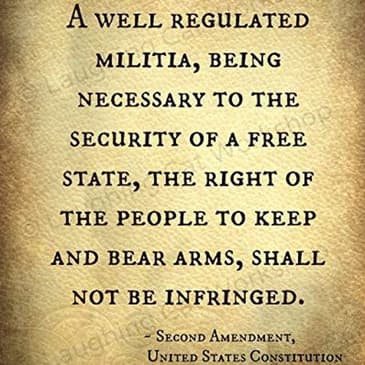
Now this is the FCB podcast Network. They're greed us all Germany and they thought so America. Welcome back to the Growing Patriot podcast American History for Kids. I'm your host, Amelia Hamilton. We just wrapped up the First Amendment, so now it's time to dive into the second and see what that's all about. The Second Amendment says a well regulated militia, being necessary to the security of a free state, the right of the people to keep and bear arms shall not be infringed. Now we're going to be joined by a Second Amendment expert to tell us just what that means. But first some questions. Hi, my name is Zach Benson. I live in Arizona. I enjoy the outdoors and engineering. The second one is the right to bear arms shall not be infringed. If that's the case, why are there limits on what firearms were allowed to own as citizens? And now some more questions. Hi, my name is a Staer. I live in South Carolina. I'm named after the singer Spooner. I play baseball, and I have some questions about the Second Amendment. I was wondering why our founders thought it was so so important in the Bill of rights. Is it still important today? Does it have any restrictions today? Did women have guns? The slaves have guns? Did it have any restriction back then? Why did they call it arms? My name is Stephen Gatowski. I'm the founder and editor of the Reload dot Com, which is a news publication that focuses on FIMS policy and politics. I'm also a Scene End contributor where I talked about the same topics on TV. And I'm also a certified farms instructor so and and an avid shooter and somebody who likes to do competitive shooting and build my own guns. And I'm very very much interested in in the recreational aspects of shooting. And I carry a gun as well. I have a concealed carry permit here in Virginia where I live, as well as in Pennsylvania where I'm from. So yes, I'm very very closely associated with firearms and and everything about them. So yeah, what it came time to do my second Amendment episode, I knew exactly who I wanted to talk to. So I'm so glad you're joining us today. Yeah. Absolutely, I really appreciate you reaching out and I think it'll be a lot of fun yeah, all right, So let's start with the beginning. Why did our founders think it was important to have a right to bear arms in the Bill of Rights? The founders, if you know, remember your US history here, had just gone through a revolution where they threw off their old government to the King of England because they felt he was pressing them and take stripping them of their God given rights, and they used arms to throw off that tyrannical government and form a new one. And so part of the vision for the new country was that it would have robust rights protections so that the government that they were creating could never become tyrannical in the way that the one they had just revolted against was. And so part of that was writing the Bill of Rights. When they went to create the constitution, you know, there's a few years into the new country. The old system they were using, the initial system, the Articles of Confederation, weren't working, and so they created a new system called the Constitution. And one of the concerns that some of the founders had with that new constitution is that it gave too much power to the government, to the federal government. And so one of the compromises that was made at that point was to write the Bill of Rights to give these guarantees of individual rights to the people so that the government couldn't do certain things. And they wanted this to be written down and enshrined in as part of the Constitution as the first ten amendments to the Constitution. And so that's where the Second Amendment comes in as something that they've viewed as necessary to a free state. Right. They talked about in the Second Amendment to a well regulated militia being necessary to the security of a free state, that the rights of the people to keep him about bare arms should not be infringed. So they they viewed, of course, the right of individuals of the people to continue to have arms as a core function of protecting the freedom of people in the country in the same way that it had done that during the revolutionary period. Yeah, you talked a little bit about the language in it, and I would love to know a little bit more about what we talked about a well regulated militia and the term infringed. So what is well regulated mean? What's militia mean in this context? Yeah, that's a great question, right, Well, what is the militia of what is well regulated mean, how does this connect with the right of the people to keep him bear arms? Right, there's sort of this. The Second Amendment is a little bit unique in this way that they have what the Supreme Court has called a prefatory clause. Might be that's a big word, but essentially it means that it's a justification for why this right would be enshrined in the Constitution. It's not a condition of that right. So you don't have to join an official militia in order to be a part of the people who have a right to keep him bear arms and well regulated at the time meant and still does in some circumstances today, basically well trained. So the militia who was during the Revolutionary War was a key aspect of winning that war. But one of the key parts of the strategy for using the militia was that they should be well equipped with the arms that they needed, and they should be well well trained in order to be an effective fighting force that would supplement, you know, a standing army, and so that was something that they put in there. You know, the founders were also very weary of a just the government having an army around all the time in that period. They had concerns over how the government would would use an army that's just around. It's obviously the culturally is different than it is today, but that was one of the concerns, and so they didn't They wanted also to have this militia of people who were active there. You know, who's the militia. Well, at the time, um, you had George Mason, who's a pounding father from Virginia explain, um, in a debate about the militia and the Virginia Constitution that the militias is basically everyone, um, you know, the people, any able bodied man at the time. And and so the more important thing though is to look at who the right is reserved too. You know, they say, the right isn't the right of the militia, it's the right of the people. And you know, the people has mentioned several times throughout the Bill of Rights, you know, whether it's the Fourth Amendment or or the First Amendment, you know, and and every time it's been interpreted to mean individuals, you know, people that generally everyone in the United States. And and so that's how the Suprint Court has also interpreted it for the Second Amendment. Okay, what about in fringe, What shall not be infringed? I mean, yeah, that's a great question, right, because that's where you get into, well, what's acceptable as far as gun regulations go. Then if we have the Second Amendment, it says the right to keep them bear arms shall not be infringed. What's an infringement. Well, that's kind of the big question when you're looking at court cases or different laws that exist and have existed even back to the Founding period. The Supreme Court has said that, you know, there are some regulations that are constitutional under the Second Amender. There are some gun regulations as long as they have a long standing tradition. There's this long history that dates back to the Founding air. The same people who wrote the Second Amendment, if they also had gun regulations that were common during that time, then presumably they were okay under the Second Amendment. If the same people who wrote the Second Amendment also had restrictions on you know, a criminal could have firearms, then you know that's okay under the Secondment. So the infringement is the key thing, like what constitutes an infringement, And that's not something that's totally settled, right, This is something that's an ongoing fight, and not just around the Second Amendment. Right, this is something that we've been arguing about for centuries, under the First Amendment, the Fourth Amendment, the Fifth Amendment, basically all of them. There's we have these rights, and exactly what that means in practice is something that we have a whole court system to figure out. Right, Yeah, absolutely, And that kind of goes along with a question that I've been asking when I had guests on about freedom of the press and things like that, which is technology has changed a lot. You know, our founders when they said freedom of the press, they didn't know that we'd be able to send a tweet that everyone would see, or post something on TikTok that everyone could watch, or like a podcast, right, exactly, a podcast. So do you think that our founders, you know, if they knew the weapons that we'd have today, would they still say shall not be infringed? Yeah? Sure, I mean I think that the same principle applies there with modern weaponry, modern firearms compared to you know, modern press technologies. You know, the founders would probably be far more surprised by something like the Internet than they would buy something like a modern semi automatic handgun. Really. I mean, it's obviously there's been a lot of advancement in technology in both areas, but your modern rifle doesn't isn't that different from the muskets that they used at the time. It certainly has significantly advanced, but it's not something where you know, the very basic technology remains similar. It's it's far far improved, of course. But yeah, but yeah, this is something that the Supreme Court has also weighed in and actually unanimously they ruled in a case called Satano back in twenty sixteen that you know, the Second Amendment protects modern arms as well. There's no, it's not just arms that were in common use during the founding US. It's also modern firearms. Is the principle remains the same, and it still applies to new technology today. Sure, because a lot of those founders, you know, the weapons that they had were the peak of technology then and they were okay with everyone. I mean they had cannons and warships too. Yeah, some of the stuff they had is far more potentially devastating and are powerful. Exactly. Yeah, we did average civilians today. We did an episode when we started talking about the revolution with Ashley Hill Lebinsky, who is I'm sure you know her a firearms historian. Yes, and we talked a lot about about what was available at the time, and it was some pretty some pretty impressive stuff. Yeah, I mean always so it's advanced. You know, not to discount the last two hundred years of firearms technology, but I'm just saying the Internet is far more stark change from the peduncle of the day than moving from you know, a puckle gun to an I R fifteen. So, you know, it's it's not that technology hasn't changed, It certainly has. It's just that the principles haven't changed, you know, they've remained the same. That was kind of the point of a written constitution, right, is that you write these things down so that the principle can remain in effect for generations to come. And of course this the founders also gave us a way to change the constitution, you know, to keep up with changes in technology or changes in culture, changes in time. You know, we have a method to amend the constitution. Right that that that was their solution. You know, they knew things weren't going to always be the same um and that modern problems might require different approach. And so therefore they gave us a way to change concerts. Then we've done that for the better many times. Right, Like you know you asked about, um, you know, who's the militia right well, at the time and the fact during the founding Obviously the country is made up of people, and people are flawed and and there were some very significant falls that were in place during our founding air. Right, the slavery women didn't have rights, so the militia wouldn't have included African Americans or or women and them, and that's something that we've changed in the constitution over time to ensure that the rights of minorities and women are protected the same way the rights of white men are. Yeah, so um, you know, along with with that, you know, Lysander asked if slaves and women could have guns at the time, and as you said, they couldn't. But that's definitely something that's that's changed, and you helped with equality. Yeah, their rights were severely restricted or completely destroyed at the at the founding period and for up until the Civil War, right, and for women up until uh, you know, the nineteenth Amendment. The suffer, the suffragets, the women who fought for the right to vote and to you know, to be um invested with those same rights that everyone else has. And so at the founding era, we didn't have those protections and it was a great wrong right in American history and something that Americans had to fight to change, both you know, minorities themselves and others who were allied with them, and it I mean, and it took a Civil War unfortunately, to to get rid of slavery and to change the Constitution to um outlaw that practice and to give people their full rights. That's what the fourteenth Amendment was about, right, And so yeah, at the time, minorities and women didn't have the same rights as everyone else, and that's a black mark right on our history. But again it's something that we changed and today they do absolutely. So speaking of restrictions, I want to get into a little bit about what some of the restrictions are today. I know you mentioned having a concealed carry permit, and some states you have to get a special permit if you want to carry a gun. In some states say what's called constitutional carry, where the Constitution says you can, so you can. So what are some of the restrictions that have been placed sure. I mean, there's quite a lot of restrictions on fire ownership in the United States, not not as much as in many other countries, but certainly you have restrictions on who can own guns. We have federal laws and state laws that govern that. So somebody who's, for instance, been convicted of a felony, if they've served more than one year in jail, they can't own guns for the rest of their lives. Somebody who's been involuntarily committed as a you know, a threat to themselves or others, a judge has ordered that they be put into a mental institution, that person can't own guns for the rest of their lives. You know that somebody who's been convicted of misdemeanor domestic violence, so it's a lower level crime than a famony, but because it's domestic bonus related, Yeah, we've the federal government prohibits people from owning guns over those sorts of crimes that they've been convicted of. You know. Of course, there's a lot of regulations on how you can sell firearms. If you sell guns as a business, you have to get a federal license to do that, and you have to conduct, for instance, background checks on people who buy guns from you. So if you go into a gun store, that person is going to have a license from the federal government to operate. They're going to do a background check on you that goes through the FBI's background checks database to see if you have any of the records of those sorts of things that I just mentioned that would make you prohibited from possessing guns. And then you know there's record keeping requirements and things along those nature. Yet carrying a gun is another another area where there's significantly more restrictions. For instance, many states, although most states, as you mentioned, don't require a permit anymore to carry firearms so long as you can legally have the firearm. So you know, somebody who is a convicted felon, for instance, they can't legally carry a gun because they can't legally even possess a gun. Yeah, and so, but even places that have permit lists carry have required they have different areas where you can't take a gun courthouses or schools or you know, voting owning places, things of that nature. Some some states have a lot more of them. Right, I think people generally call these gun free zones. Right, you can't take you can't carry a gun on private property where it's posted that guns aren't allowed. Um, that's usually illegal. And you know, so there there's age restrictions. For instance, there's a federal law that restricts handgun sales to anyone under twenty one, So even if you're an adult and you're over eighteen, you can't buy a handgun from a licensed dealer. Although that a lot of these are being challenged in courts. There's still a lot of debate over these restrictions, but they exist. There's there's restrictions on how guns can come into the country for sale or whether they can be exported for sale. You know, there's a lot some states have bands on the sale of certain kinds of guns, like a R fifteen there's or so called assault weapons. And some states have bands on magazines that hold more than ten or fifteen rounds. You know, there's there's a lot of variety out there in terms of you know, and so you have the federal laws and then of course you have the state laws, and those can be much more, much more restrictive, but also just wildly different depending on the state you're in. Yeah, so, so has it ever in American history? It seems like it's probably never been harder to buy a gun with all the all the laws. Yeah, I mean that's kind of true, right, I mean, um, you know, not that it's if you have no criminal background or not nothing in your record that would keep you from buying a gun. And in most states it's not that difficult to do. You know, you go to a store and you you the system. The background check system is designed so that it's supposed to be instant. That's in the name, right, the National Instant Criminal Background Check System is what it's called, or KNICKS. But you know, so you can you can buy a gun relatively quickly in most states, so long as you pass that background check. But yeah, you're you're right. Um, for instance, you can't buy a gun and have it shipped to your house like you would if you bought something off Amazon, right, there's no Amazon Prime for guns. You have to if you buy a gun online, you have to have it shipped to a local gun dealer and then go pick it up from them and do the background check there. Um, you know, private sales or are generally not allowed across state lines for for handguns at the very least, And you know, so unlike if you wanted to sell your TV to somebody in your neighboring state, you could do that. You can't do that with a handgun. Um and not. You know, these are and I'm just listening the regulations. Whether people like them or dislike them is another question. But yeah, um, yeah, you know you used to be able to there's restrictions on fully automatic guns machine guns. Right, you can't buy new machine guns anymore. You used to be able to. You used to be able to buy machine guns through the mail and have it delivered to your door with no background check. That's yeah. You know you go back not even necessarily that far, like the the nineteen thirties, and you could do that, um, but you can't do that today. And and you know not to say that. That's These are all super controversial regulations. A lot of them have broad support, but that but you're right, your great grandparents generation would have had far fewer restrictions on how they can buy guns and what kind of guns they can buy than the current generation does. So what are what are some other things that people might might misunderstand about the Second Amendment that we can clear up? Yeah? I mean I think there's uh, there's there's a lot of confusion over um that militia clause, right, there's a lot of debate and confusion over it. There's a lot of you know, this has really been settled law in the federal courts by the Supreme Courts since two thousand and eight, that the Second Amendment applies to individuals, not to you know, and it's not some sort of collective right that means nothing for individuals. It doesn't apply to people who are in the National Guard or something that you hear that occasionally that sort of the national Guard is like the militia, which is not really true comparison anyway. But but you know, you hear these sorts of things still today all the time, the stuff about that it just protects muskets or whatever. You know, these things are well outside of what is actually being argued in court anymore, because the Supreme Court has already ruled on this, and certainly, you know, the Supreme Court can change its mind over time, but it's unlikely any of that is going to change anytime. But you still hear a lot of that debate in you know, in the media or or just generally online where you get a lot of people talking about how the Second Amendment basically just doesn't mean anything like that's. Yeah, this collective right argument is kind of like, well, it's a collective right and the government can restrict it in any way that it wants. So I always kind of wonder like, well, what do you think the point of that amendment being in there? Right? It just means nothing, but anyway, so you still get a lot of that debate, even though you know it's pretty well settled in the courts at this point. Okay, so final question, why is the Second Amendment still important today? You know, two hundred and fifty is years later. Yeah, I mean, I think it's still matters for the same reasons that it mattered at the founding, Like it's a bulwork, and armed people is a bulwork against tyranny, you know. And now that's pretty remote concept for us today, right, We're not necessarily worried about being invaded or about the government trying to send us all to camps or something like that. It's it's not a it's not a top of mind thing, which is good, right, That's that's a positive thing. Although you can you do see it elsewhere in the world. Right Ukraine being invaded by Russian that they rushed to armed civilians in that scenario. So you can still see it in modern um context around the world. But yeah, for for us today, I mean, you know, not only is the Second Amendment there for the purpose of the protection of a free state, but but it also is there to help people exercise their right to self defense. This is the other aspect of the Second Amendment. That's that's key as well. There's there's hunting too, right, You firms have all kinds of uses, and you get hunting gets talked about a lot um around the Second Amendment or whatever, and you don't need certain kinds of guns for hunting. But the second modments poor. While it does certainly protect you using your firearms to hunt, it is more about self preservation and national preservation than it ever was about the right to hunt. And so you know, self defense is only as your right to self defense is only as useful as the tools you have to carry it out. So if you restrict the people the right to bear arms, you're restricting the right to self defense. And you know, you're limiting what people can use to to defend themselves against potentially a bigger, stronger person that is trying to harm them or multiple people, and so it remains an important thing, a thing for all of them those reasons, right, it's not just one or the other. Even recreation, right, you know, there's recreational shooting is probably the most common way that people use their farms. Right, even even though self defense is the main reason that a lot of people buy a gun, and the philosophical sort of view of the Second Amendment protecting our liberties is important to a lot of people. And even hunting is a common pastime or even way to get you know, a practical way to get food. But most people use their guns for recreation most of the time. That's that's where the best majority of time is spent, the best majority of rounds are discharged in recreational shooting, competitive shooting, going to the range, plinking, you know, shooting, and your your your local range, your backyard range if you have one, if you have the ability to do that safely. But there's, um, there's a whole use of firearms. And it's not just one or one thing here, one thing there that makes them relevant today. It's it's all of this stuff at once, absolutely all, right, well, Stephen, thank you so much for joining us today. This was a great overview of the Second Amendment and why it's still important. Absolutely thanks for having me there. You have it all about the Second Amendment, what it means to bear arms, what it means to be a well regulated militia, and what it means to infringe those rights. So what do you think? You can find us on Facebook, Instagram, and Twitter at Growing Patriots and find more about us and the Growing Patriot books at growing patriots dot com. Talk to you next time. That great US solved for Jarany and they thought so we would be America land Over. This has been a presentation of the FCB podcast Network, where real talk lifts. Visit us online at FCB Podcasts dot com.