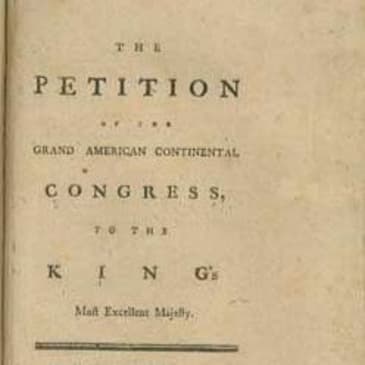
Now this is the FCB Podcast Network. They're greed us soldiery and they thought so when working America. Welcome back to the Growing Patriot podcast American History for Kids. I'm your host, Amelia Hamilton. The First Amendment says Congress shall make no law respecting an establishment of religion, or prohibiting the free exercise thereof, or abridging the freedom of speech or of the press, or the right of the people peaceably to assemble and to petition the Government for a redress of grievances. Well, we've talked about religion, and we've talked about freedom of the speech and a press, and you'll probably notice that they all go together, like peace of a puzzle. And since you can pretty much already tell what that picture is, we're going to do those last two today. The rights of the people peaceably to assemble and to petition the Government for a redress of grievances. We're going to start with the right of peaceable assembly. Speaking alone or writing about something can be a really effective way to share a message, but sometimes it's more effective to get a whole group of people together. They can share their ideas, talk about problems and how to fix them. And even tell the government what they think. So the right to assemble, as long as you're being peaceful is really really important. At the same time, tyrannical governments like we had with the King, they didn't really want people to be able to get together. They didn't want those ideas of liberty spreading, and that is why our founding fathers knew they had to protect that right. They had to make sure that the government wouldn't stop people from getting together and sharing their ideas. And the right to petition, of course, which is another word for the redress of grievances, means that we can tell the government what we think. We can tell them that we have problems and they need to solve them. In fact, you write, might remember that the colonial governments wrote to the king before we even declared independence, saying you need to fix these problems, and it was being ignored that made us go to war. In the Declaration of Independence they wrote, we have petitioned for redress in the most humble terms. Our repeated petitions have met with repeated injury. A prince whose character is thus marked by every act which may define a tyrant, is unfit to be the ruler of a free people. So that means we have tried to ask you nicely for help so many times, and you've ignored us every time, and that means that you are a tyrant, and a tyrant is not allowed to be our king, so we will declare independence. The king should have already been familiar with the right to petition. Anyway, These rights go back so far. They go all the way back to a document called the Magna Carta, which came out in the year twelve fifteen, and it's one of the first documents that really lays out the freedoms that all people have. So the right of petition was chapter sixty one in that Magna Carta, and it said that people could come to the king with their problems. Since it was a really old English law, the king should have been more aware of it, but he messed up and he lost the American colonies. But we gained all of these freedoms in the Bill of Rights. In order to change things, we need to be able to get together. That way, we can advocate for causes, for beliefs, for the things that matter to us. We can tell the government and the people in it what we think about what they're doing. And what they need to be doing. And if they don't want to listen to our grievances, we can vote for somebody else. That is an awful lot of power. So when you take the whole First Amendment together, we are allowed to express ourselves, to get together, and to make changes in ways that aren't allowed in a lot of other countries in the world. We take a lot of these things for granted, but it's important to remember that our founding fathers knew that these things could be threatened. They had lived through it, so they put it all down in the very first Amendment to the Bill of Rights to make sure that everyone knew, that the people knew and the government knew that these rights could not be infringed. Thanks for listening to this quick episode wrapping up the First Amendment. Remember you can find the books and every episode at Growing Patriots dot com or we're at Growing Patriots on Facebook, Twitter, and Instagram. Thanks and we'll see you next time. They're pretty us solved, and they thought so would be America. This has been a presentation of the FCB podcast Network, where real talk lifts. Visit us online at FCB Podcasts dot com.