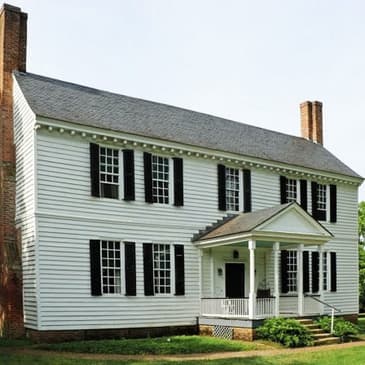
Welcome back to the Growing Patriot podcast American History for Kids. In the last episode, we left off with the death of John Adams on July fourth, eighteen twenty six. His last words were, Thomas Jefferson survives. In this episode, we're going to kick off our conversation about that man, Thomas Jefferson and his life. Remember we're going in order from the oldest to the youngest when we talk about the founding fathers and Thomas Jefferson was born on April thirteenth, seventeen forty three, making him about seven and a half years younger than John Adams. He was born at his family's plantation, Shadwell, near Charlottesville, Virginia. His father, Peter Jefferson, was a successful planter and surveyor who did not have much formal education, but read a lot to educate himself and it made him highly value education for his own children. His mother was Jane Randolph. The Randolph family was one of the most prominent in Virginia, and Shadwell Plantation was named after the Shadwell parish where she was born in London. Thomas Jefferson was one of ten children, Although with a brother like Thomas Jefferson. It's pretty hard to compare now two siblings died as babies, but here's what we know about the seven who survived. First was Jane born in seventeen forty so she was the oldest and died at only twenty two years old, unmarried. But Jefferson was really impacted by her death and wrote a Latin epitaph for her, which is like a short commemoration, and the English version was Oh Jane, best of girls, snatched away in the flower of your verdant youth. May the earth lie lightly upon you. Farewell, a long, long farewell. Next was Mary born in seventeen forty one. She went on to marry John Bowling, a descendant of Pocahontas and John Ralph. They lived at Chestnut Grove, Bowling's family plantation in Chesterfield County, and they also had ten children. Then came Thomas Jefferson, and over this episode and the next few you'll hear all about him. The third child was another girl, Elizabeth, born in seventeen forty four. We don't know much about Thomas's little sister, Elizabeth, who he called Bet, but we think she had some kind of developmental disability and She died in seventeen seventy four, maybe of drowning. Two years after Elizabeth was born. There was another little girl, in seventeen forty six, Martha. When she was nineteen, Martha married Thomas Jefferson's close friend, Dabney Carr. Dabney was a lawyer, a militia man, and a Virginia assemblyman, and they had six children together before Dabney's death at a young age. And at that point, Thomas Jefferson became something of a father figure to his nieces and nephews, and Martha became an important presence in his home when he was abroad, but we will get to that in a later episode too. Then, in seventeen fifty two came Lucy. She was nine years younger than Thomas, and at age sixteen, she married her cousin, Charles Lilburn Lewis, who was related to Meriwether Lewis of a Lewis and Clas expedition. They went on to have six children as well, but Thomas doesn't appear to have been very close to Lucy after her marriage. It seems like maybe Thomas Jefferson and the Lewis family didn't get along very Well. Then finally, in seventeen fifty five were the last two yes, twins, Anne Scott Jefferson and finally one more boy, Randolph Jefferson. They were only two when their father died, so Anne stayed with her mother at Shadwell. She lived with various relatives as a young adult, and then surprised a lot of her family by announcing that she married a young man named Hastings Marks in seventeen eighty seven. Her big brother Thomas wrote to her, congratulating her and saying, in every situation, I shall wish to render him and you every service in my power, as you may be assured, I shall ever feel myself warmly interested in your happiness and preserve for you that sincere love I have always borne you. So he's saying, I'll always be here for you and your husband. I'll do anything I can to help you, because I've always loved you, and I always will. And then he wrote to her husband Hastings, and he said, a thorough knowledge of her merit and good dispositions encourage me to hope you will both find your happiness in this union. And this hope is strengthened by my knowledge of yourself, So he says, I know that my sister is wonderful and she's so sweet, So I feel pretty good that you guys are going to have a happy marriage, and that hope is even stronger because I've heard great things about you. Hastings Marks owned property in Charlottesville and was just kind of middle class in seventeen eighty seven when they got married, but by seventeen eighty nine he was in debt and had to sell off his land. Thomas Jefferson came through on that promise to help and gave her unlimited credit. She could spend whatever she wanted to get whatever she needed. And then when Hastings died in eighteen eleven, Anne came to live with the Jefferson family at his home Monticello, which again we will get to in a later episode. Now, what about Anne's twin, Randolph. He was the only surviving brother of Thomas Jefferson, so he inherited about two thousand acres upon their father's death. He was educated at an uncle's plantation and then sent to Williamsburg, Virginia for further learning when he was sixteen, but that only lasted for a couple of years. He served in the Virginia Light Dragoons during the Revolutionary War and was a signer of the Oath of Allegiance to the Commonwealth of Virginia in seventeen seventy seven. In seventeen eighty one, he married his cousin Anna Jefferson Lewis, and they had six children. That is a lot of Jefferson's and they had a lot of children. But let's get back to Thomas. Like I said earlier, Thomas Jefferson was born in seventeen forty three and then at only five years old he began school, and that was just the basics at first, but then a few years later his studies got even bigger to include things like nature, which he loved, and then he studied Latin, Greek, and French. He read his father's books, he began riding horses, and then in seventeen fifty seven, when he was fourteen, his father died. So this large estate was divided between the two Jefferson sons, Thomas and Randolph, and Thomas's portion included the Shadwell House and plantation. And at that time a man named John Harvey became his guardian and continued his education from seventeen fifty eight to seventeen sixty he was taught by the Reverend James Moray near Gordonsville, Virginia, and he studied history, science, and the classics while staying with Mary's family, and here of something big happened. He traveled to Williamsburg, and the young Jefferson met and came to admire a man named Patrick Henry, which will be important for both of them later And speaking of Williamsburg. In seventeen sixty one, at just seventeen years old, he entered the College of William and Mary there in Williamsburg, where he studied mathematics and philosophy with a man named William Small. It was here that he encountered the idea of British empiricists, including John Locke, Francis Bacon, and Isaac Newton. To overstate what a big deal Williamsburg would be for Thomas Jefferson's life. We already talked about meeting Patrick Henry, but he would also meet two other people that would change his life. His teacher, William Small, introduced Thomas Jefferson to some of the most important people in Williamsburg. One was a local lawyer named George with who would go on to be Thomas Jefferson's mentor and a founding father, and the other is Francis Fauquier, the lieutenant governor of Virginia. They both saw how exceptional Thomas was, and he became really close with both of them. Jefferson later wrote that while spending time with them, he heard more common, good sense, more rational, and philosophic conversations than in all the rest of my life, basically saying that these were more good, smart conversations than he ever had again, and many of those conversations were held over dinner at the governor's palace. It's crazy to think about considering that he would go on to write the Declaration of Independence from those very governors and their king. Now, that didn't mean that he wasn't also a silly college student, Especially in his first year. He spent a lot of time at parties and dances, and he spent way too much money. But in his second year he kind of regretted all those decisions and he tried to spend fifteen hours a day studying. But those connections that he made at William and Mary were important for the rest of his life. Not just George With and Francis Foqueer, but he also joined something called the Flat Hat Club that is the oldest secret society in America, and members also included Saint George Tucker, who went on to be a prominent judge in Virginia, Edmund Randolph, his second cousin and a founding father, who went on to be the governor of Virginia, and James Innes, who fought in the Revolution and went on to be Attorney General of Virginia. So by the time he graduated in April of seventeen sixty two, his formal studies were complete. He had made a lot of important friends, but there was still education to be had. After graduating from William and Mary, Thomas Jefferson decided to go into the law, so he became a law clerk for that good friend, George With. You might remember from our conversation about John Adams that that's how you became a lawyer in those days. But With was more than just a teacher to Thomas Jefferson. He was a friend and a mentor and in a lot of ways, a father figure. In the five years that Thomas Jefferson spent with him, With shaped his views on rights, virtues, and how the law should work and if it tells you anything about what George with believed. He also went on to sign the Declaration of Independence. So we're going to leave you there for today with Thomas Jefferson in seventeen sixty seven, and next time we'll find out what happened next. Remember, you can find pictures, videos, links, and other resources related to this episode and every episode at Growingpatriots dot com. We'll see you next time.