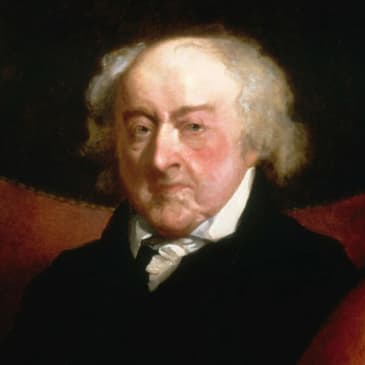
This is the FCB podcast network. They bringing us solved from tyranny, and they thought so when we were in America, And. Do you remember where we left off in the story of John Adams. It was just after the election of eighteen hundred, one of the meanest elections in American history, and John Adams had lost to Thomas Jefferson. That led to a big moment when John Adams, a Federalist, simply stepped aside and handed over the presidency to the next person who had been elected, Thomas Jefferson, a Democratic Republican. That seems pretty normal to us today, but it was something people at the time had really never seen before. In a time when nearly every country had a king, a person leading the country really only changed if there was a war and one person booted the other person out, or if a king died, it went to the next person in line, probably their son. So the idea that people could just choose a new leader and one who had a different point of view, like Thomas Jefferson did from John Adams, and the old leader would just step down and hand all of their power over was incredible. The idea of America seemed to be working, but In today's episode, we're going to hear what happened after John Adams stepped aside and went into retirement. John Adams's presidency ended on March fourth, eighteen o one, when he was sixty five years old, and that was pretty old at the time. He and his wife, Abigail retired to their family farm, Peacefield, back in Quincy, Massachusetts. Abigail in particular was really happy to be retired from public life. Now she was the wife of a gentleman farmer. Family was still a big part of their life. John and Abigail's son, Charles, had died in eighteen hundred at the age of thirty, but his widow, Sally, and their two young daughters moved in with them, so John and Abigail had their daughter in law and granddaughters in the home. Their son, John Quincy, was a grown married man at this point too early in John's retirement, he would come and visit and stay for weeks at a time. Later he would work abroad, kind of like his dad had done, and John Quincy's son came and stayed with John and Abigail. Thomas Adams, another son lived nearby and visited often too, so the house was full of family, and while John and Abigail were no longer separated for work like they were in the early years of their marriage, they had no need to write to each other all the time anymore. But John still wrote a lot of letters and a few other things. Let's talk about that writing. Most of what he did was defend his presidency. Things had not gone perfectly and he wanted to tell his side of the story. So some of the people he wrote to the most were Benjamin Rush, Mercy Otis Warren, William Cunningham, the Boston Patriot newspaper, and his son, John Quincy Adams. First is Benjamin Rush. He was a physician in Pennsylvania and fellow signer of the Declaration of Independence. In Adams's retirement, he was one of the people that he wrote to the most. They talked about everything, their beliefs growing older, their days. They were just faithful correspondents. Next was Mercy Otis Warren, a longtime friend and a prominent historian, and that's where the problem is. In eighteen oh five she published a history of the American Revolution, and it was kind of critical of John Adams's political views, and it accused him of leaning a little bit toward the monarchy. Adams was really offended, and he wrote her a bunch of angry letters in eighteen oh seven, defending his presidency, trying to repair his reputation, but ruining their friendship in the meantime, although they did make up later. Third was William Cunningham, and he was a relative on John adams mother's side. Between eighteen o three and eighteen twelve twelve, John Adams wrote really personal things to this family member, and really private things that he had to say against Thomas Jefferson and Alexander Hamilton, his political rivals. Those letters were later made public, which was a big problem. But he also wrote some letters that were intended to be public. He sent those to the Boston Patriot. Frustrated by how history was characterizing his presidency, he essentially wrote letters to the public by publishing massive weekly essays in the newspaper from eighteen oh nine until eighteen twelve. Those letters defended his foreign policy, particularly his decision that avoided a full scale war with France but did have other consequences. And last, but not least, his son, John Quincy Adams. Like his father before him, John Quincy was abroad for many years, representing America around Europe and Russia. So instead of writing to his wife all the time, John was writing to his son. But he didn't only write letters. From eighteen oh two until about eighteen oh seven, he also started writing his autobiography, The Story of his Own Life, but he never finished it, partly because it was just kind of hard work to copy all of these old political records by hand, and he thought that maybe he could do a better job of repairing his reputation and securing a good place in American history by his letters to the Boston Patriot or through mercy Otis Warren. However, that autobiography was finally published in nineteen sixty one as part of the Adams Papers by the Massachusetts Historical Society, so you can find it now. The first person I mentioned here was Benjamin Brush, and he had another big impact on John Adams's later life, repairing a broken friendship that all also led to a lot of letters. Benjamin Rush really thought that John Adams and Thomas Jefferson needed to put their differences aside and become friends again, but it took years. In eighteen oh nine, he told each of them that he had a dream, they became friends, and they even died on the same day. At first, they were really not interested in hearing it. They were not interested in being friends again. But then Thomas Jefferson heard in eighteen eleven that John Adams still spoke pretty fondly of him and said nice things, so he asked doctor Rush to see if maybe John would be willing to write to him. He did that, and John sent Thomas a note wishing him a happy New Year. For eighteen twelve, they started writing each other again regularly, and that lasted for fourteen years until they're deaths, and they exchanged hundreds of letters in that time. As they grew older, it became really important to them to have this friendship. After all, they had been through a lot together and not many people could relate, even fewer people as they got older. For example, Abigail Adams died in eighteen eighteen of typhoid fever and didn't even live to see their son, John Quincy Adams, elected the sixth President of the United States in eighteen twenty four. John himself passed away on the fourth of July eighteen twenty sixth, America's fiftieth anniversary and his last words were Thomas Jefferson survives and it's Thomas Jefferson that we'll be talking about starting in the next episode. Can't wait to see you. Then, remember you'll find links, videos, and all of other resources related to this episode and every episode. At Growingpatriots dot com. They create a Solve the Tyranny everything and they thought so well working America and