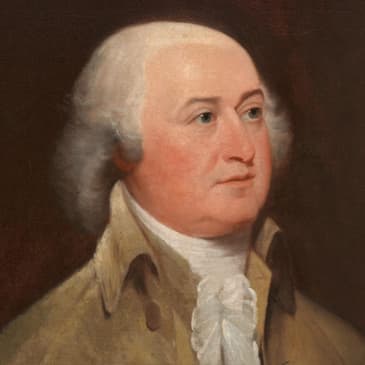
This is the FCB podcast network. They bringing us out into Army staying and they thought so when we were doing America and. Welcome back to the Growing Patriot podcast American History for Kids. When we finished the last episode, it was the summer of seventeen eighty eight and John Adams was just getting back from Britain. He'd been representing America abroad for nearly ten years and it was time to come home and America had a big job for him here. That's what we'll be talking about in this episode. John Adams didn't have much time just to lay low and relax. He settled in at his country home, Peacefield, in Braintree, Massachusetts. The Constitution had been ratified on June twenty first, seventeen eighty eight, just days after he returned home. As the year went on, it was time to select the very first president, something we talked about in the George Washington presidential episode. Since it was obvious George Washington would win, John Adams was a great choice for vice president. We talked a lot about Virginians like George Washington and Thomas Jefferson being chosen for important jobs because they were Virginians, and a lot of colonial problems were in Massachusetts. Well, now the opposite was true. If a Virginian was going to be the first president, somebody from Massachusetts maybe should be the vice president to balance things out. Of course, trying to win the office of vice president was kind of tricky. You might remember that the way elections worked at this time was different from how it works now. Now, a president and a vice president run together as a team, so people vote for them together. But back then everyone ran separately. The person who got the most votes became president and the person who became in second became vice president. But coming in second it's hard to do. John Adams had to get enough votes so he didn't come in third, but he couldn't get so many votes that the election ended up as a tie with George Washington, or even worse, have him win. And because he was the obvious choice for vice president, a lot of people were going to vote for him, so there was a lot of worry that he he might accidentally win the presidency. While Alexander Hamilton asked a few people to switch their votes to somebody else to avoid that big problem happening. When the votes were counted, he got the vice presidential spot pretty easily, but his feelings were actually hurt because the number came in pretty low from what he was expecting. He was kind of humiliated. And then when he found out what Alexander Hamilton had done, he called it dark and dirty. But he still got a lot more votes than his next competitor, John Jay. It was just a lot less votes than George Washington. As a reminder, George Washington from Virginia got sixty nine votes and then John Adams from Massachusetts only got thirty four. But don't worry, John Jay from New York, who came in third place, only got nine votes, so he still got a ton, but nowhere near as many as George Washington. And he became the first ever vice president of the United States of America. So just like George Washington got to decide what the office of the president would look like, John Adams got to figure out what a vice president would be. Because he was the first one, he helped to shape the responsibilities of that office. He was also the tie breaking vote in the Senate, and Vice President Adams was instrumental in passing several key pieces of legislation. The thing is, he wanted to be a lot more involved than he was allowed to be, and that was hard for him. Just think about what a big voice and how involved he was in things like the Continental Congress, and that wasn't really his job anymore. So it was good news for him. I guess that during President Washington's two terms, the Senate was evenly split. The same number of people favored the new constitutional government that party was called the Federalists and the number of people that opposed it. Those were anti Federalists and Jefferson's Republicans. So there were a lot of tie votes, and like I said, he was the tie breaker. So Vice President Adams got to cast thirty one tie breaking votes in the Senate, more than any other VP in our nation's history. And if you're wondering Adams was a Federalist during that first term, Washington didn't really rely on Adams all that much, and we don't really know why for sure. Still, John Adams was the only high ranking official to serve President Washington for two full terms, so I think it's fair to guess that George Washington did trust him. But after Alexander Hamilton, Henry Knox, and Edmund Randolph, all men who served in the Continental Army under General Washington retired from Washington's cabinet, the president came to rely more on Vice President Adams. So maybe Washington relied on those other men more just because they had served under him. Maybe he was used to counting on them. But that second term came around in seventeen ninety two and he was voted vice president again. This time George Washington got one hundred and thirty two votes. Again that was unanimous, and he was elected president. John Adams got seventy seven votes and the third place went to George Clinton, who got fifty votes. But then after two terms as president, George Washington, as we've talked about before, was done with public life and wanted to retire. So the election of seventeen ninety six was kind of the first real election in America. It was the first time everyone didn't just assume that a certain person was going to win. And this time John Adams ran for the top seat, not vice president. So in seventeen ninety six, John Adams ran for president and one, defeating Thomas Jefferson, a member of another party. He got seventy one votes and Thomas Jefferson got sixty eight remember John Adams was a Federalist and Thomas Jefferson was a member of the Democratic Republican Party, so that meant that his vice president was his rival, a member of another party, and that got pretty awkward, but we will talk about that in a few minutes. John Adams became president on March fourth, seventeen ninety seven, and there were a few big things that we remember from his presidency. Internationally, there was something called the quasi war, which means kind of like a war, but not officially a war or exactly a war. It's also called the Xyz Affair. We don't need to get into the whole background or we would be here all day. But it was a conflict between the navies of America and France, and France ended up attacking American merchant ships, not American military ships. So President John Adams sent three Americans to France to try to make things friendly between our countries again, but the man they had to talk to in France refused to talk to them unless America basically paid him a bribe. The Americans didn't think he'd change anything even if they paid, so John Adams authorized expanding the United States Navy and the army to avoid a full war with France. Now, some people, even in his own party, the Federalists, like Alexander Hamilton, thought we needed to fight back stronger. But John Adams negotiated a peaceful end with the Convention of eighteen hundred. But the American public was furious with France, and they got really worried about people who still liked France and with French immigrants who lived in America. So that led to one of the things we remember on the domestic or a mi American part of John Adams's legacy, and that is something called the Alien and Sedition Acts that happened in seventeen ninety eight before everything was finished and wrapped up with France. So let's talk about what those words alien and sedition mean. Alien doesn't mean a creature from outer space. It just means from somewhere else, and in this case they pretty much meant France. Sedition means something that gets people to rebel against the government. Now, it's pretty crazy coming from John Adams to talk about not rebelling against the government, right, Really, most of the people in charge at this time had actively overthrown the king. But anyway, the alien and Sedition Acts. Were four laws pushed by the Federalists. Number one the Naturalization Act. This changed the rules to be a mayor citizen. Before you had to live in America for five years before you could officially become a citizen. This changed it to be fifteen years. Number two the Alien Friends Act. This gave the president power to deport which means send back to your own country any non citizen who was suspected of plotting against the government. Number three the Alien Enemies Act, and that allowed the government to arrest and deport any male citizens of an enemy nation during wartime. So if you're at war with a country like France, you can arrest and send home any man from that country. And number four the Sedition Act, and that made it a crime to publish false, scandalous, and malicious writing against the US government, Congress, or president. So it was a crime to publish any lie, any scandals, or anything malicious which is like mean, against the government. Well, what do you think would laws like that be used wisely? Well they were not. In fact, they were used a lot to go after journalists and other politicians just for disagreeing with the Federalists. So in response, Thomas Jefferson, john Adams's own vice president, and James Madison wrote something called the Virginia and Kentucky Resolutions and that said that, in their opinion, states could just go ahead and ignore unconstitutional federal laws. Oough, I can't imagine what it would be like to have a president and a vice president that publicly saying you can just go ahead and ignore the other one. While all of that was going on, let's check in on John Adams's wife, Abigail. She had a big job too as first Lady, and she was also the first one to live in the brand new White House because the capital had moved to Washington, d C. She was receiving the public, presiding at public ceremonies, entertaining visitors, repaying visits. Some days she was reported to have met with up to sixty callers. She also presided at public ceremonies sometimes and about once a week she even had a huge dinner party with congressmen, diplomats, and other important citizens. She was also really tired of all of the political fighting, and a lot like the Washingtons, she just wanted to go home. She and John Adams still had a really close relationship. The whole time, and within the administration and even in the public, A lot of people knew or believed anyway that the First Lady really influenced the president because they talked a lot, and she advised him, they talked things out. Critics sometimes even called her Missus President because of how much influence they thought she had. When eighteen hundred came around, it was time for another election, but this time it was unlikely that the president and vice president would be from different parties. They had learned their lesson in seventeen ninety six, so each party ran two people. That way that the voters could vote for two and get a president and vice president who matched. So here were the main candidates. John Adams and Charles Cotesworth Pinckney, a Revolutionary War veteran and diplomat from South Carolina, for the Federalists, and Thomas Jefferson and Aaron Burr, a former senator and powerful politician from New York were the candidates for the Democratic Republican Party. This presidential election has gone down in history as being really mean. The candidates said horrible things about each other. It's actually known as one of the most vicious campaigns in American history. And when everything was over, the Democratic Republicans Jefferson and Burr won by seventy three to sixty five votes, so Adams would not get a second term as president. But there was something really remarkable about his loss to Thomas Jefferson. He simply handed over power. It was, of course, the first time one party lost to another in American history. There was no war involved for one group to take power from another, just an election. So the Federalist's time in the White House ended and the Democratic Republicans time began at the beginning of the next term. It wasn't necessarily friendly, it was actually very unfriendly, but it was peaceful. It was a test of the Constitution, which was still very young, and the Constitution passed the tests. The people who created America believed in it enough to do what they promised. At the end of his term, John Adams finished his presidency, handed it over to Thomas Jefferson, and he and his wife Abigail headed back to Massachusetts where he would spend the rest of his life. And that's what we will talk about in the next episode. Thank you for joining me for this episode of the Growing Patriot Podcast. Remember there are links pictures, videos, and all kinds of resources related to this episode, just like every episode at Growingpatriots dot Com. See you next time. Freed us alve From tranny everything, and they thought so well, we were in America and