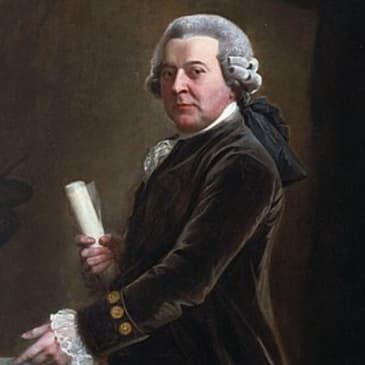
This is the FCB podcast network that. Bringing us out from Tranny. And they thought so when they were in America. And welcome back to the Growing Patriot podcast American History for Kids. The last episode ended on July fourth, seventeen seventy six, and John Adams was officially a leading member of the American Revolution that took up pretty much all of his time. He was also a leader of the Continental Congress, serving on about ninety committees, chairing the Board of War and Ordnance, and he helped to draft America's first military and foreign policy that would lead to what he spent most of the revolution doing, and that's what we're talking about in today's episode. John Adams knew that America would need support from foreign countries, support meaning military and money to win a war against Britain. He kept telling Continental Congress that envoys those were sort of like ambassadors needed to be sent to Europe to get the support of those foreign countries. So guess what, He ended up being named a commissioner to France. And you know, Benjamin Franklin was already there from a previous episode and along with a man named Arthur Lee. On December twenty second, seventeen seventy eight, John Adams and his ten year old son, John Quincy Adams got on board the ship Boston and headed to France. It was a tough journey and they faced bad weather and even a skirmish with a British warship on the way, so they didn't get there until April first, and when he arrived he found out that General Gage had won a big victory at Saratoga and as a result, France had already agreed to alliance with America back in February. You can learn more about that in the episode about Benjamin Franklin's time in France. So the job was already really done before he even got there, but he still headed to Paris, got there on April eighth, and really he probably just wanted to sleep. But the next day he met up with Benjamin Franklin, who got him caught up on all the news and introduced him to everybody he would need to know. John Adams and that other emissary, Arthur Lee started to worry pretty quickly that ben Benjamin Franklin wasn't actually getting enough done, but he sure was living the life of a celebrity. The other problem that became obvious pretty quickly was that Lee and Franklin couldn't stand each other, and John Adams was stuck in the middle. He figured out pretty fast that he was never going to get them to be friends, so he kind of figured, well, I'll just do it myself. Later, he wrote in his autobiography, I found that the business of our commission would never be done unless I did it. But the problem was he didn't speak French. He was doing his best to learn, but the French were shocked he didn't know the language. Not only was it his job to be in France and negotiate with people, but it was kind of the international language of getting things done. In a lot of the major countries, people just spoke France. But it reinforced how much the French court, you know, the king and the people in charge just preferred Benjamin Franklin. And then France and Britain got into their own war while the American War was still going on. So by the winter of seventeen seventy eight, John Adams thought the US needed more French help. Adams and Franklin drafted a letter to the French saying they needed warships and France needed to coordinate better with the Americans, while the French leaders didn't take that very well. They thought John Adams was telling France how they should wage war against Britain, but maybe France just didn't really want to lose a bunch of ships either way. What Adams didn't know was that actually the Continental Congress had already voted earlier in the year to dissolve the American Commission to France because the alliance was already done, so the whole thing was honestly just a mess. An official notice got to France on February twelfth, seventeen seventy nine. They said that Benjamin Franklin was going to stay in France as Minister to the the court of King Louis the sixteenth. Arthur Lee was sent to Madrid to work with Spain, and John Adams wasn't told anything. He wasn't given any orders at all. It was honestly kind of insulting. He was one of the key members of the Continental Congress and it sort of felt like they forgot about him. He wasn't told to go anywhere else, and he wasn't told to go home. So John Adams just stayed in France and kept giving his opinion about how France and America should work together, but that probably wasn't a great idea either. In June of seventeen eighty, John Adams told France that Congress was about to devalue the American dollar. Now that's a long story for another day, but it was not great news for France. So France said that since it was going to be bad for them, John Adams better just go home and tell Congress that France wouldn't stay for it. That also solved their problem because they wanted John Adams to go home anyway, but he refused to go home. Instead, he just wrote a letter to Congress. In July, the French ministers had had enough. They said they were only going to deal with Benjamin Franklin from now on. The official American minister, John Adams was sent off to Holland. This was a great place for John Adams to have a new job, and it was a great place for America to have someone because it was one of the few republics in the world. So he thought that maybe they would be sympathetic to America and give them a loan which would make them less dependent on France in July seventeen eighty he was named envoy to Holland and took up residence in Amsterdam the next month in August. But he wasn't very successful. It was a really complicated type of government, so he could never figure out who to talk to and how to luence people. And again he didn't speak the language Dutch, and the Dutch didn't speak English. He did have some help with a translator, but it didn't work as well because he needed to speak with people directly. Plus, the Dutch didn't want to make Britain mad, so they didn't want to get involved. And the American War was not going as well. It wasn't really obvious who was going to win, so picking a side, especially picking the American side, was not a good bet for the Dutch. They didn't want to put their own safety on the line for a country that wasn't likely to win. But then seventeen eighty one came along and Americans won at Yorktown and that got the people of Holland excited. So John Adams was able to use that the excitement of the people of Holland to get the government on board. They recognized America as an independent country on April nineteenth, seventeen eighty two, and Adams was able to negotiate a financial loan. In October of seventeen eighty two, he was also able to negotiate a trade agreement. This was huge in making the American economy work, and as a little note, the house that John Adams bought when he was in Holland became the first American owned embassy on foreign soil. He had been really successful in Holland, but now it was time for John Adams to go back to France to negotiate the Treaty of Paris, the treaty that would officially end the American Revolution, along with Benjamin Franklin, John Jay, and Henry Lawns. Keep in mind that this whole time John and John Quincy Adams had been abroad, his wife, Abigail Adams, and the rest of the family were back in Massachusetts, where abbagat l was running the farm, managing the family finances, and overseeing everything. But now it was time for the rest of the family to come to Europe, so they joined him in France and settled in a suburb of Paris. The Treaty of Paris worked out great They negotiated wonderful terms for the Americans, and the treaty was signed on September third, seventeen eighty three. The war was over and the new United States got a lot of territory in the West. Now reunited with his family, John kept working on more treaties with European countries. He stayed in Europe for a couple more years, negotiating trade agreements along with Benjamin Franklin and Thomas Jefferson from seventeen eighty three to seventeen eighty five. One of the biggest was something called the Prussian American Treaty of seventeen eighty five. It's also called the Treaty of Ama and Commerce, kind of like friendship and business. The region of Prussia doesn't exist anymore, but parts of it would touch countries like Germany, Poland, Russia, even Lithuania that part of Europe. That treaty was really ahead of its time. It did some sort of traditional things. It recognized America as its own country and said the citizens of both Prussia and America could buy, sell, and own goods in each country. But it also said that if prisoners were taken from the different countries, they would be treated humanly in the event of war, which was really unusual at the time, and they agreed not to hire people to steal from each other's ships. No piracy would be allowed. That was really unusual for the time between Holland, Paris and Prussia. He was doing so well that his next job was going to be the biggest one yet. In seventeen eighty five, John Adams was appointed the very first US Minister to the Court of Saint James's in London. Does anyone else think that would be a little awkward? He had to represent America to King George the Third, the guy they had just gone up against. He was honored and excited to be chosen, but some people in Congress actually didn't think that he was the best choice as the most senior man in Europe. But he was determined to prove that he could do it. He met with King George the Third in person on June the first, seventeen eighty five. Remember, John Adams had helped to write the Declaration of Independence and then signed his name to it, which had called the King a lot of names and accused him of a lot of things. And then the King had left John Adams off of the list of people that he would pardon after the war. These two knew each other well, knew about each other, and they were not friends when they met. He told the King, I think myself more fortunate than all my fellow citizens in having this distinguished honor to be the first to stand in your Majesty's royal presence in a diplomatic character. And I shall esteem myself the happiest of men if I can be instrumental in recommending my country more and more to your Majesty's royal benevolence, and of restoring an entire esteem, confidence, and affection, or, in better words, the old good nature and old good humor between people who, though separated by an ocean and under different governments, have the same language, a similar religion, and a kin hundred blood. I beg your Majesty's permission to add that, although I have some time before been instructed by my country, I was never, in my whole life in a manner so agreeable to myself. So he's saying that he thinks he's the luckiest man out of every American because he has the honor to be the very first American to meet the King as a diplomat, because he is the emissary from America, and he'll be the happiest man if he can be the one who makes the King see America well, if he can make America seem like a great country and help to restore a good relationship between the countries. And then the King said to him, the circumstances of this audience are so extraordinary. The language you have now held is so extremely proper, and the feelings you have discovered so justly adapted to the occasion, that I must say that I not only receive with pleasure the assurance of the friendly dispositions of the United States, but that I am very glad that the choice has fallen upon you to be the minister. I wish you, sir, to believe that it may be understood in America that I have done nothing in the late contest, but what I thought myself indispensably bound to do by the duty which I owed to my people. I will be very frank with you. I was the last to consent to separation, but the separation having been made and having become inevitable, I have always said, as I say now, that I would be the first to meet the friendship of the United States as an independent power. So that means he says, listen, I know that this is a pretty awkward meeting, and this is pretty weird, but the thing that you just said to me, the part that I read first, you said some pretty nice things to me just then, and I really appreciate you being so friendly. I'm really glad that America chose you. And then he says, I want you to understand that everything that happened in the war is because I felt like I had a duty to Britain and everything I did was for that duty. He tells John Adams, I want you to know that I was really the very last person who agreed to independence. I didn't want it, but now that there is independence, I want us to be friends. So honestly, that went about as well as it could have. But in general, the British did not like John Adams very much. They made fun of him for not having very much money, because America in general didn't have very much money. They made fun of America overall, and they said that that country would never survive. The press was really mean to him the whole time. His job was to go to Britain and create a good relationship between the two countries, but he did not have a lot of success because Britain was still just too mad about the war. So on March thirtieth of seventeen eighty eight, he headed back to the United States and he arrived home on June seventeenth, just a few months short of ten years after he left. But getting home didn't mean his work was done. While John Adams had been in Europe, a new country had been built and he was going to help run it. And that's what we'll talk about in the next episode. Thanks for listening. You'll find resources like videos, links, pictures, and coloring pages that go with this episode at Growingpatriots dot com. Talk to you next time. They create us out of tyranny to stand the thing, and they thought so we would beat America DA