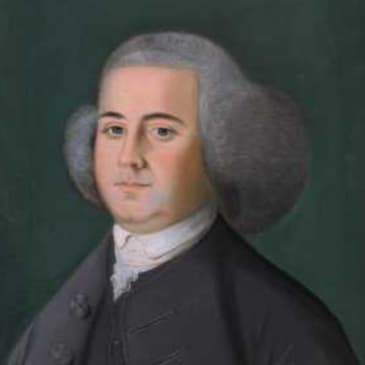
This is the FCB podcast network. That bringing us all to Jeremy and they thought so when we were in America, and. Hi, welcome back to the Growing Patriot podcast American History for Kids. We've talked about the early life of John Adams and we've gotten caught up with his wife, Abigail Adams. Now it's time to find out what happened next. Before we talked about John Adams as a scholar and a lawyer. So we left off in seventeen seventy, just after he had defended British soldiers after the Boston massacre. And in this episode, we're going to talk about his rise as a leader in the revolution, which means we're actually going to go back in time a bit because his time as a lawyer and his time becoming a revolutionary overlap. So we're going to go to the late seventeen sixties and I'm going to actually spend just a minute on his legal career. Again. I know it technically goes in the last episode, but it lays the foundation for his rise in the revolution, so we're going to talk about it here. In seventeen sixty seven, a man named Jeremiah Gridley died. He had been one of the most prominent lawyers in Boston and was a mentor to John Adams. They even fought the Stamp Act together along with another lawyer, James Otis. Now James Otis was one of those sons of Liberty, those men in Boston who got together to fight against the British. He is actually famous for the saying no taxation without representation. He was one of the first people to call for American independence and really influenced a young John Adams. But he also had a lot of health problems, which got even worse after he was beaten by British tax collectors in seventeen sixty nine. So, in seventeen sixty eight, when Jeremiah Gridley passed away and James Otis was having health problems, who was a prominent person in Boston supposed to call when they were accused of violating the British Acts of Trade. Well, they couldn't call John Otis. They were to call John Adams. And that's how John Hancock became a client. In seventeen sixty eight. John Hancock was one of Boston's wealthiest merchants and a rising political figure, openly protesting the British and even paying or a lot of those things the sons of Liberty were doing. In June of seventeen sixty eight, the British seized a ship called Liberty, a ship owned by Hancock. They found some Madeira wine, but not very much, not as much as the ship could have held, that's for sure. But the ship's captain had been in trouble for smuggling wine before, which means they were bringing in the wine illegally without paying taxes. And here's where it gets a little bit silly. The inspectors when they came to look at the ship said that there was just a little bit of wine, no big deal, nothing wrong. They paid the taxes on the wine that was there, so there was no problem, no evidence of smuggling any other wine. But then a month later one of the inspectors said there were actually one hundred whole casks of wine, but the crew took most of them off the boat, just snuck them right out of there before the British came to look, so they only had to pay taxes on what was left. He said that John Hancock tried to bribe him, pay him off to stay quiet, and when he wouldn't. He was actually held captive on Liberty. So the British took Liberty and dragged it over to a Royal Navy warship that was in Boston, and a riot broke out in Boston. They tried to come to a compromise. The British and the Loyalists wanted harsh punishment against John Hancock, but demonstrators in Boston wanted to burn the warship for stealing Liberty. Well, when the British heard that, they sued Liberty and John Hancock himself. Now, a lot of people thought that prosecution was politically motivated, and it kind of was, but to be honest, John Hancock probably did it. The evidence against him was pretty weak, so after a few months the charges were dropped. The British knew that they could never win in court, but they did keep Liberty, and they passed more laws to stop smuggling and put more troops in Massachusetts. So they really just made the situation worse. Now. For John Adams, defending Hancock made him even more famous, and it helped him really sharpen his arguments against the British, and it made him some new friends with the revolutionaries. Of Boston. Maybe it's no surprise that in June of seventeen seventy he officially entered politics. He became a member of the Massachusetts House of Representative, although he only had that job until April of the next year. During this time, for a few years, John, Abigail and their growing family moved back and forth from Boston to their country house in Brainew. When he got married in seventeen seventy one, he had an office in Boston and the family lived in Braintree. But then he moved everyone to Boston in seventeen seventy two, thinking they should have a fancy and elegant life in the big city. But in seventeen seventy four things were just getting too dangerous in Boston, so they moved to Braintree and they stayed there permanently. But I did mention last time that he was traveling quite a bit away from Massachusetts at all, while Abigail took care of things at home. Let's talk about a big change in Massachusetts. In seventeen seventy two, the British Crown decided that they would pay the salary of the governor and the judges of the colony instead of the Massachusetts legislature. So that meant that they were relying on England to get their paycheck, not on the people of Massachusetts. And John Adams thought, and a lot of people thought, that that would make them rely too much on England and want to make England happy instead of Massachusetts. So he had said before that he thought the British had made some pretty big mistakes, but nothing that couldn't be fixed. After that, he started to see that the King was never going to listen. So John Adams, Samuel Adams, his cousin, and a man named Joseph Hawley drafted a resolution that was adopted by the House of Representatives in Massachusetts, threatening independence if the only option that they were given was tyranny. Governor Hutchinson said Massachusetts had to be loyal to Parliament, but the Patriots in Massachusetts said that they never promised to be loyal to Parliament. Even their colonial charter said that they had to be loyal only to the King. And then in Soea seventeen seventy three, you might remembered that the big thing happened in Massachusetts, the Boston Tea Party, and there was no turning back after that. Of course, you can listen to the full episode on that for the whole story. The link will be on the website. John Adams said it was the grandest event in the history of colonial protests and something that was absolutely and indispensably necessary for them to move forward. So when the first Continental Congress met in seventeen seventy four, you better believe John Adams was there, and he was one of only twenty three people in all the American colonies on something called a Grand Committee. Their job was to write a letter to King Georgia Third explaining exactly what the problem was and what he would have to do to fix it. Of course, that did not stop war from breaking out. The King did not want to fix it at all. He just wanted his way. The first shots in the Revolutionary War were fired at Lexington and conquered in April of seventeen seventy five. Again, there's a whole episode on that, And a month later, John Adams attended the Second Continental Congress. This time he was the head of the Massachusetts delegation. During that Congress, John Adams was really important. He sat on ninety different committees. He was the chair, the head person of twenty five of them. Nobody else had as much work as he did. One person named Benjamin Rush said that everyone knew he was the first man in the house, but the group of men that were there were still pretty divided. Some really wanted independence, they wouldn't think of anything else, and some would not even consider independence. They were a British colony and they intended to stay that way. And some didn't really want to take a side. They just wanted to keep peace among the colonies. So publicly, John Adams said that solving things with Britain would be great if it were possible, but in private he knew that it wasn't possible at all. So in June of seventeen seventy five, to get the colonies united against Great Britain, he nominated George Washington of Virginia as Commander in chief of the army, and that army assembled around Boston. He praised Washington for his skill and experience, as well as his excellent universal character, meaning he was the kind of guy that everybody would approve of. By this point Adams was against attempts at peace. That ship had sales. He wrote in my opinion, powder and artillery are the most efficacious, sure and infallibly conciliatory measures we can adopt, meaning we are only going to finish this with a war. And by the fall of seventeen seventy five he wasn't even pretending to want to solve our differences with Britain. He was all in on independence. As seventeen seventy six moved on, John Adams was getting impatient. He organized the Committee of Five, which was charged with drafting a declaration of Independence. Now, Thomas Jefferson really thought that John Adams should write it, but Adam persuaded the committee to choose Jefferson. Many years later he wrote down his reason for this. He said, reason first, you are a Virginian, and a Virginian ought to appear at the head of this business. Reason second, I am obnoxious, suspected, and unpopular. You are very much otherwise. Reason third, you can write ten times better than I can. Basically, he said, there were three reasons that I wanted you to write it instead of me. The first is that you're a Virginian. And this kind of goes back to why George Washington was chosen. A Virginian could unite everyone. A Virginian was from the South. It was the wealthiest colony, and it would bring all of the colonies together, unite the North and the South, and get everyone in this as one united colony. The second one, John Adams knew that people didn't necessarily like him. He said that he was obnoxious, unpopular, and suspected was the word he used. But not Jefferson. Everybody liked him, so really the letter should come from him. And the third reason was simply that Thomas Jefferson was a better writer. This was going to be one of the biggest documents ever written, and it better be written well. And let's face it, it was so on July first, they brought their draft of the Declaration of Independence to Congress. There were people who still wanted to oppose it, but by this point, probably from being a lawyer, John Adams was so good at debating and arguing that on July second it passed. Twelve colonies voted yes. New York said, oh, we're not going to vote on this at all. You guys do whatever you're going to do. And one other person, mister Dickinson from Pennsylvania, who was the biggest voice against independence, didn't show up to the vote at all only third. The day after this was passed, John Adams wrote to his wife Abigail, and you know they were always writing to each other from last week's episode, that yesterday was decided the greatest question which was ever debated in America, and a greater perhaps never nor will be decided among men. So he was saying, this is the biggest thing that has ever happened in America, and I don't think anything this big is ever going to happen in America in the future. And so far I think he's right. He went on to say to Abigail, the second day of July seventeen seventy six will be the most memorable epoch in the history of America. He predicted that Americans would always celebrate the second of July, the day that the Declaration of Independence passed. Of course, he was just a little bit off. We celebrate Independence Day on the fourth of July, the day it was approved by Congress, rather than the day the declaration of Independence was approved. But what matters is that that July in seventeen seventy six, independence was proposed and independence passed, And as you know, the things that came next would change history. Forever. In the next episode, we'll talk all about how John Adams was part of that history. You can find links to the episodes that we referenced in this one, coloring pages, videos, and all kinds of other resources for this episode and every episode at Growingpatriots dot Com until next time. The free to solve the granny stay thing, and they thought, so, what we work in America? Mana