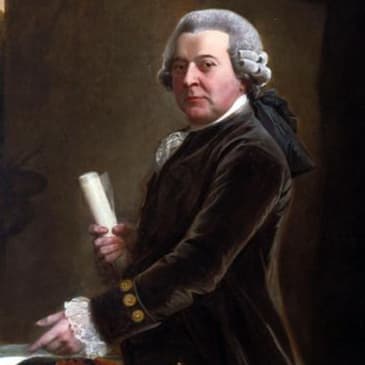
This is the FCB podcast network. They breed us solved fearny thing, and they thought so when we were in America. Manda, Hi, and welcome back to the Growing Patriot podcast American History for Kids. In the last episode, we wrapped up our talk about George Washington. Now it's time to talk about the next founding father, John Adams. Remember we're going in order in which they were born, So Benjamin Franklin went first. He was born in January of seventeen o six. Then the next founding father, George Washington, was born in February of seventeen thirty two, so Benjamin Franklin was He was already twenty six years old when the next youngest founding father was born. And John Adams was born in October of seventeen thirty five, so just about three years after George Washington. And in this episode we will start talking about his childhood, his early education, and how his legal career set him up for a life in politics. So John Adams was born in Braintree, Massachusetts, that's about fifteen miles away from Boston. His family wasn't wealthy, but they had a nice comfortable life. His father was a deacon, in the Congregational Church and worked as a farmer and shoemaker. And speaking of his family, his father, also named John Adams, came from a family that had been in the Boston area for a very long time, even by the seventeen thirties. John Adams's great grandfather, Henry Adams, came to Massachusetts from Braintree, Essex in England in about sixteen thirty eight, so the family had already been there almost one hundred years before John was even born. As a child, John loved being outside and even once said that he would have preferred to be a farmer than how his life ended up. However, his dad insisted that he get a good education and hoped that he would join the church just like him, But John skipped school quite a bit to hunt and fish. When he was about six, John started attending what was called a Dame school, which meant he was taught by a woman in her home. He learned the basics like reading and writing, and then after a couple of years at that school, he went on to Latin School. The Braintree Latin School was designed to teach kids who planned to attend college, and a college education at that time was really rare. It was only for the tip top of society, so for John to go was a big deal. But he did a great job in his studies and entered Harvard College when he was around fifteen or sixteen years old. That age wasn't unusual in the eighteenth century. When it came time to take the test to see if he would get into Harvard, John was pretty nervous. He wrote that he was so quote terrified at the thought of introducing myself to such great men as the president and fellows of a college. I at first resolved to turn home, but foreseeing the grief of my father, I aroused myself and collected resolution enough to proceed. So that means that he was so scared at the idea of going to Harvard, meeting the president of the college and the other people there. And he was thinking that maybe he would just skip it and go home and forget about this college thing. But then he thought about how sad his father would be. This was his dream for his son John. So he got himself together and got his bravery together and went on to take the test. He did really well in that test and was admitted the same day. He said he was quote as light when I came home, as I had been heavy when I went. So basically his mood just flipped from sad and afraid to happy, and John came to love Harvard and love learning. He wrote, I perceived a growing curiosity, a love of books, and a fondness for study, which dissipated all my in clination for sports and even for society of the ladies, I've read forever. So he started to notice as he was at Harvard that he became more curious about learning. He loved to read, he loved to study, and those things became even more important to him than the things that were important before, like playing sports and maybe spending time with girls. You notice, maybe at the end of that quote he said, I've read forever, And he did love to read, But he also loved speaking. He joined a speaking club, which was a group of students that would meet practice giving speeches. They would debate things like that, and his friends and classmates told him he was so good at it that maybe he should think about being a lawyer instead of a minister like his father. He graduated in seventeen fifty five, right before he turned twenty. He graduated fourteenth out of a class of twenty four. But the rankings aren't really the same as class rankings might be today. It wasn't based on how well a student did, how good their grades were, or anything like that. Harvard said they ranked students according to the dignity of their birth or the rank of their parents. So it meant, you know, how fancy was your family that you were born into, how important were your parents. That's how they ranked the students. He got to speak at the graduation ceremony, and that led to his first job. After graduating from Harvard, John Adams became a teacher. He taught at a Latin school, but he knew this probably wasn't going to be his job forever. Instead, he used the money that he earned from that to pay to study the law so that he could become a lawyer. So from seventeen fifty six to seventeen fifty eight he studied law with a prominent lawyer, John Putnam, in Worcester, Massachusetts, and then in seventeen fifty eight he gave his master's thesis address at Harvard. And this was something that ambitious Harvard graduates did three years after graduating and continuing their studies. Basically, it was a big, long research project, and then he had to present what he learned, make really good arguments to prove why he's right, and convince people at Harvard that he was an expert in the subject. So what was his thesis about? Something that would be a theme for the rest of his life, the idea that society needs a civil government. And that's something we've talked about a lot before when we talked about the Constitution and the Bill of Rights. When John Adams was done with his thesis at Harvard, he took on his next big challenge. He was officially sworn in as a member of the Bar, which is the society for lawyers, on November sixth of seventeen fifty eight, and he started his own law practice. But he was not a huge success right away. In fact, John only had one client in his first year and he lost that case, and he lost the case because of a mistake that he made. It took him almost three years before he would win a case in front of a jury. That happened in the autumn of seventeen sixty and then he felt like he had his confidence back. It started him on the road to being a really respected lawyer. Through the seventeen sixties, his legal practice kept growing and he became really successful. During that time. He also met his wife and started a family, but that will be another episode, so you have to wait for that one. I am going to mention though, one other family member, his cousin Samuel Adams. You probably remember me mentioning Samuel Adams before. He also lived in Boston and was pretty different from his cousin John. Samuel was famous for being fiery and radical. He was one of the first people to call for American liberty. Now, John was a lawyer and more of an intellectual, but they both believed in a lot of the same things. They just went about it different ways. So keep that in mind, because in seventeen sixty five things were getting pretty heated between America and Britain. Colonists were protesting against the Stamp Act, which it was a big tax on Americans. And again you can go back and listen to that episode if you want all the details. So Samuel Adams got busy getting the people of Boston organized against Britain and the unfair tex So he was doing things like setting up protests, boycotts, and things like that. Now John wasn't so sure that was the right way to go about things. He thought that, yes, people like Samuel were upset about the Stamp Act, but they might actually just be using the Stamp Act to push people toward American independence, and really he wasn't wrong, but he did not want to get involved, and if he had to get involved, he really didn't want to do it in a big, splashy way. He didn't want to put his legal practice in danger, especially with a young family to support. So he thought that maybe the American colonists were really just trying to push people toward independence. And he also thought that of course the Stamp Act was wrong, but Britain maybe just made a mistake and things would be better in the future. They didn't need to go crazy right away. So he did get involved, but he wrote anonymously without using his name. But as time went on, he realized this wasn't just a mistake Britain made. They kept trying to text the colonies and taking away the rights that American colonists had to lead themselves, and he realized that people like his cousin were right and began to openly support them. In seventeen sixty five, he wrote something called the Braintree Instructions, and these were instructions of what he wanted his local representative to the Massachusetts legislature to do. So he was saying, hey, if you're going to go represent Massachusetts, if you're going to represent my part of Massachusetts, here's what I think you should do. And in those instructions he explained that the Stamp Act was unconstitutional because colonists were not represented in Parliament. And the instructions that he wrote were so good that more than forty towns adopted them. So while the Stamp Act was his first big splash in politics, he was still a lawyer and he would make a big legal splash that was also pretty political in seventeen seventy. There's a pretty big twist to this case. In seventeen seventy, John Adams was a really successful lawyer with plenty of work to do. But on March fifth of that year, the Boston massacre happened again. There's a full episode you can go back and listen to to get all the details. But a group of British soldiers fired in to a crowd of American civilians on King Street in Boston, and it was one of the big things that led to the American Revolution. Guests who was chosen to defend the British soldiers John Adams. Nobody else would do it, but John believed it was really important that the law was followed and they deserve to have their side heard in court. Plus, John Adams actually did believe that some of the soldiers were wrongly accused. They had fired into the crowd in self defense. He thought the British government was wrong for having them there in the first place, but that was a different matter. He and his cousin Samuel definitely disagreed about the Boston massacre. During the trial of these British soldiers, John Adams delivered one of his now famous quotations. He said, facts are stubborn things, and whatever may be our wishes, our inclinations, or the dictums of our passions, they cannot alter the state of facts and evidence. So that means that you can't change facts. They're stubborn. So even if you want the British soldiers to be guilty and sent away to jail, that might be our inclination, our wish, But the things that we want and wish for does not change the facts and it doesn't change the evidence. So he was there to make sure that the facts and evidence were all presented fairly. And he did such a good job of defending these men that none of the accused soldiers were sent to jail. A lot of Boston was unhappy with him, but he thought he did the right thing and I think history would agree, and it set him up for a lot of the big things that would come later. Thanks for listening to the Growing Patriot podcast. You can find more resources for this episode and every episode at growingpatriots dot com. In the next episode, we will hear all about John Adam's wife Abigail, about her family, their marriage, and their family together. Can't wait to see you next time. They freed us Out the tyranny for start of the thing, and they thought so we work in America and