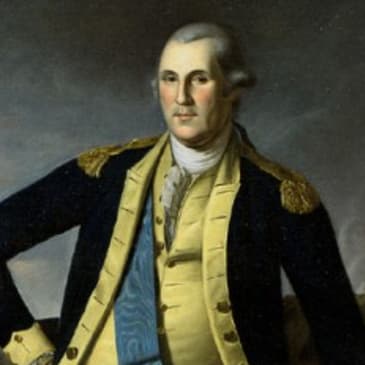
This is the FCB podcast network. They breed us solved the tyranny the thing, and they thought so when we were in America. And we left off with George Washington when he was about to head to the First Continental Congress in seventeen seventy four. This was a huge deal because the thirteen Colonies were coming together to talk about America's future as Britain was getting more and more mad at them, and America was getting more and more mad too, And instead of acting like thirteen British colonies, they were acting like thirteen parts of one America. Just as he had a few years earlier, George Washington once again supported one of the main issues of this Continental Congress, non importation. That was saying that colonies needed to stop bringing in and buying British goods, and they also said they would stop exporting sending their own things to Britain. Out of this Congress, two really important things happened. The first was something called the Declaration of Rights and Grievances. The first part declared their rights. It said that colonists had the rights of all other Englishmen, rights like life and liberty, representation for taxation, the power of local legislature to be governed by people right there, not across an ocean in England. And the right to a trial of jury by their peers, again by people that they lived with in their own communities, not a jury in England. And then the grievances, their complaints, things like taxation without representation and having a British army in the colonies all the time even when they were at peace, and that they didn't agree to. The other big thing was that they said they would have a second Continental Congress. This turned out to be the big one. The first Continental Congress ended on October twenty sixth, seventeen seventy four, and they decided that a second Congress would begin in May of seventeen seventy five if Parliament didn't shape up. Well, guess what Britain didn't shape up. Remember how I said that the First Continental Congress ended on October twenty sixth, seventeen seventy four, while on November thirtieth, King George the opened Parliament with a speech condemning Massachusetts. So that second Congress opened on May tenth, seventeen seventy five, and by that point shots had already been fired in the Revolutionary War. The shot heard round the world was fired on April nineteenth, so they were preparing for war and it had kind of already begun, but they were still trying to avoid it. Of course, you know that war already happened, the American Revolution, and on June fourteenth, the Congress created a Continental Army to lead that war. They appointed George Washington, Commander in chief to lead it and sent him to Boston to meet the troops. There were a few reasons that he was chosen. He was one of the few delegates of that Congress with direct combat experience, which he had from the French and Indian War that we've already talked about. Even wore his military uniform to Congress, showing his dedication to the military effort. And there was another big reason. He was a Virginian. At this time, most of the conflict was in New England and mostly in Massachusetts, so by choosing a Southerner, Congress was really showing England that this wasn't just New England fighting the King, it was America fighting back as one unified country. And it sure didn't hurt that Virginia was also the wealthiest colony and they needed that money to fight the biggest military in the world. Plus, George Washington had a certain air about him. He was forty three years old, so he was old enough to be taken seriously, but not an old man. He was serious and thoughtful, not a hot headed revolutionary one man Benjamin Rush said, he has so much martial dignity in his deportment that you distinguish him to be a general and a soldier from among ten thousand people. That means that you could look at a group of ten thousand people and pick him out at a soldier right away. So George Washington accepted the job, but not the payment. He said he only wanted to be paid back for any money he had to spend out of his own pocket. And when he accepted the job, he even agreed to obey Congress. On June sixteenth, he said, I am truly sensible of the high honor done me in this appointment. I do not think myself equal to the command I am honored with. Yes, he thought it was an honor, and he didn't even think he deserved it. He really didn't think he was good. He even told his fellow Virginian Patrick Henry. Remember, mister Henry. What I now tell you from the day I enter upon the command of the American Armies, I date my fall and the ruin of my reputation. He thought that he was going to fail and ruin the wonderful reputation that he had built for himself, and before heading off to Boston, he even bought some books on how to organize and lead armies. We've already done a whole bunch of episodes about all of the American revolutionary battles, and so we're not going to go through all of that again, but we're going to talk about a few of the main things that George Washington did that made him a great leader. I'm going to take just a minute to talk about something that you might not always think of, and that's what a big problem sickness could be in those camps. In seventeen seventy six, smallpox was a big problem in the army. The smallpox is ten times more terrible than Britain's, Canadians and Indians together. He meant that it could kill ten times more people than people from Britain, Canada, and the Native Americans combined. But you might remember that George Washington survived smallpox when he went to Barbados with his brother Lawrence, so he knew how scary it was, and he knew that because he had survived it before, he couldn't get it again. So he made a really bold decision. Over the winter of seventeen seventy seven in New Jersey, he did something that's kind of like a vaccination today. It was called inoculation, and reports say that death by smallpox went from seventeen percent of all deaths to only one percent. His strong leadership and grit almost lost, like in New York in seventeen seventy six and again right before America finally won in seventeen eighty one. There were times when some of the biggest problems he faced were just getting enough supplies like uniforms, blankets, gunpowder, and even soldiers. But he always managed, and the conflict finally ended with British soldiers surrendering at Yorktown in October of seventeen eighty one. It's hard to exaggerate what a huge deal this was. The odds of America winning the revolution were tiny. Britain was the biggest military in the world, but George Washington never took all the credit he thanked some of our most important allies, the French. He wrote a letter saying, I should be wanting in the feelings of gratitude, did I not mention, on this occasion, with the warmest sense of acknowledgment, the very cheerful and able assistance which I have received in the course of our operations from his excellency the Count de Rauchambeau and all his officers of every rank in their respective capacities. He's saying that he won't be ungrateful. He has to think and wants to thank the Count de Rouchambeau and his soldiers for all their help. And then he went on to say no thing could equal this zeal of our allies, but the everlasting spirit of the American officers, whose ardor would not suffer their exertions to be exceeded. This means that they were so energetic and excited to help. The only people that were more enthusiastic to help were the American officers, and they wouldn't let anybody outdo them. After the surrender at Yorktown, things were just about over. Things changed then from outright war to negotiation for peace, just figuring out what everything would look like now. The British still held some of cities in America, like New York and Charleston, so they had to talk about how to hand everything over, what territories would belong to who, and who would pay for what, that kind of thing. George Washington went back to New York to keep watch there since that was a major British stronghold, and as it happened, he would still have one big issue to fix. Have you ever heard of the Newburgh Conspiracy? A lot of people haven't. In March of seventeen eighty three, a lot of American military officers still weren't getting paid very regularly. While at their winter encampment in Newburgh, New York. Some of them even started talking about challenging Congress. It got close to a mutiny. On March tenth, seventeen eighty three. An anonymous person called the officers to meet the next day. On March eleventh, a note went around from Major John Armstrong saying Washington was too moderate, basically too nice, and they needed to start getting forceful with Congress. If Congress wouldn't do what they wanted, the army had to disband, which would leave the country unprotected. Or, on the other hand, refused to disband even after the peace treaty was signed, and that was a threat. George Washington got them to push the meeting until March fifteenth, thinking that if he gave it a few more days, maybe everybody would calm down. And he surprised everyone by showing up himself at the meeting, and he gave a speech known as the Newburgh Address. In that speech, he promised that Congress would pay them. He asked them to keep being patient and patriotic, and read them a letter from Joseph Jones, a congressman from Virginia, And when he left, the officers continued their discussion alone and decided to keep working with Congress for their pay instead of doing anything crazy that they couldn't take back. And that really speaks to how much the army respected George Washington. And they did get paid for all five years. Then the Treaty of Paris officially ended the war on September third, seventeen eighty three. That's when he did something that any people say was his greatest show of strength ever. He resigned. He surrendered all of his power on December twenty third, seventeen eighty three, he gave back his military commission to Congress, saying, having now finished the work assigned me, I retire from the great theater of action, and bidding an affectionate farewell to this august body under whose orders I have so long acted, I hear offer my commission and take my leave of the employments of public life. Basically, he was saying, you asked me to do a job, and I did it. I'm going home now. He wasn't going to try to take political power because he'd been victorious with the military. America wasn't going to be like that, even though a lot of leaders had been throughout centuries of history. Once the war was over all he wanted was a private life back home at Mount Vernon. Of course, that didn't mean that's what Americans wanted, and that's what we will talk about in another episode. Thanks so much for listening. You can find out more about what we talked about in this episode at Growingpatriots dot com. You can't wait to talk to you next time. They agreed to solve. The tyranny, understand everything, and they Thought so we working America da