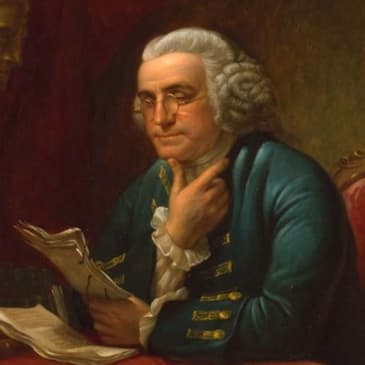
This is the FCB podcast network. They breed us all the tyranny standing. And they thought so. Way working America And. Welcome back to the Growing Patriot podcast American History for Kids. Today, we are finishing our talk about Benjamin Franklin and we have some questions from Parker. To kick it off. Hi, I'm Parker. I'm five years old and I live in Indiana, and I liked a place port and I love God. That's so cool. What are your questions about Benjamin Franklin? Where did he live? What did he have for his job? What did he invent? Those are great questions. Let's dive into the answers. Parker's first question is where Benjamin Franklin lived. While he was born in Boston, Massachusetts, and then he moved to Philadelphia. He lived in London, England, and in France, and those places that he lived give us a lot of clues about Parker's next question, what was his job? Like I said, Benjamin Franklin was born in Boston. That was in seventeen o six, and in seventeen o three, when he was twelve, he was apprenticed to his brother James to be a printer. That means he was working with his brother and for his brother while learning the trade and learning the skill of how to be a printer. He didn't stay with James very long though. Just five years later, in seventeen twenty three, he ran away and went to Philadelphia and he set up his own printing shop. So that was his next job, owning his own printing business. And he only did that in Philadelphia for a year before he went across the ocean to London, England, and guess what, he worked as a printer there too. He was only there for two years, and then he came home in seventeen twenty six, back to the colonies, back to Philadelphia again. He started his own print shop, and in seventeen twenty eight he started to publish things like the Pennsylvania Gazette, which was a newspaper, and Poor Richard's Almanac. We're going to talk about all of that a little bit later when we get to the things he created, but it's important to know that he ran that for twenty years, so that became a really big part of his life. Benjamin Franklin was always busy. He helped his wife operate a general store which sold things like soap and fabric and other things that you would need. But what's really important about this time when he lived in Philadelphia is he started doing work for the colony itself for the government. In seventeen thirty seven, the British government appointed Benjamin Franklin the postmaster of Pennsylvania, and you know from previous episodes that that is a really important job and got even more important during the Revolution. He had that job until seventeen fifty three, when he became Postmaster General of all of North America. In seventeen thirty nine, he got his first official government role, the Clerk of the Assembly of Pennsylvania. That led to a lot of big things in his future. Starting in about seventeen forty eight, he was wrapping up the printing business to focus on that civic work, that public work, that political work, and he was also focusing a lot on his experiments and his inventions, which we'll talk about later. Eighteen fifty one, he was chosen to represent Philadelphia in the Pennsylvania Assembly, so the different areas of the colony would get together and figure out what would be best for the colony as a whole. While he was there representing Philadelphia, he impressed people so much that in seventeen fifty seven he was sent to London, England to be a colonial agent. Originally he was over there to represent Pennsylvania. Again. We've heard a lot about this in a previous episode if you want to get all the details about that. But he just kept doing a good job and getting bigger and bigger jobs. So we ended up representing Pennsylvania, Georgia, New Jersey, and Massachusetts to the British government. And then in seventeen sixty two, after five years in London, he came back home to Philadelphia. He got back to his duties as a postmaster and representing Philadelphia at the Pennsylvania Assembly. But this was a short time to time two, because just two years later he went back to London to do that same job again representing those colonies, and that lasted until seventeen seventy five when things were really about to kick off with the American Revolution, and he was brought back home to Philadelphia. There he served as a member of the Continental Congress, and he had some really big jobs like helping to draft and create the Declaration of Independence, and he got another new responsibility becoming the first Postmaster General for the colonies. We talked about this again in a previous episode, but this was a really important job because it meant that with our own postal system, the colonies could communicate with each other without Britain reading the letters and getting in the way, and that would be really important when the revolution began. After America declared a independence in seventeen seventy six, Benjamin Franklin was sent to France. There's an episode about this too, so be sure to listen to that for all the details. But as a commissioner and Minister to France, Benjamin Franklin's job was getting French military and money to help America win the revolution, and he did it right up until he helped negotiate the Treaty of Paris, the official end of the revolution. And what a lot of people forget is that from seventeen eighty one to seventeen eighty three he also was minister to Sweden. Maybe people forget because he never actually went to Sweden, but he still did the job from Paris, and after the war ended, guess where he went back to Philadelphia in seventeen eighty five, But don't worry, he'll be in Philadelphia for the rest of his life now, no more moving around. But when he got back in seventeen eighty five, he became the estate's executive, which is like a governor today, and he served that job three different times in a row, each of them for one year. So he was the governor for three years, and then in seventeen eighty eight, when that job was over, he actually retired at the age of eighty two years old. That's pretty old to retire even today, but in the eighteenth century it was really really old. That's about twenty years past when most people died of old age at the time, and a lot of people didn't even make it to old age. A lot of people died when they were more like forty, so that's about twice as old. And he worked almost until the very end. So there it is Benjamin Franklin's jobs. I know, I just threw a lot at you, but he was a busy, busy guy. Now we'll get to the last question. What are some of the things that Benjamin Franklin invented. I'm going to include a lot of things here because aside from his scientific inventions and things like that, he also founded and created a lot of different organizations to help his community, and he wrote a lot. And since those are all different kinds of creations, I'm going to say that they're inventions and put them in this section. Let's start with the writing. He wrote so many important things. Maybe all of that time in a printing shop inspired him. When he was still a teenager working for his brother, he wrote the Silence Do Good Letters, which we talked about in the episode on his early life. I'm including them again because there's some of the earliest things that Benjamin Franklin wrote and they really show his personality. These are fourteen letters that he wrote and then published in his brother's newspaper, the New England Quran. Now it was a teenageed b. Njamin Franklin writing the letters, but he signed the name Silence Dogood, pretending to be a middle aged lady who just wanted to share opinions about colonial life. Well, people loved them and thought they were so funny, so he kind of went viral. If that would have been a thing in Boston in early seventeen hundreds. One of his next big most popular publications was also under a false name, something called Poor Richard's Almanac, which he started publishing in seventeen thirty two, this time under the name of Richard Saunders. This was a pamphlet that he published once a year which had some information that would be helpful to people, like calendars and information about the weather. But there were also proverbs, poems, advice, little sayings that you could remember to help make you a better person or help make your life easier. So it was fun but also useful and became so popular in Colonial America that it sold about ten one thousand copies every year. And Poor Richard's Almanac then inspired something called The Way to Wealth in seventeen fifty eight. It was actually a collection of the most popular sayings and things that he had published in Poor Richard's Almanac over the years, but it was published in one place, and it was mostly advice about saving money and working hard. Those are still the way to wealth today, we know. Benjamin Franklin loved science and science experiments, and in seventeen fifty one he published something called Experiments and Observations on Electricity. This was probably the most important of his scientific writing. Like the title said, it explains how he conducted his experiments on electricity and what he observed and learned from them, but it was written in a way that regular people could understand, which is something that made it so important and popular. As Benjamin Franklin got older, he started thinking about leaving a record of his own life behind. So from seventeen seventy one to seventeen ninety he worked on something called the Autobiography of Benjamin Franklin. An autobiography is a book that somebody writes about themselves, telling their own story. This one is written as letters to his son, and it talks about his life going from being the poor son of a little known family to being one of the most influential and famous people in the world. Unfortunately, Benjamin Franklin never finished it, so it only goes up to seventeen fifty seven, until he was about fifty. He didn't necessarily write them himself, but I'm going to give an honorable mention to the Declaration of Independence and the US Constitution. He didn't write them alone, like I said, but he worked on them, and we can't overlook his contribution. Thomas Jefferson mostly wrote the Declaration of Independence, but Benjamin Franklin was on the group of people who worked on a first draft, deciding what needed to go into it, and he had some really important suggestions, like using the phrase self evident in that famous opening line, we hold these truths to be self evident. Jefferson originally had sacred and undeniable instead, which one do you like better? He was also behind the scenes of the Constitution. Again, not the main writer, James Madison did that, but Benjamin Franklin helped settle disagreements about what should be in it. So his influence really impacted the final draft. Between his newspapers, almanacs, his scientific writing. It probably won't surprise you to hear that Benjamin Franklin cared a lot about educating people and just about making his community safer and better, so he founded some groups and organizations that did just that, things like the Library Company of seventeen thirty one. If you like going to the library, it's a lot like that. It was a place to provide affordable access to books, and people who were members could come in together to buy books together, share things with each other that they already owned, and it became a lending library like we have now where you could just borrow a book. In seventeen thirty six there was the Union Fire company, which was a volunteer fire department that he helped to found and it was the first firefighting organization in Philadelphia. What was so interesting about his firefighting organization and not like there are other ones that existed in the colonies, is that you didn't have to be a member, you didn't have to subscribe to fireman services. Anybody in the community who needed their help could have it. He was also a founder of the Academy and College of Philadelphia, a boys' school and a men's college in Philadelphia that taught reading, writing, and arithmetic whether you could pay or needed some help. And this school is still kind of around today, but now we call it the University of Pennsylvania. And speaking of education, the American Philosophical Society is another of his organizations that still exists today. It brought people together just to know more about the world. They would research things, have meetings, publish their information, find libraries, do community outreach. It was just a place for education. Okay, Okay, you've listened to me talk all about writing and all about these places that he founded, but you want to hear about the actual inventions, right, Well, let's start when he was eleven years old, In seventeen seventeen, Benjamin Franklin invented swim fins. No, they're not like the floaties or water wings that kids wear today. There were paddles that you could hold in your hand to help you swim faster. Then, when he got older, he kept inventing things that would make people's lives safer, easier, and more comfortable, things like the Franklin stove, which helped to heat a house better while using less wood, or a street lamp that was much better than people were using at the time because it stopped the soot from making it all icky and dark inside and also made maintenance easier. To get people to want them, Benjamin Franklin put a couple outside of his own house and let people see how great they were and guess what people wanted them. His first invention that you might have already heard about, is the lightning rod, which was around seventeen fifty. A few minutes ago, I told you about the book that explained Benjamin Franklin's electrical experiments. Well, one of the things he discovered is that lightning is a form of electricity, So he invented this lightning rod to create a safe path the lightning would strike the rod, and that electricity would go straight into the ground where it would be safe, rather than hitting a building or something else that could catch fire. Here's one that your parents have heard of. An odometer. That's something that measures how far a vehicle goes. They have them in cars today. Now. Odometers existed kind of before Benjamin Franklin, but he invented a version that you could actually use easily. You could attach it to your carriage wheel, and he used them to measure the distances for his postal roots, so he could make them as easy and efficient as possible. Benjamin Franklin loved music. He played the violin, the harp, and the guitar. He attended concerts, and he even composed the music. One was called The Downfall of Piracy, which was about Blackbeard the Pirate. So maybe it makes sense that the invention that was Benjamin Franklin's own favorite was an instrument something called the glass harmonica, like a harmonica, but with no h and he said it had a quote incomparably sweet sound, like the name says, it's made out of glass. It has different sizes of bowls which spin around when the musician presses a pedal with their foot. Then they get their fingers wet and touch the spinning bowls and sound comes out. This was a really popular instrument in the eighteenth century. Even Beethoven and Mozart wrote music for it. Be sure to visit Growingpatriots dot com and look at the blog post for this episode. I'm going to post a video of the glass armonica in there so you can hear what it sounds like. As Benjamin Franklin got older, he couldn't see as well. That happens to a lot of people, and he was getting tired of switching his glasses when he needed to see something close up, and then a different pair when he needed to see far away. So in seventeen eighty four, he invented something to solve the problem. Buy focals. The top half had a lens that helped him see things far away, and the bottom half helped him read and see things close up. He just had to move his eyes instead of changing his glasses entirely. This invention was so useful and so popular that people still wear bifocals today. I'm going to include one more. In seventeen eighty six, Benjamin Franklin invented something called a long arm. It was an eight foot long wooden pole with a little grabber pincher on the end so he could reach books way up high on his bookshelves. After all, he was about eighty years old then, and he didn't want to be climbing around to get things. And like so many of his inventions, versions of this still exist today for people who have trouble moving around. So did you notice anything about these inventions? Some of them had to do with his other work, things to prevent fires, something to measure the distance for his postal work. It's pretty cool how he found ways to make things better. All of these creations, from what he wrote to the things he founded, help his community. His inventions, they're quite a legacy to leave behind. And that's not including all of his work for American liberty. As you probably noticed, Benjamin Franklin was working and writing and inventing until he was a very old man, basically as long as he could. For the last few years of his life, he was having some trouble with his health and spending a lot of time in bed, and he died from a problem with his lungs on April seventeenth, seventeen ninety, when he was eighty four years old. His funeral was on April twenty first and was the largest ever in the city, with about twenty thousand people coming to pay their respects and honor him. When Benjamin Franklin was in his twenties, he wrote something for himself called an epitaph. That's something written in memory of a person who has died, usually an inscription to put on their tombstone. And here's what Benjamin Franklin wrote for himself. The body of B. Franklin Printer, like the cover of an old book, its contents torn out and stripped of its lettering and gilding. Lies here food for worms. But the work shall not be wholly lost, for it will, as he believed, appear once more in a new and more perfect edition, corrected and amended by the author. So let's look at that in two parts. The first part again says the body of B. Franklin Printer, like the cover of an old book, its contents torn out and stripped of its lettering and gilding. Lies here food for worms. But the work shall not be wholly lost. So there Benjamin Franklin is imagining that when he dies, he'll be like an old book. The cover and the fancy stuff is gone, but the work will live on, and it certainly did. He is one of the most famous people in history, and his contributions to lib and his inventions are still so important. But we find out in the last section that that's not even the work that Franklin meant. I like this part best. The epitaph ends, but the work shall not be wholly lost, for it will, as he believed, appear once more in a new and more perfect edition, corrected and amended by the author. He's saying that he believes our creator, the author, will make him even better once he's gone, he says, new and more perfect. He says corrected and amended. Amended is making changes, like correcting something or updating it. You've heard about that before when we talked about amendments to the Constitution to add the Bill of Rights. So Benjamin Franklin believed that even though he will have died when anyone reads this, and only his body will be left, he knows he will be even better in heaven, and that's what he believed his true work to be. Thanks for joining me for another episode of the Growing Patriot Podcast American History for kids. Like I mentioned throughout the episode, we only got to touch on some things here that we went into more detail with in earlier episodes about Benjamin Franklin. So if you want to know more about his time in London or France or when he was young, check out those episodes. Also visit Growingpatriots dot com go to the podcast tab and you can find resources that go along with this episode and every episode. Thank you for joining me and we'll see you next time. Agreed us out with Jeremy start the thing, and they thought so well working. America and hey m