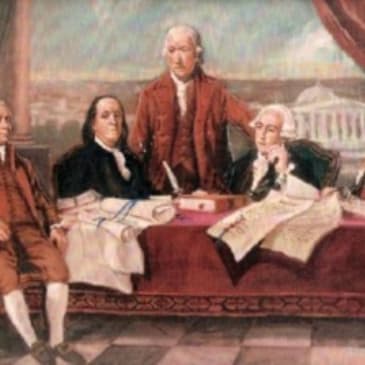
This is the FCB podcast network. The breed us all the tyranny, and they thought so well were America. And in the last episode we heard all about Benjamin Franklin's time in London, but that wasn't the only adventure he had across the Atlantic Ocean. In this episode, we hear about what Benjamin Franklin was up to during the American Revolution when he was in France. First, here's Lily with a few questions. Hi, my name is Lily and I'm seven years old and I'm in South Carolina. Why was Benjamin Franklin lending so long in France? What was he doing during the revolution? Why is his at a founding father? Those are all great questions from Lily. Now let's dive into the answers. As for why Benjamin Franklin was called a founding father, we'll talk about that one last and it'll make a lot of sense when we get there. But first let's talk about her other two questions. Why was Benjamin Franklin in France for so long? And what was he doing during the revolution. Those two questions actually go together. So he was in France from seventeen seventy six to seventeen eighty five, and the American Revolution lasted from seventeen seventy five until seventeen eighty three, so he was in France almost the entire time. As you might remember from the last episode, Franklin was in London for nine years before the revolution. He returned back to America in May of seventeen seventy five, and fighting had just started in April. That made him even more determined to be on the side of independence. He was chosen as a delegate someone to represent Pennsylvania at the Second Continental Congress, and he was a really active member. One of the really important things he did happened on July twenty sixth, seventeen seventy six, and that's when he established the first US post office, and Congress named him Postmaster General of the Colonies. It made sense to give him that job because he had been postmaster of Philadelphia and the joint Postmaster for the whole colonies before seventeen seventy four. So it was his job now to establish a line of posts, which are like our post offices today, from New England all the way down to Joe through our whole colonies. And he was allowed to hire as many postmasters or like postman as he thought would be needed to make the postal system work, and that put in place the foundation for the postal system we still have today. Mail might not seem that important to us now. It's just something that happens and usually it's not all that exciting. But this was a really important, really big deal then. It was huge. It was such a big step for the new nation because the postal system meant colonies could communicate between each other without the British government getting involved, and so could the new Continental Army, and that would become really important as the revolution went on. And Benjamin Franklin was so important to the Continental Congress that he also served on some key committees, which are smaller groups within the big Continental Congress. One of those was called the Committee of Secret Core Correspondents. I love that name. That was a group that helped communicate with people in other countries, especially Great Britain and France, and they had to do it secretly because these were people who supported American independence and they were helping to gather support in their own countries. The other really important committee he was on was something called the Committee of Five. It had that name because only five people were chosen to be on it. There was Benjamin Franklin, of course, plus Thomas Jefferson of Virginia, John Adams of Massachusetts, Robert Livingston of New York, and Roger Sherman of Connecticut. The job of these five men was one of the most important in the history of the world. The Committee of Five created the Declaration of Independence before it was presented to the entire Congress on June twenty eighth of seventeen seventy six. And then after declaring independence, America needed friends, or what they called allies, so they could win the revolutionary war. Since Britain and France were always enemies to each other anyway, it made sense to see if France might be on America's side. But who would we send? And that brings us to Lily's second question, why was Benjamin Franklin living so long in France? Of course, the Americans decided to send Benjamin Franklin to France. He became American Minister over there. His mission was to secure French support for the American Revolution, and he did it. In fact, he got France to spend almost all of their money on the revolution, which led to their own problems, but that's a story for another day. On October twenty sixth, seventeen seventy six, just about three and a half months after we declared independence, Franklin got on board a ship in Philadelphia and headed across the ocean again to France to serve as American Commissioner. And like I said, his job was to get their support, both with their military and their money for the American side and the revolution. But if he had been captured by the British Navy while he was crossing the ocean, he would have been hanged as a trader. Fortunately he got to France safely. And keep in mind that he was already seventy years old. That was really really old in seventeen seventy six. And because he had already lived such a long, exciting life his time in London, his famous science experiments, and his work in the American colonies, he was a famous celebrity, so that made him a great choice to represent the United States in France. He was famous there too. His picture with glasses and wearing a fur hat instead of a wig was seen everywhere. You could buy pictures of Benjamin Franklin on candy dishes on walking sticks, to wear in a ring, and even embroidered onto clothing. But he actually wasn't allowed to say why he was there. It was kind of a secret mission. At first. He just had to make people like America and feel good about the American cause, about American independence. Back home, the revolution actually wasn't going very well, so he didn't want to push it and get a no for an answer. The King of France actually liked Benjamin Franklin and even kind of liked the idea of an independent America, but he did not like the idea of losing a war with Britain. So Benjamin Franklin had to be careful and choose the right time to ask for help while pretending that everything was going just according to plan back home. But everything changed on December fourth, seventeen seventy seven, when Franklin finally got news from America. It wasn't all good news. Philadelphia, which was the capital of America at that time, had been captured by the British. Washington's army had retreated to winter camp at Valley Forge. That was very bad news, but the good news was very very good. In October, Americans had won the Battle of Saratoga and captured the British forces there, including a general. This was such a big victory that France was ready to help. Officially, they signed the Treaty of Alliance with America on February sixth of seventeen seventy eight. This made it official France would give military and financial support to America, and America would do the same for France if they were to be attacked by Britain. It's also the first official recognition of the United States as an independent nation by a foreign power. Once there was a formal alliance or friendship, Franklin's job chain changed, but it definitely did not get easier. He had to keep supplies flowing from France to America so Americans had what they needed. Things like guns, gunpowder, uniforms, ammunition. They all came from France. In today's money, historians think it would be somewhere from fifteen to twenty billion dollars worth of supplies. And of course, France also supplied soldiers and sailors, people like the Marquis de Lafayette and the Comte de Rochambeau, who played a crucial role in battles like Yorktown. They also sent people who had really special skills that Americans didn't have, like artillery and engineering. Then, as the Revolution drew to a close, Benjamin Franklin did one more critical thing in France. He worked on the treaty to end the war. That was the Treaty of Paris. Talks of peace, which meant the surrender of the British and liberty for America, began in seventeen eighty two. Franklin made it clear that he would not make a separate peace deal with Britain. France had to be included. The final peace treaty was signed in Paris on September third, seventeen eighty three, officially ending the Revolutionary War. Britain had to say that America was free and independent, and it put things into place for America to grow into the future. When Americans declared independence, they could hardly have dreamed of such a good outcome. And then Thomas Jefferson took over from Benjamin Franklin as the US Minister to France in seventeen eighty five. He was asked if he was replacing doctor Franklin, and Jefferson's famous reply was, no one can replace him. Sir, I am only his successor. You might think that Benjamin Franklin would go back to Pennsylvania then to enjoy old age and the new country he'd helped to build. While he did go back home, but he still had work to do. He joined the Constitutional Convention in seventeen eighty seven as their oldest delegate at eighty one years old. Now let's go back to the question of why Benjamin Franklin is considered a founding father. Well, you've heard a whole lot about his political work in London and during the Revolution, both in America and France. So he was involved in the cause of building America, creating a foundation for it. And he was the only person who signed four key documents establishing the United States, the Declaration of Independence, the Treaty of Paris, the Treaty of Alliance with France, and the US Constitution. No other person signed all four of those. I would say that makes him a founder, wouldn't you. They create a sound. From tyranny, understand everything to be agreed, and they thought so we would be America. Lander Degre