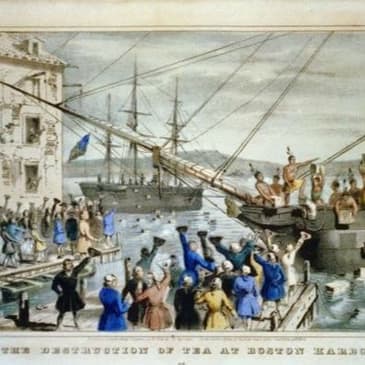
This is the FCB podcast network. They freed us, solved the Jeremy state of the thing, and they thought, so we work in America and of Hi, welcome back to the Growing Patriot podcast American History for Kids. I'm your host, Amelia Hamilton. We've been talking about America's founding period for years now and that is a lot to remember. So in this episode, we're going to talk about seven moments I really don't want you to forget. First up is the landing at Jamestown. People came to America for a lot of different reasons, but the first people to colonize America had one particular thing in mind. Gold. The Spanish had found gold in South America, and so the English were hoping to find gold in what they would come to call Virginia. So let's back up just a minute. So at the end of the sixteenth century, that was the fifteen hundreds, Queen Elizabeth the First of England was on the throne. She never married, so she was called the Virgin Queen. Sir Walter Raleigh was a famous adventurer and one of the Queen's favorites, and historians think that Sir Walter Raleigh suggested the colony be named Virginia after her in around fifteen eighty four, which was the year she gave him permission to colonize that region that would become Virginia. There were a couple of different voyages before Jamestown, but none of them became permanent settlements. In fact, those places that he first went ended up not even being Virginia. They're now what we call North Carolina. And England had spent a lot of money for those colonies that didn't even work, so they were a little bit nervous about trying again. But then in sixteen oh three, Queen Elizabeth died and since she didn't have any children, the crown went to her cousin's son. He became King James the First. I know this is all getting a little bit confusing, but stick with me for a minute. So King James the first get it, James Jamestown. So yes, he was willing to try that whole American colony thing again, and this time it was a little bit different. It was something called a joint stock company with the Virginia Company of London, so it was a way to make sure that the crown wouldn't lose as much money if the whole thing went wrong. So in sixteen oh seven, one hundred and forty four England buish men and boys established the Jamestown Colony. On May thirteenth of sixteen oh seven, three English ships they were called the Susan Constant, the Godspeed and the Discovery, they landed and planted the first permanent English colony in North America. They were established by that Virginia Colony of London and would be called Jamestown after King James the First, and this time it succeeded. By sixteen eighteen, people were paying money just to be able to go to Jamestown and start a new life in that new world. So the site for Jamestown was picked for a few different reasons. First of all, water, It was surrounded by water on three sides, and now it's actually fully an island. It's surrounded on four sides. But it was pretty far inland, which meant they could defend it against the Spanish if they would decide to attack. The water was deep enough that the English could tie their ships at the shoreline, which basically means good parking. And it was not inhabited at that time by a native population, but things were still really hard. There was disease, drought, there was not enough food. Things change when a man named John Rolfe introduced a new crop called tobacco, and that ended up making them enough money not just to survive, but thrive, and the Virginia Company even started recruiting women to move there so that the men of Jamestown could start families. Like any settlement, it had its ups and downs, but it did pretty well until a fire in sixteen ninety eight, and when the state House was destroyed in that fire, Virginia's government was moved to Williamsburg and that started a new era for Virginia. But Jamestown was really the beginning of the American colonies. The second thing that I really want you to remember is the intolerable acts. So it can be hard when you start to grow and people still treat you like a kid, right, But it was really hard for America because they were in ocean away from the king, and that's who was treating them like a little kid. He had no idea what life was like in America, and he was still trying to tell them what to do, and the colonists had no voice at all. Remembered The big phrase to remember is no taxation without representation. And then things became intolerable, which means it got so bad that no normal person would be able to take it. And it got to that point with what the colonists called the Intolerable Acts in seventeen seventy four, but what they were really called were the Boston Port Act, the Massachusetts Government Act, the Administration of Justice Act, and the Quartering Act. So here's what each of them were all about. First, the Boston Port Act. Parliament passed the bill for the Boston Port Act in March of seventeen seventy four, and then King George the Third gave it his royal assent to make it official in May. Basically, it said that the Port of Boston, where the ships go, couldn't do business anymore, mostly, but it could still receive things that the British Army needed, and they said that it couldn't reopen until Boston paid back the cost of what they destroyed in the Boston Tea Party, and the King decided that they were obeying British law as well enough, and then Britain decided it was safe to use the harbor again. So it was really all up to the King still. Second was the Massachusetts Government Act, so Massachusetts, like all the other colonies, had their own representatives that governed the colony. Well, not anymore. This Act was passed again in May of seventeen seventy four, but they got royal ascent the same day, the same day that the Boston Port Act was passed, so King George had a busy day. It used to be that the Massachusetts Council was elected by the people to represent them. Now it was going to be chosen by the King. And not only that, but the new Royal governor would choose governors and sheriffs without the council's approval. And not only that, but those sheriffs would choose the jurors that decided if someone was innocent or guilty in a trial, and they didn't want anybody talking about that in town meetings, so those were only allowed to happen once a year. Now, basically, the King wanted total control over everything that happened, So there was going to be no freedom in Massachusetts. And if that wasn't enough, here's another thing the King did that day, the third Intolerable Act, the Administration of Justice Acts, and that gave the king the power to move a trial to another colony or even all the way to Britain. So that took away any chance to get a fair trial of your peers, like choosing the sheriffs and the jurors wasn't already enough. And now for the fourth of the intolerable Acts, the Quartering Act. This one was a little bit later and got royal assent on June second, and this is the only one that applied to every colony, not just Massachusetts. This one is a little bit misunderstood. What it actually said was that high ranking military officials were allowed to demand a better place to stay and refuse that the troops be given inconvenient places to stay. So a lot of people think it means that people were forced to let soldiers stay in their houses, but it didn't really say that. What it did say was that they had to be allowed to stay in any empty houses, barns, or extra buildings, and colonists did have to pay for it, which is already pretty gross. So those are the four intolerable acts. Would you be able to live like that, especially if you were in Massachusetts? I don't think I could. And the colonists weren't going to stand for it either. And keep in mind that even though most of them only applied to Massachusetts, the colonists could see that it could apply to any of them if they misbehaved like the people in Massachusetts had, or like the King thought they had, and any of them could be next. If they did something that the King or the royal government didn't like, any colony could be next. So if they didn't stand together as the thirteen colonies, there would be nobody to stand up for them. When the time came. They all had to stand up for each other. The third thing I want you to remember is a big one that I doubt you would forget, the declaration of independence. So the colonies, they didn't just decide to declare independence out of nowhere. They actually tried really hard to make things work and not declare independence. The First Continental Congress met in the fall of seventeen seventy four after those intolerable acts to talk about what they were going to do. It did show Britain that they were united, but it also showed that they were willing to compromise and and try to come to some agreement. They first sent a different declaration the Declaration of Rights and Grievances. It told the King that the American colonists were equal to all British citizens and that taxation without representation wasn't okay, and they refused to be taxed without representation. But of course Britain didn't change their ways, and things only got worse. So there was a second Continental Congress, which met in May of seventeen seventy five, and that was really different. First, they sent an olive branch petition in July of seventeen seventy five, and an olive branch is sort of a peace offering. It was a last try to avoid war, even though honestly a lot of our founders knew it wasn't going to work, but they really wanted to try. And then, of course, as we all know, a year later, in seventeen seventy six, America declared independence. And it's hard to say what a huge deal that was put down in writing the idea that all men were created equal and that we all have the right to life, liberty, and the pursuit of happiness. We're really used to that idea now, but at the time it was brand new. People had never heard of such a thing before. So the declaration did a few things. As for what it did, the name is in the title. It declared that we were independent, but it also explained why we wanted independence, and since we were independent, it meant we were able to get allies like France. There are three main things I want you to remember about this. It told the world the way a government should be. It listed the complaints the colonists had against Great Britain and let the world know that the colonies were now quote free and independent states. And once this was out there in the world, there was no going back. It said that these American colonies were up against one of, if not the most powerful military in the world. Up next the Articles of Confederation. Sometimes these get lost in our history. But now that we'd declared ourselves to be our own country, which came out of the Second Continental Congress, we had to figure out how we were going to govern ourselves. So we became a confederacy, a group of colonies. So we created a name of our thirteen states as the United States of America. The Articles of Confederation said that the governments of the states still held most of the power, and that the states combined were responsible for helping to protect each other from attacks. The Articles of Confederation worked pretty well throughout the Revolutionary War, but afterwards they really weren't strong enough to keep us together, which we'll talk about in a few more minutes. They failed because they were crafted to keep the national government as weak as possible, and there was no power to enforce laws. There was no judicial branch, no national courts. It was enough to keep us together through the revolution, and what came next would be even better. The surrender at Yorktown was a huge deal, and that happened on September twenty eighth of seventeen eighty one, when America actually won the American Revolution. Well, that's when Cornwallis surrendered at Yorktown, which effectively ended the war, even though it didn't officially end until seventeen eighty three when the Treaty of Paris was signed. But the surrender of Yorktown is what you really need to know about. It was the end of the last major battle, the start of our real independence, and it cemented Washington's reputation as a great leader, and it put him on the road to be the first president of the United States. Washington himself called Yorktown an important victory and a glorious event. Remember I said, when the thing that came after the Articles of Confederation would be even better. Well, here it is the Constitution, including the Bill of Rights. So, like I said, when the revolution was over, we needed something stronger than the Articles of Confederation. They just weren't working. So in seventeen eighty seven, delegates met in Philadelphia again from almost every state, and at first they thought about fixing the Articles of Confederation. That was the plan, but they decided that they really needed to start over and started working on what would become our constitution. Of course, we did a ton of episodes on the Constitution, so you can get all of this details in there. But here's the basic scoop. The Constitution is a huge achievement because it gives us four big things. Checks and balances, which provides each branch of government with powers that can check the other branches of government and stop them from becoming too powerful. It separates the powers so that it balances them out between each other. There's also something called federalism, which again divides those powers between the national government and the state governments. Also limits government, and it makes sure that the federal big government only has the powers that are given to it in the Constitution, and it's not allowed to do anything else. The Constitution also has something called popular sovereignty, and I know that's a big word, but it really means something pretty simple. All of the power comes from the people. They have to give their permission to be governed by electing people. Now there's also something called republicanism, and that's not political. It doesn't mean Republicans like Republicans and Democrats. So John Adams, one of our founding fathers, said that it means that the government in which all men rich and poor, magistrates and subjects, officers and people, masters and servants, the first citizen and the last are equally subject to the laws. So it just means that we are all equal. And then later in seventeen ninety one, the Bill of Rights was added, which spells out some of the key rights that are protected, and it just makes it super clear that the government cannot step all over the people. And the last big moment that I want you to remember from our founding is George Washington's inauguration. This one always seems to me like the moment when America was really on its own, not that it wasn't before when we declared independence or when cornwallis surrendered at Yorktown. But once it had its own leader, it just feels different to me. The king wasn't just gone, he was replaced. And this happened on Thursday April thirtieth, seventeen eighty nine, on the balcony of Federal Hall in New York City, even though Washington had actually been president for almost two months at that point. He found out he was elected on April fourteenth. He left his home in Mount Vernon in Virginia two days later and headed to New York. But April thirtieth was the big day. The oath was administered by Robert R. Livingston, the Chancellor of New York, and then he shouted, long Live George Washington, President of the United States. So there you have it, the big moments in our founding history that I hope you will always remember. Which five would you have chosen? As always, thank you for listening. You can find out more about us, more about the books, and find every episode at Growingpatriots dot com or on social media on Facebook, Twitter, and Instagram at Growing Patriots. Can't wait to see you next time. The Creed us solved for Jereanny stand the thing, and they thought so well, be working America. This has been a presentation of the FCB podcast Network where real talk lives. Visit us online at fcbpodcasts dot com.